Search This Blog

Monday, July 7, 2014

Oriental Heroes and the Lands of Nippon- Warhammer style


Old-School Warhammer Oriental/Nippon cut-away diorama.
All kinds of amazing!

(Blog Note: WoooHooo! 100th published blog post — better make this a good one! Onwards toward 200.)

Much like my recent foray into Oriental Adventures, I thought I’d pause and retrace some steps back to Warhammer. I’ll be taking a moment to comment on Oriental Heroes and the line of minis for Nippon in Warhammer Fantasy Battle. I’ve been working on a Nippon Army in an on-again, off-again fashion over the years.

But first, a very cool diorama (see to the right). I’m not sure where it’s from, but I found it while scouring the web for Nippon imagery for Warhammer.

Right now I’m in a bit of a prolonged lull in regards to Warhammer that has been going on for a number of years. After being burnt out with the Word of Hashut webzine and all that came with it, I’ve been largely uninterested in Games Workshop’s wares. I’ve found it’s far better to wait until my disinterest wanes and I’m interested again, rather than forging ahead for no reason other than to do it. This happens to me from time to time, but this one has been far longer. In the meantime, I’ve been having fun collecting minis from the Oriental lines of Games Workshop in the 1980s — minis I really wanted back in the day but was never able to secure more than three of them, being on the other side of the pond…

Nippon was a curious case for minis. They figured right from the earliest days of Games Workshop, appearing in the rules here and there, but never had their own dedicated army other than the mercenary contingent in the 3rd Edition Warhammer Armies book (see below). In the orange 3rd Edition Warhammer Fantasy Battle rulebook it notes on page 205: “Lustrian, Steppeland and Cathan creatures and races are dealt with in sufficient detail for you to assemble armies of Slann, Nippon etc. but we feel that only by dealing with each area in a separate supplement can we hope to do them justice.” It became obvious when looking at the history of Games Workshop at the time that they were already underway with 4th Edition Warhammer and weren’t going to revisit these lands, at least not in the 3rd Edition
sense.


Nippon Army contingent from 3rd Edition

It was not to be, however. Aside from this blurb along with the Nippon mercenary force listed in the aforementioned Warhammer Armies book, that was it. I have a feeling it was a number of factors that led to this decision:

  • The 2nd Edition Nippon army list in Ravening Hordes was enough?
  • If they did a Nippon army, would they have to create a Cathay one as well? Would there be an outcry for Amazons? Norse? Pygmies?
  • By the time the 3rd Edition Warhammer rules were gaining steam, the “ninja craze” of the 80s was already waning.
  • Limited resources?
  • The rise of Warhammer 40,000, which would become (and still is) its “breadwinner.”
  • The oft-repeated line of “there are already two human armies in the game.”
  • Some combination of these?
  • Perhaps none of these?
  • Too many manga/anime inspired fans?

In any event GW showed no inclination to move on an Eastern themed army. I don't see them ever doing it either. I don't have an inside info, this is more or less just a hunch, a hunch backed by 25 years of watching Games Workshop. NOTE: they would eventually release a Cathay army for Warhammer Old World.

Here is a partial list/number of links of the actual GW line of minis, at least enough to give an idea for those not in the know.
Oriental Heroes at the Stuff of Legends
Ninjas at the Stuff of Legends
Older Oriental Heroes at the Stuff of Legends
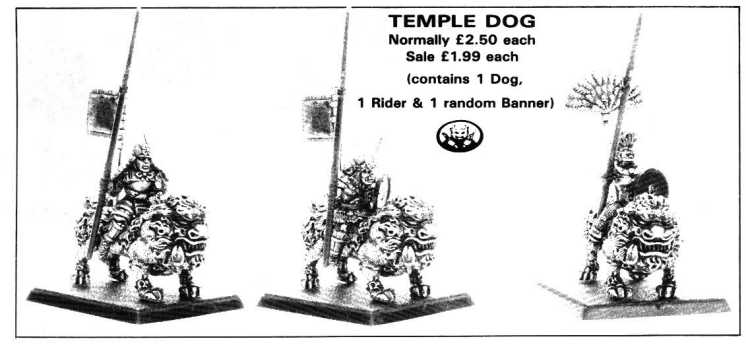
Temple Dog Riders

Onto my oft delayed Nippon Army, as of right now it has a serious amount of lead for it as chronicled here. I'm hoping as the weather turns colder in the Fall to get back to working on it. In the meantime I'm continuing to trade for minis at the excellent site Oldhammer Forum. I'm a big fan of the guys and the excellent work they are doing there. In fact I just secured some more ninja bringing me closer to having one of every GW ninja from the Oriental range.

Unlike in the past when I've worked on an army I've always been in a rush and with an eye towards playing. In reality I get to play so infrequently that its no my prime concern. So with that in mind Im working on my Nippon warband in terms of how they might have looked or been configured for 3rd edition warhammer using the 3rd edition Mercenary contingent as a guide.

In the meantime while I get my act together regarding my Nippon army here are some great images to get inspired by (I found the thread here).


 What are your thoughts? Tired of the same old pseudo-medieval European campaign worlds? 

Saturday, July 5, 2014

In Defense of the Maligned- Part II, Oriental Adventures


(Part I of this two-parter covering Unearthed Arcana is here.)

Much like Part I, this is not a straight review of the product itself, but more of a high-level discussion around the particulars of the time, and the how and why it came about.

The biggest gripe that makes me shake my head? “It’s too much Shōgun and not enough Crouching Tiger, Hidden Dragon!”

Usually a lot of the ire also revolves around some of the things Oriental Adventures (OA) featured — namely non-weapon proficiencies. As we all know, NWPs (“non-weapon proficiencies”) were included because those things are from the spawn of Satan and any game that has them can’t be good. More on that below.

Did it ever occur to these same people that some folks actually like Shōgun?

Consider the timeframe. James Clavell’s Shōgun was written in 1975, and the miniseries aired in the early 1980s. It was very much in the national consciousness and a contemporary of Dungeons & Dragons. It seems completely natural to me that Oriental Adventures would come about.

Before I get going, on a completely random note: I really like the cover of the book. Samurai, ninja, a Japan/Nippon-style castle in the background, and those pastel colors invoking the Far East? Damn skippy. Pack it with samurai riding a foo creature? Good to go.

Oriental Adventures (at least to me) was part of the "ninja craze" that gripped the USA in the middle 1980s. There were awesome/bad movies like American Ninja, GI Joe had ninjas, Hell go back to the 1960s with James Bond and ninjas show up in "You Only Live Twice". Point being that the inclusion of was building long before the publication of Oriental Adventurers. Couple that with the point above about Shogun? Works for me.

The Messy Production History of Oriental Adventures

Now onto some of the particulars about OA which aren’t really in dispute:

  1. Oriental Adventures started as an idea by Gary Gygax and François Marcela-Froideval. Apparently François’ manuscript was only about 30 pages, double-spaced… obviously not enough to fill a major hardcover book.
  2. Gary turned to Zeb Cook to finish it on a tight four-month deadline.
  3. Given that TSR needed hardcovers out the door because of their shaky financial position (due to mismanagement by the Blumes), getting the book published was critical.
  4. Gary was tied up with the fight against the Blumes, hence him tapping Zeb to finish the product.
  5. Cook did the work.

After that, the story of Oriental Adventures gets as sordid as a soap opera. Note that Gary’s name is on it — this is hardly a revelation — but it doesn’t say “By Gary Gygax.” There’s a whole twisted tale here that outlines Mike Berrault’s work with Zeb regarding the situation around 2nd Edition and touches on the timing of Oriental Adventures. (Warning: it’s long and full of grognardiness.) It also shows some interesting tidbits regarding Gary’s maneuvering to regain copyright.

Then there’s the whole angle of Gary’s later distaste for the product after he had left TSR. I’m not going to delve into Gary’s musings, but the legend of François Marcela-Froideval’s “Lost Manuscript” just won’t seem to die. There seems to be a faction of people that believes this lost piece of gamer lore, as originally presented, is “the holy grail, the font of knowledge, etc.” (I’m aware of the samurai class as presented by François, but not much more past that.)

With no slight intended to Mr. Marcela-Froideval, if it had been up to par in Gary’s estimation, then how come there wasn’t more? How come it didn’t form the book? Partisans on either side will point fingers, saying the other side is self-serving on this point of contention: just how much there was to become an actual rulebook. By Cook’s estimation there wasn’t nearly enough. In the absence of any evidence to the contrary, that’s where it stands. The burden isn’t on Zeb’s work to prove it doesn’t belong; it actually got produced. The burden of proof is on those who believe François’ work was/would have been better.

Another angle to consider is to look at Zeb’s output compared to François’. François was (and apparently still is) active in the realm of comic books/graphic novels. I have no objection to that. In the realm of gaming, Zeb had a lot more output of gaming material — and depending on which side of the partisan divide one is on, the quality of it. For me, Zeb’s place is assured. 2nd Edition AD&D is excellent, and he produced such gems as X1: Isle of Dread, I1: Dwellers of the Forbidden City, BH2: Lost Conquistador Mine, Planescape , and many more. Usually the objections I hear are that a lot of his stuff is uneven — again, depending on which side of the divide you’re on. Ironically, the works of his that garner the most praise in old-school gamer circles (I2) is one of the things I like the least. And in newer circles Planescape garners a lot of praise but again is not my favorite.

Looking at the quandary objectively and using Gary’s own words from Tim Cask's Q&A thread over at dragonsfoot: "I have nothing to add save to state that I stand on my creative works, and Mr. Arneson can do the same."

Applying that same logic: let’s take Zeb’s work and compare it to François’ in the context of AD&D. If François’ Oriental Adventures was indeed superior, would it not have seen the light of day by now? Or put another way: compare Zeb’s output to François’. It’s not even close.

Again, I’ll reiterate that I don’t know either man. I never got a chance to converse with Zeb before the rabid neckbeards ran him off from Dragonsfoot, and I’ve never corresponded with François. I am, however, interested in slaying this particular zombie as it keeps staggering back to life.

I should also note that I am not implying any rivalry between Zeb and François. I have no knowledge of that timeframe, nor do I claim to. I’m simply looking at the scant evidence presented and making logical inferences.

Gary is a somewhat unreliable source in all of this as well, as his statements are not always consistent over the years. Again, nothing is implied here. We are human, memories fade, and they vary. Add to the fact that Zeb was the lead designer of 2nd Edition and he didn’t follow Gary after he left TSR? I’m sure there was some bad blood on Gary’s side in regards to Zeb. Prior to Gary leaving there seems to have been some affection for Zeb; afterwards it ended.

From what I’ve read about Zeb, it seems clear he was aware of his own failings, took criticism (whether deserved or not), and did the best he could. He handled the situation with dignity and class in the face of unreasoning hate for something he tried his very best to do. And for the abuse hurled at him from around the web? Ridiculous.Forgotten Realms - Kara Tur Box set

So what am I trying to say? Just like 2nd Edition itself, people attach all sorts of crap to the rules of OA — and by extension to Zeb — that has everything to do with defending Gary and nothing to do with the rules themselves or Zeb as a game designer/writer. What does that sound like? (Yes, I’m repeating myself): 2nd Edition Dungeons & Dragons as a whole.

OA fits into that era to a degree — it’s a late 1st Edition product. And much like I alluded to in Part I, it also points the way that Gary may very well have been going in regards to his version of 2nd Edition.

On the negative side

I can see how people object to the land mass (which predates the inclusion of the Forgotten Realms) being more China-inspired, yet the rules being more in line with Japan. This is a fair point. By the flip side, the Kara-Tur boxed set does detail the mysterious Orient well and expands the lands in far greater detail. Taken by the book alone it’s a fair criticism perhaps, but stuff doesn’t exist in a vacuum. Added to this, if need be, OA has enough details that the Kara-Tur boxed set isn’t exactly needed.

Non-Weapon Proficiencies (NWPs) were an area of the game that was badly needed, and with their inclusion — along with the ones in the Dungeoneer’s Survival Guide and Wilderness Survival Guide — they pointed the way forward.

Now, to run a counter-line to my own thinking and tangentially related: perhaps adventuring in Wa is too boring. After all, it models feudal Japan after Tokugawa united the land following the turmoil of the 1400s. In a way it’s too orderly, with not enough action and fighting going on. Strangely enough, this is mirrored in the Forgotten Realms in the Kingdom of Cormyr. Cormyr is too orderly, too close-knit — well… boring. Despite my love of 2nd Edition, I’ve never been a fan of adventuring in Cormyr: too many rules, too much law, and the War Wizards watching everything.

While that sounds like a very safe place to live (especially if you’re a pseudo-medieval peasant), it’s an entirely boring place to be an adventurer. You even need adventuring licenses? Ugh. The best adventuring locales tend to be areas where law is the weakest — where the heroes are making their own way, whether on the frontier of the American West, the Borderlands with its eponymous Keep, or something in between. So too for the Utter East.

In summation, I’ll gladly take Shōgun. It’s what you make of it once you’re presented with it that counts.

Tuesday, July 1, 2014

The Five Worst AD&D Modules of the TSR Era

No BS, no long winded explanations, here goes the five worst AD&D modules of the TSR era.

  1. N2 - N2- The Forest Oracle The worst and I mean the worst 1st edition Dungeons and Dragons module of all time, AND for bonus points the worst Dungeons and Dragons module of all time of any edition: N2 - The Forest Oracle (I just vomited in my mouth thinking about this capitalistic suck fest of a module). Some want to say that the mini module Terrible Trouble at Tragidore is the worst, that is Shakespeare compared to this hideous beast of a module. I think people offer up TTT as a slight thrown in the direction of 2nd edition, but that dog don't hunt.

I so wanted to like this module based on the rather cool cover when I bought it, but alas this thing is so bad its actually an insult to things that are actually bad... To paraphrase the immortal line from the movie Spaceballs, "Its gone from suck to blow". And the kicker? I think I paid $5-6 dollars for this piece of shit which turned out to be $5-6 too much.

So what is wrong with this suckfest? Where do I begin? The text blocks are difficult to read, the stats are contradictory, confusing or plain wrong. The random rolls instructions are a mess, the plot (such that it is) is full of more holes than Swiss cheese, the suspension of disbelief is not there, the NPCs are odd, in short its a train wreck.

Did I mention that it has a cool cover?

Let’s see there has to be at least one good point about N2... Let’s see, hrmmm, maybe? How about?

Did I mention that it has a cool cover? Wait...I already said that?

I won't bore you with all the gory details of the actual module as that might be a violation of the Geneva Convention so I'd say get yourself some Xanax, a stun gun and a frontal lobotomy and you are good to go with this "module". If you can get it for free I still think that's too much.

Also for your reading pleasure the fine folks over at Enworld terminated this module with "extreme prejudice". (Bonus points for the movie quote reference.) "These men are not acrobats"... Indeed.

  1. WG7- Castle Greyhawk Coming in at a far distant second is Castle Greyhawk. I say distant second not because there are redeeming qualities to WG7 - Castle Greyhawk... its because N2 - Forest Oracle is that bad. The joke module of Castle Greyhawk in the vein of Paranoia and Toon which were comical RPGs back in the day. There were some other adventures in the same vein in Dungeon like "Fluffy goes to Heck". In all I usually classify these with the April Fools issues of Dragon where there would be puns afoot. I have to say this is also a disappointing module for me as I thought I was getting my hands on "Castle Greyhawk", little did I know. In all its just another sad part to the saga that is the loss of Gary and Rob's actual Greyhawk Castle and mega dungeon. In a way, it's time to move on, with Gary gone and the fact that the dungeons were only barely sketched out as it is a case of their true nature will never be seen.

Yes I'm aware of Gary's stuff with Castles and Crusades but at the time Gary was not well and I have to wonder as to all of it being as he remembered it, rather than what it was.


3. WG9- Gargoyles, WG10- Child's Play and WG11- Puppets 

All three of these sucked ass so bad that the stench emanating from each has a distinct odor, that of equally bad well...suckage. It might be a cheat to add all three together, but ah well.In general all three are boring reads, I think one of them has drool damage from me falling asleep reading one of them. As a punishment I refuse to put them in plastic bags to protect them in the man cave. Sometimes I torment them by placing them next to the very few 3e stuff that I have, serves 'em right I say. On really bad days I threaten them with "I'm going to buy some 4e stuff and you can go sit in that corner!"

Thank God in each case I only paid $1 for each; I think Child's Play I got for free. On second thought, TSR/Wizards/Hasbro actually owes me and everyone else who bought these pieces of crap and/or wasted their time on them.

Gargoyle? Hired to collect a wingless gargoyle's wings??? I've heard of some crappy motives to go on an adventure but this has to be right up there with the worst.

Child's Play? Just look at the cover! I wonder if he's specialized in rake? To be honest its been years since I even glanced at it. Every time I get the notion to read one of the three (especially this one) I lie down and count to one million, because that would be more interesting.

I do hesitate for a second on Puppets as it could have been a cool idea, the idea was sound, but just doesn't get there. Oh yeah recycled art for the cover of Dragon #80 for the not-so-much-of-a-win... Seemed in vogue at the time with TSR as they also did it with B11 and B12.

So there you go, #3 here gives you three sucktastic modules for the "price" of one.

4. C1- Hidden Shrine of Tamoachan Heresy I know right? Along with some of the others on this list I've wanted my money back after spending it. This is a boring, near zero treasure slog. I've played it twice and enjoyed it less and less each time. It's also the poster child for a "DM's woody module" as in "Look how I just dicked you guys over, are you dumb or what? HAHAHAHHA!" Inescapable death traps with minuscule treasure? Yeah sign me up for that... (roll eyes)

Oh, and the setup to get to this rail-road? "CCCCHHhhhhhhoooo Choooooooo, AAAAAALLL ABOARD!!!!!!!" Next time a grognard complains the Dragonlance modules and their railroad nature, fling this at them.

  1. UK1- Beyond the Crystal Cave Let’s see if I have this right? A game predicated on hacking and slashing, taking monsters treasure and the point of this module is to not do so? This ugly stain of a module is the only wall flower in the otherwise outstanding modules that comprise the UK line. It dishonors the UK line in much the same way WG7 dishonors Gary's works, just not at the same magnitude.

Like N2, the cover looks enticing, but its all downhill from there. Romeo and Juliet in AD&D, how wonderful, except Shakespeare's Romeo & Juliet had more action, deaths and plot than this slog to boredom.

Dishonorable mention goes to Terrible Trouble at Tragidore, for me by reputation alone. Fortunately my 2nd edition DM screen came without this "module" so I can't say for myself. Vecna Lives! also gets a sniff somewhere in the pantheon of bad modules.

"Enjoy" these craptastic modules and drink a whole bottle of alcohol if you really want to punish yourself at the gaming table.

EDIT: Some have suggested RS1 Red Sonja Unconquered (See below- I can't say for certain as I don't own it), but the two Conan modules CB1- Conan: Unchained! and CB2- Conan: Against the Darkness! aren't anything to write home eitherand are somewhere in the dishonorable mentions.  

Sunday, June 29, 2014

In Defense of the Maligned- Part I, the Unearthed Arcana

The 1st edition Unearthed Arcana hardcover rulebook

This is Part I of a two-part series. Part II will cover the much-abused Oriental Adventures (which also rocks, by the way).

To start: about Unearthed Arcana (UA for short)… I’ve never understood the hate.

There, I said it. I’m an unabashed fan of Unearthed Arcana, but not in a weird way like the Bobs from Office Space.

The book is roundly reviled in some quarters, especially once you get into the OSR (“Old School Renaissance”) weeds. I get the impression some would prefer to pretend Gary Gygax’s name isn’t on the cover, or that these aren’t really his rules. But they are.

Some feel that UA led directly to the “terrible” 2nd Edition of Advanced Dungeons & Dragons, but to me that’s a stretch. If anything, it was showing its hand toward the direction Gary was heading with his version of 2nd Edition AD&D.

(There’s an excellent article that sums up the various clues Gygax left us about where he was going. I’m not going to rehash it all here, as it won’t lead to anything productive.)

UA opened up a new realm of possibilities. It also changed my perception of fighters. As presented in the 1st Edition Player’s Handbook, fighters are pretty milquetoast. UA gave them some real umph — especially when you consider how much magic-users outshine them at higher levels. That’s not to say it’s perfect (bow specialization is still the most egregious example). But overall, I’ve always liked fighters, and they might very well be my favorite class to play.

Taken as a whole, the book has some bad parts, some middling ones, and quite a few good ones. To me, the good parts more than balance out the bad — even the crap spells for clerics and druids, many of which I’ve never seen used in an actual game.

Jim Rosof Art from from the 1st edition Unearthed Arcana

When taken in historical perspective, some people dislike Unearthed Arcana because of the politics of the time. The book was (likely) rushed out the door as TSR was experiencing a major cash crunch due to the mismanagement of the Blumes (allegedly). Others point to the really crappy binding of the original printing. I was lucky — my original copy was bound well (it’s since gone missing). Any copies I’ve bought off eBay since have been the later printings with the better bindings.

As far as the “rush it out the door to save the company” angle? Good, I don't mind. Because it helped lead to 2nd Edition, which I like.

Taken all in all, UA dovetails nicely with what I consider core AD&D.

I use the 2nd Edition rules, but having come into the game during the later stages of 1st Edition’s run (as I outlined here), I pull from a variety of sources from the 1984–1989 time frame — particularly Dragon magazine.

Myself and others who play like this are what I call “Hybrid Players.” As I’ve gotten older, I’ve largely rejected kits and a lot of the additional books. Some, like Ships and the Sea or Arms and Equipment, are handy. The various Complete guides less so — but not always for the reasons most gamers dislike them.

Cavalier from the 1st edition Unearthed ArcanaTo me, kits speak to larger market forces. At the time, 1st Edition Warhammer Fantasy Roleplay was gaining steam in the US and it had a boatload of classes. I think the kits were TSR’s response to WFRP. I have no hard data to back this up, but it makes logical sense. I’ve used them in play before and at the time they were fun — no regrets. But as time has gone by, I’ve pared player choices back to the 2nd Edition Player’s Handbook and use NPC classes for various supporting characters.

For me, in closing: Unearthed Arcana holds a special place because it was the first Advanced Dungeons & Dragons hardcover I ever bought for myself (sent away for it via mail order!). Prior to that, all I had were the Basic and Expert sets plus hand-me-downs from my older brothers. It probably explains why, early on, I played an inordinate amount of cavaliers.

But hey — cavaliers aren’t so bad. They nerf illusionists in 1st Edition splendidly. And any time an illusionists is nerfed its good. Well, if they could squeeze in a special ability to slay gnomes too, I’d be completely okay with it.

As an aside, I’ve pretty much solidified on 2nd Edition AD&D when I DM (sorry, Randolph), but I do include options for my current campaign world. Instead of the UA cavalier, I use the “Corrected Cavalier” as well as the article “Tracking Down the Barbarians” from Dragon #148. Both work better than the UA versions. In fact, it’s a great example of how things can be lifted straight from 1st Edition and dropped into your 2nd Edition games. Oh yeah, almost forgot — I also allow the 1st Edition assassin pretty much as written. It works, and I’ve had little to no problems with the class aside from the occasional “High Gygaxian prose.”

Now about all those pole-arm illustrations in the back of the Unearthed Arcana... 

Friday, June 27, 2014

Boot Hill BH4 Burned Brush Wells – Classic TSR Old West Module

Cover art for BH4- Burned Brush Wells

BH4- Burned Bush Wells
The 4th module of the Boot Hill series certainly has a weird name, at least to me that is. It really, really does not roll of the tongue either.

Much like the other Boot Hill modules I did not play Boot Hill back in the day as we were not into Westerns at that time (a shame) and most of our time was spent playing Warhammer Fantasy Role-play and AD&D. For my own part I used to watch a lot of westerns with my father, but drifted away at the time. A few years back I started watching them again and got hooked on Boot Hill. In any event BH4 - Burned Bush Wells is a module produced by Jeff Grubb with some input from Allen Hammock and Brian Blume.  

BH4- Burned Bush Wells is one of the later Boot Hill modules. I say "later" because the graphic design had changed noticeably from the earlier releases, reflecting TSR's increasing focus on Dungeons & Dragons and Advanced Dungeons & Dragons as the company's primary breadwinners.

The power struggles within TSR during the mid-1980s may also have played a role. It's possible there simply were not enough people interested in developing the Boot Hill line. Donald Kaye's untimely death certainly could not have helped the game's long-term prospects, though that is only speculation on my part.

In any event, Burned Bush Wells would become the second-to-last Boot Hill module, following the same general format as its predecessors. It is strange to think that it was released in 1983, with only Range War following in 1984. From BH1- Mad Mesa in 1981 to Range War in 1984, the entire line of Boot Hill modules spanned just four years.

Interior art by Larry Elmore for Burned Brush Wells
Art by Larry Elmore for Burned Brush Wells

The cover and interior art
Elmore seems to be a polarizing figure for some in terms of TSR era art. In the realm of Boot Hill (and others) I think his stuff is very good and it certain captures the feel well, certainly for a western RPG. Another thing to ponder the American West isn't usually depicted in the winter, whether its a movie or art; usually its baking, scorching hot deserts and cactus. I also like to point out the crop with the snow on the bottom right corner outside the frame. In short, I like it. One thing that detracts is some of his art in the interior. Not that its not done well, but a lot of his characters tend to look alike, a certain feel to them if you will. Perhaps this is where people object?

Content

Like BH2, the Game Master is presented with an outline of events rather than a rigid sequence of encounters. Much like a movie, certain scenes occur at the appropriate place and time. As I've discussed with like-minded folks over at the OD&D Pro Boards, it is not so much a "sandbox" as a "jungle gym." The module provides a framework for the players without becoming overly railroaded.

This is an area where all of the Boot Hill modules struggle to some degree. A Western is built around a series of largely self-contained scenes that collectively tell the story and inevitably lead to the final showdown. That structure works well when the adventure is treated more like the script of a Western film than a fantasy sword and sorcery adventure with six-guns and Winchesters.

One thing that stands out in this, and every other Boot Hill module, is the sheer number of NPCs. In most cases, I cannot see this level of detail ever becoming terribly important. The local saloon keeper? Yes, we need to know his name. The names of all of his children? Probably not.

The main action takes place in the eponymous town of Burned Bush Wells during the dead of winter. As the module explains, winter is a lean season in the West, and the wolves are hungry. Since Burned Bush Wells is surrounded by cattle ranches, predators are naturally a problem that must be dealt with. Rules are provided for hunting and trapping wolves, along with the animal rules that seem to make an appearance in nearly every Boot Hill module.

The principal mover and shaker is Lyle Underhay, the wealthiest man in town and the businessman with the widest range of interests. He fills the role of the thoroughly unlikable, power-hungry entrepreneur. Underhay is squeezing smaller businesses and ranchers in an effort to force them out. In response, they unite to form the BBBC, the Burned Bush Business Council, and fight back over the ownership of the Waterhouse deed, specifically the deed to the Old Stage building.

Underhay wants the deed, the player characters will most likely end up with it, and from there the central conflict unfolds. It is a classic Western premise that translates well into an RPG. The challenge lies in locating the former owner of the Waterhouse deed so the transfer can be made legally, thereby foiling Underhay's plans. Naturally, a man as powerful as Underhay is not willing to let matters end there, especially since he effectively has the town's lawmen in his pocket.

The BBBC is a particularly well-conceived idea that echoes real historical events such as theJohnson County War in Wyoming, which eventually drew in the U.S. Cavalry. There, the powerful Wyoming Stock Growers Association found itself opposed by the smaller Northern Wyoming Farmers and Stock Growers' Association. Another obvious parallel is the Lincoln County War, the conflict that famously involved Billy the Kid.

The adventure's most likely course sends the player characters toward Gordon, where the next phase of the story unfolds. The overland journey feels authentic, thanks in part to the random encounter table. Having recently watched Will Penny, I especially appreciated the inclusion of a line rider as a possible encounter. It is a minor detail, but it demonstrates that the author had a solid grasp of the setting.

Another aspect I enjoyed is the inclusion of a ghost town. Gordon, an abandoned mining town, provides an atmospheric backdrop for several of the adventure's key scenes. Ghost towns are common throughout the American West, but we tend to view them through the lens of nearly 150 years of history. In the context of the game, a town that has only recently been abandoned makes the campaign world feel lived in and believable. By comparison, many Western RPGs published over the past two decades have leaned heavily into supernatural horror, largely following the influence of Deadlands.

Finally, a brief word about the maps. They are consistently clear, easy to read, and well executed. Their style matches the cartography found in many TSR products of the era and would have looked perfectly at home alongside the maps that later appeared in Dragon magazine.

Conclusion

Much like the modules that came before it, BH4 plays out more like a script than a traditional adventure. It presents a series of events rather than the dungeon crawls most gamers were accustomed to. I know I sound like a broken record in these Boot Hill reviews, but it is an issue the line never fully solved.

By this point in TSR's history, the company's focus was clearly on Dungeons & Dragons. Add in the growing power struggle between the Blume brothers and Gary Gygax, and it is no surprise that TSR's secondary games, such as Gamma World, Top Secret, Gangbusters, and Boot Hill, gradually took a back seat. Boot Hill was a solid game, and its roots as a miniatures-based skirmish game are evident throughout the rules. It was not until 3rd Edition that it fully embraced role-playing, but by then the ship had largely sailed.

The "cut scenes," labeled I through IX, are well executed and help establish the town and its inhabitants. My favorite section, however, is Waterhouse's Deed. The scene where the player characters are summoned upstairs to meet Underhay, under the guise of legal business, sets the entire conflict in motion. I can easily picture this sequence playing out in countless Westerns. The corrupt land baron confronts the heroes, demands they either leave town or surrender what he wants, they refuse, and from that moment on everyone knows the final confrontation is only a matter of time.

As an aside, by the time 3rd Edition Boot Hill arrived in 1990, my high school gaming group was barely playing AD&D anymore, let alone TSR's other games. We still occasionally broke out Marvel Super Heroes of Twilight 2000, but that was about it.

In a sense, Boot Hill never really entered my gaming orbit. I cannot remember anyone in my high school group owning it, much less suggesting that we actually play it.

Next up
In my queue to review in the not too distant future is review of the elusive BH5- Range War!


I say elusive as it has been eluding me on eBay (its not worth $75 dollars folks) I should take comfort some wags on Amazon think people are going to pay $400 for it...

Lastly, in order, to date here are my reviews of Boot Hill materials
Boot Hill itself
BH1- Mad Mesa
BH2- The Lost Conquistador Mine
BH3- Bullets and Balllots

On a completely personal note I bid a fond farewell to Eli Wallach who starred in incredible westerns like "The Good, The Bad, the Ugly" and "The Magnificent Seven" to name but a few.

Sunday, June 15, 2014

Jedi Duels: Ranking the Lightsaber Fights Across the Star Wars Episodes I through VI


In light of the theme of my blog I figured it was time to speak to Star Wars.

With J.J. Abrams taking the helm of Disney's new intellectual property toy, its time to consider the previous movies before we get to Episode VII next year. Rather than rehash which is the best movie or "why the prequels suck" (to some people) for the five billionth time on the web I'm going to focus on one of the things I (almost) always enjoy in the movies: the Jedi duels. By focusing on this one aspect the order of best to worst movie shifts quite a bit in my opinion. You may disagree but hey, it's my blog and part of the fun.

If you disagree give good reasons as to why as this discussion can get heated across the net, has been that way for years.

If one were to consider Best to Worst in terms of the movies Jedi fight scenes my list would look like: 


  • Phantom Menace (1999) - The fight between Obi Wan and Qui Gon vs. Darth Maul is the best of the series. The fact that martial artist Ray Park plays Darth Maul and choreographed the fight is the primary reason why it's good. The music, Duel of Fates is epic as well.
  • Revenge of the Sith (2005) - The finale as it were, Obi Wan vs Darth Vader. The best part to me is the titanic wielding of the force where each tries to force push the other and are evenly matched and they hurl away from each other. Battle of the Heroes for the musical backdrop is powerful and a great piece of music.
  • Empire Strikes Back (1980) - Luke is still not quite ready and in context is certainly better than the worst (see below). The great thing about this battle is the movement and that it rages all over Cloud City it seems. Obviously the "big reveal" is what makes it memorable.
  • Return of the Jedi (1983) - Moody, dark and light contrast and this time around Luke stronger than Vader. In a way he is toying with him trying to tempt him back to the Light side of the Force. His rage at the end and his realization that path he is heading down is what makes it great.
  • Attack of the Clones (2002) - Ugh Yoda and the CGI animators! I've said it before I'll say it again. Had they made Yoda move and fight similar to Shifu in Kung Fu Panda they would be onto something. Shifu is much smaller than his opponents but moves in a believable manner and is under control. That's not what we get in Attack of the Clones. The CGI animators wanted to show us what they could do with their toys and that's what we got. A shuffling, cane walking Yoda flips and shouts all over the place?
  • Star Wars (1977) - There really isn't too much to say with a geriatric Obi Wan facing off against Darth Vader. I've heard some say because its based on Kendo's formal poses that's why it seems so slow. Slow is an understatement, it's a snoozefest. Fortunately it's over quickly. 
  • When looked at through this narrow prism as a said the order shifts quite a bit. Revenge of the Sith is a curious case in all of them, to me its such an uneven movie. We know whats coming long before the Emperor unleashes

    As far as Episode VII? I'm cautiously optimistic that it will be good, it certainly an be worst then the craptastic parts of Return of the Jedi. I'm hopping for less kid driven crap like Ewoks or Jar Jar Binks. As we all know when Lucas' input is limited we get better movies (usually). In terms of the Jedi fights lets hope it's more like Phantom Menace rather then Star Wars which is a weird thing to say at face value.

    What are your rankings of the Jedi duels in the prequels and OT? 

    Sunday, June 8, 2014

    Guns of the Magnificent Seven (1969) – The Best Sequel in the Series

    "A coward dies many times, the brave only once."

    To what do I refer? I am talking about the excellent movie Guns of the Magnificent Seven. Now, obviously the original is the best of the four movies, but after being let down by the sequel Return of the Seven, Guns more than makes up for it in my opinion. Return is basically the first movie with different actors, done badly. Guns tells a slightly different story and is much better for it.

    Before I go too far here is the order of the movies from best to worst:

    1. The Magnificent Seven
    2. Guns of the Magnificent Seven
    3. The Magnificent Seven Ride
    4. Return of the Seven

    Now of course people will say Seven Samurai is the best. Well of course it is, it is the source material, but that is not what the topic of this post is about. So with that side track out of the way...

    I am going to assume if you are reading this you have seen the original Magnificent Seven... and if you have not, go watch it, come back here and then read the rest of this post! Better yet watch Guns of the Magnificent Seven too then come back.

    Ok, you are back?

    One downside that starts us off, Yul Brynner is not playing Chris Adams. This time around George Kennedy takes the helm as Chris Adams. While not as slick as Yul Brynner he did make for a great leader of the Seven. At first I thought I would not like his portrayal, but I was pleasantly surprised. While watching it I did not see him as Chris Adams so much as George playing another guy named Chris Adams... If that makes sense. In other words it is a good western and a good actor that stands on their own merits. If it had not been part of the Magnificent Seven series it would stand on its own merits as a fine movie.

    One area I think that helped drive the story is that in this version the viewer actually cares about the assembled Seven, unlike Return where the viewer is left scratching their heads. I especially like Joe Don Baker's character Slater as an ex-Confederate soldier trying to make a living in the west while maimed from his wartime service which has caused his life to spiral downwards. He does not have too many scenes in the movie, but I found myself wanting more of him on screen.

    Monte Markham stars as Vin Tanner, err make that Keno, Chris' right-hand-man in this version of the series. I found myself liking him in this role and I think he did well rather than the ill fit of Robert Fuller as Vin in Return. Much like the casting of Kennedy it works.

    Another point on actors is James Whitmore as Levi Morgan, an aging knife thrower/former outlaw who looked old even back in 1969. Most younger people will know him from his role as Brooks in The Shawshank Redemption.

    Rounding out the thoughts on the cast. In a 2 hour-ish movie it is difficult to get to the other characters but they somehow manage to do it with Cassie a black laborer-physical dynamo, Max the young Mexican (taking over the role/spot of Chico) and PJ the enigmatic clad in black gunfighter who has the least amount of screen time of all of them.


    Without spoiling it too much let's say the story is a departure from the normal fare in regards to the theme of the Magnificent Seven of helping innocent villagers. The assembly of the seven goes quickly as we hop from member to member without any lag in the story. The use of the Mexican federal military rather than raiding outlaws is a welcome change. It is also cool anytime a western has a Gatling gun which the bad guys do.

    In closing, as the title of the post suggests, the best line is delivered at the very end by George Kennedy in Spanish to a very young Reni Santoni. What makes this great is that his character Max repeats it back in English (which is a twist on the way his character communicates through the movie; struggling to find the right words in English and reverting to Spanish):

    "A coward dies many times, the brave only once."

    I give Guns 4 out of 5 stars and if I could, I would give Return of the Seven zero...

    Lastly, on a side note it looks like Denzel Washington is talking about joining a remake of The Magnificent Seven. Woot!