Search This Blog

Showing posts with label 1st Edition. Show all posts

Tuesday, July 15, 2025

Gaming, Growing Up, and the Ghost of the ’80s


Glad it didn't happen in my town in the 1980s...

Of Stranger Things

As I reflected on THE CAMPAIGN in (Parts I, II, III, IV, V, VI ) , I realized how deeply formative that experience was for me—not just as a gamer, but as a early teen navigating the strange and wondrous years of adolescence. Decades later, the memories are still vivid: the characters we played, the choices we made, the jokes, the deaths, the victories. But more than that, I remember the feeling of it all. The time. The place.

Am I filling in gaps? Romanticizing the rough edges? Probably. But does that matter?

I don’t think it does.

In many ways, these memories aren’t about perfect accuracy. They’re about meaning. About resonance. And as I think about this, I’m reminded of something else that tapped directly into those same feelings: Stranger Things.

Later this year, Stranger Things will come to an end. And while the Upside Down didn’t open up beneath my small Western New York town (that I know of), the show still managed to capture something remarkably true. The way it recreates the 1980s—from the mall culture and cassette decks to the friendships forged over character sheets and Mountain Dew—feels like it was pulled from the collective memory of an entire generation.

It’s often called a “love letter” to Gen X gamers. But I think it’s more like a message in a bottle. Something we threw out to sea decades ago, filled with the thoughts we couldn’t quite name at the time. And now, years later, the tide has returned it to us—weathered, a little warped, but still true.

Or maybe it’s a time capsule. Buried and forgotten, until one day it cracks open and you’re face to face with who you were.

That’s how rereading what I wrote about THE CAMPAIGN felt. Like opening something sealed away by time. Like remembering who I used to be when everything felt new and limitless.

There’s a scene in Stranger Things that stuck with me: Will wants to keep the game going, but Mike is distracted—by Eleven, by the changes pulling them into adolescence and away from childhood. That dynamic mirrored what happened with our group. After THE CAMPAIGN we migrated toward Warhammer Fantasy Roleplay, Twilight 2000, and 2nd Edition AD&D. By our late teens, we had landed in Warhammer Fantasy Battle. The games were still fun—but the magic of THE CAMPAIGN never quite returned.

Not because we stopped playing. But because we were growing up.

That was our zenith. Our Stranger Things moment. And while everything that followed had its own feel to it, nothing quite recaptured the spell of that first, long campaign.

Like the kids in Hawkins, we changed. The world changed. And that’s part of why the show resonates so deeply. It reminds us of what we left behind—not just dice and character sheets, but a sense of discovery, of possibility, of unbreakable bonds forged in basements and dimly lit bedrooms. And rock-hard stale pizza left over from the week before.

Yes, some of us stayed friends. But life took us in different directions—careers, families, moves across the country. In my case, I eventually found myself back in the town where it all started.

As Season Five approaches, I suspect Stranger Things will be about more than monsters. It’ll be about endings. About letting go. Maybe even about what comes after. But for those of us who lived that era—not just watched it—that ending is going to land differently.

It’s going to mean something.

I’m looking forward to it. But I’ll admit—I’m also bracing myself. Because saying goodbye, even to something that only existed in fiction, still stirs up everything we thought we left behind.

And maybe, just maybe, that’s the point.

Friday, August 1, 2014

Poker, Chess and Breaking the game with Monty Haul


While the later editions suffer from "builds" when players think about characters, the earlier editions are not immune to their share of munchkinism. In fact, if one looks at just the Player's Handbook in 1st edition its easy to break the game, using the Unearthed Arcana it gets even easier. It bears repeating, although its tougher to do with just the PHB in 1st it can be done. Enter the Monty Haul aspects of the game. I don't beleive that Gary intentionally did this, after all I truly believe the game grew organically and fast.  I also think how he played was much more high powered then those that consider themselves "Gygaxian".

2nd edition avoids this to a degree in my opinion as one of the prime areas for abuse in 1st, weapon specialization is toned way, way down. This is not to say combat can't be broken, fighting with two weapons anyone, and then specialized?  (Of which there are ways to tone this down too). Point being   that 1st is open to more abuse in my opinion. So in a round about sort of way what I'm saying is that the cat was really let out of the bag even with 1st edition. The later editions *cough* 3rd *cough* really drove it home.

So without further delay here is breaking the game 1st edition style lifted from my response at dragonsfoot. The point of this exercise is that with some "creative thinking" the power curve is already bent/broken at the mid levels of the game.  


"Now swap that sword for a warhammer????"
Rules: 100,000 Xps for each character. 6 characters and no race or class can repeat (the original OP on Dragonsfoot said five characters, but in true munchkin fashion I ignored that limitation). Here was my stab at it, not meant to be the best, but certainly in consideration for munchkinism. Dual classed and multi-classed are ok when the limitation of no class repeated is considered.

Half Ogre, 7th level Fighter (Dragon #29/73)
Only single class in the lineup. Forget the duelist; of any of the NPC races/classes from Dragon that people think are uber-munch, this is it hands down. High possibility of an 18/00 strength (check the rules) double specialized in bastard sword (which he can use one handed) and attacks 2/1. He is attacking at +5/+9 with that sword before factoring in any magical items. Read that again, that's 4d4+9/4d8+9 before any magical items... This brute also starts at 2d10 for hit dice at 1st level, so just like the ranger, but better. This is of course coupled with his natural con of 18. He skips missile weapons for the most part, but when needed throws spears, but due to his high elf buddy below doesn't really need to. Damage reduction of the full plate is a nice boon and iff magical even better.

Even without magic he is encased in full plate armor and can wield a shield, of course by this level he has several magical options. Ring of fire resistance is standard as it allows him to confront a red dragon, head on... or tool him up with a girdle of giant strength, of course its the storm giant variety. Probably has the best magical shield in the group too, say +2/ or +5. Boots and cloak of elvenkind (which are fairly common magical items) negate the full plate penalties.


For added fun consider: if this were not enough, half ogres can also be clerics. Rather then "waste" nearly 30,000 XPs towards fighter (in this scenario) that would still leave him a7th level fighter; re-purpose them to a multi-class. Half Ogres  can be clerics but their spell casting is only average even with a 12 wisdom, but he's likely the last resort cleric or healing himself only. He can still use edged weapons as multi-class clerics are allowed to or use the above mentioned hammer/girdle/gauntlets combo. It will impact his hit points some, but it might not be worth the consideration.

Gray Elf 6th level Druid/ 5th level Ranger/ 5th level Magic User
(per Gary's errata in Dragon #96)
Ranger is included for no other reason then to be specialized in longbow in
order gun down enemies with a frightening rapidity (1). 19 dex + elven
bonus for bows + abilities for specialization and oh, fires 3/1 and each
arrow in point blank that does 6-16 points of damage before factoring
magical arrows and weapons he's sure to have. If anything is caught in
it's "reaper zone" (trademark- pending) that's 18-48 points of damage
per round. Further he wields a bow that allows him to gain his natural
strength bonus up to 18/90 range; and if still not enough he gets to fire one more arrows prior to initiative making that 4 arrows in a single round. Hit points are pumped up due to his ranger class adding 2d8 hit dice to the mix at 1st. Throw in a bow built for his 18/90 strength and skip the
magical bows? Between him and the half ogre they might kill a red dragon in a single round by themselves.

Because his hit points are pretty good can be the 3rd or 4th line fighter. Could go toe-to-toe with bigger baddies when needed by fighting long sword and hand axe (short sword makes more sense) and with his dex he can pull it off. Pile in his animal helpers who are subject to the senior druid's animal growth spells.

Wears magical leather armor  or bracers to preserve his stealth abilities as an elf. Sits back and takes out targets of opportunity. Can also cast as needed. He is the junior druid to the dual classed one below and his animal followers bulk out the party. Later levels will start granting additional magic user and druid spells. That leaves him with the potential for unlimited druid, 18th level magic user and 14th level ranger.

For other magical equipment the poorly worded quiver of Elhonna (2) is a must. If you really want to make it "worse" make him a Archer-Ranger from Dragon #45 (shudder). Oh and he can cast druid and magic user spells...

(1) and (2), yes I know there is errata for both, but we can skip that little bit.

Dual classed Human, 1st level Fighter/9th level Druid

That's not a typo, the druid drop kicks everything's ass in 1st edition. Read "Underestimating druids (is a bad practice) in Dragon #119 until it sinks in. A revelation happened in this thread when
people realized that animal growth is one of the most bad ass spells a druid can cast. Couple this with the fact that he double specialized in scimitar at first level when he was a fighter. When really in trouble, dual wields with a flame blade spell in the off hand. I see no issue with this in munch-land as its not actually a weapon, its magical flame! Probably has the group's bracers of defense.

He is the 2nd line fighter and with animal growth on his furry companions of his traveling zoo complements the ogre in the melee and possibly outshines him in hand-to-hand, which is no small feat. Also as a dual classed fighter he gets access to % strength. Spell casting outpaces both cleric and magic user at this XP level as he has access to 5th level spells.

Half Orc 6th level Cleric / 6th level Assassin
Arrrrgh, 1 XP away from 7th level assassin! In true munchkin fashion I'd bump him one more XP and behold, 7th level assassin! 18 strength is a natural here as is a 19 con. He gets included due to being not being able to duplicate races per the rules, still he is a viable character for the roster. Hit points might be impacted here due to the multi classing but with the half orc and the druid and his pets he doesnt have to go toe to toe with foes often.

Backstab from this guy would cut most things in half as its not explicitly stated that a fighter/thief is limited to weapons on a backstab... Since he doesn't have access to weapon specialization he uses a two-handed sword and runs around in magical studded leather armor. Don't like the cleric combo? Add fighter instead and he does gain access to specialization! Backstab with a magical, poisoned,
two handed sword of night lives stealing (or sharpness); if figther, double specialized? Yes please! For the math a two-handed sword is: 1d10 +4 to hit/+5 to damage (with an 18 strength). Back-stab would then be 1d10x2+9, plus poison, plus any magical bonuses... at mid levels that's nothing to sneeze at. One more assassin level means bakstab at x3.

If people are going to be really "sticky" on this then go with long sword instead or some such or convert to fighter/thief, plus ring of invisibility and boots of elven kind. He also has assassination abilities and can provide the party with thief skills.

The limitation of 14 wisdom means that one of the wishes off of the party's ring of wishes might be allocated to raising it to 16... In any event his cleric spell casting is the last resort with the druid and the drow's casting being better. If the half ogre is dual classed these two equal one whole caster in my opinion.


Dark elf female 6th level Cleric/5th level Cavalier/ 5th level Magic User
Packed with innate magical abilities, superior infravision and the ability to fight with two weapons at no penalty, this is a fearsome combo. Here horseman’s maces (magical of course) will work well, but consider magical long swords abound in the game and Dungeon Masters Guide so have at it. She wears full plate armor for protection (remember the damage reduction) and still casts magic user spells and can wield a shield as needed.

Has  a wide variety of weapon abilities and immunities to spells, mind
effecting spells, bonuses to weapons like longsword, lance (a few death lances from the vault?) and horseman's mace, etc. Oh and can increase her strength, dex and con.

Her steed at 4th level is some sort of gigantic spider of course (no namby-pamby unicorn riders here). Then add in clerical and magic user spell casting to good effect. She probably has a retinue of undead fodder following her around via animate dead.

Of course if the party gets girdle of giant strength of some sort or gauntlets (unless the went to the half ogre above); she gets them as the other PCs all have very high strength scores; barring that gloves of missile snaring. Poisoned weapons go without saying here.

Deep Gnome 6th level Illusionist/ 6th level Assassin
Double AARRRRGGGH 1 Xp away again for 7th level assassin! However I'd say apply the "fix" outlined for the half orc above and he has 1 more XP, boom 7th level assassin. The deep gnome
special abilities really push this over the top even at mid levels: camouflage, bonuses to saves, spell abilities, etc.

Assassination abilities and poison are another benefit here along with minor thief skills to back up the half orc and hopefully catch anything that was missed. He can scout with the ranger/druid/mu listed above with spells at his disposal, especially bending the curve with the vague phantasmal force... In a way he is the "utility infielder" of the group: jack of all trades, master of none.

Has access to weapons such as dagger+2, Longtooth and bracers of archery to provide a secondary archer for the group; shortbow+3 and a few choice arrows of slaying. Since he  is not part fighter and can't have specialization he fights withshort sword and dagger both of which are envenomed as mentioned above. 

Recap
  • Spellcasting- In short this setup has overall spell casting down pat: Magic User class on two of
    the characters, illusionist on one, clerical on two (potentially three), druidic spell casting
    on two. That's a tremendous amount of raw magical power at mid levels. Consider, two characters hurling 5d6 fireballs... the 9th level druid has access to spells like animal growth, insect plague, wall of fire, transmute rock to mud... The magic users probably have multiple scrolls with dispel magic. Magic User spells might be a bit weak, but at this XP level druids are far batter anyway. An  overlooked part is with the druids rapid rise their spell casting which is superior to the clerics so their healing is just as good as the drow  female.
  • Melee- Both of the main fighters are extreme examples and complement the other, one melee, one missile and if the half ogre goes the hammer route, both. The druid/ranger/magic user fires his bow while the half ogre closes to melee. The druid gets specialization too since he is dual classed and overall three of the characters are specialized; the dark elf getting weapons of choice due to her cavalier class. Between the characters two of them have assassination abilities, two with back-stab and three of the characters are using poison regularly; I could see the case made for all of them, the half ogre hurling poisoned spears? Three or possibly four are attacking with two weapons when it comes down to melee. When it gets rough the dual classed druids animal growth spells on his and the druid/ranger/mu animal companions can get nasty.
  • Stealth- This group will be tough to surprise (the druid/ranger/mu) and has a good stealth capability. Notice I didn't go too overboard with some of the items. Boots and cloaks of elven kind aren't artifacts after-all and in this party coupled with the natural stealth nature of
    the members? When needed they can sneak around just fine and the gnome
    thief/illusionist is there to help further. The druid/ranger/mu, thief/illusionist or the half orc cleric/assassin can all play the role of scouts. The half orc in particular can mow down opposition with a well placed back-stab or assassination, he is rarely if ever in the front line fighting it out but waiting for the right time then BAM!!!
  • Mundane- when considering munchkinism don't neglect the mundane: the longbow is the best missile weapon in the game doing 1d6 points of damage per arrow, but its RoF of 2/1 makes it even better. Looking at this group there are four characters that have potential access to this weapon with one specialized in it. That means the half ogre, dual classed druid/fighter and half orc can fire six shots a round. Damage is 6-36 or the equivalent of a wand of fireballs. Now add in 3 or 4 shots from the specialized archer? That's ten arrows in a round. For further fun this might actually be a use for flame arrow which might be one of the worst spells in 1st edition, but in this context? Gives the drow something to do while polishing her nails. If that doesn't work, all of them firing poison arrows instead? Oh and the gnome can use a short bow boosting this to 12 arrows in a single round. While not quite as bad as 3rd edition build malarkey for archers this is nothing to scoff at.
Another advantage that might not be readily noticeable is that this group is redundant in almost every area. There is at least one other character that can back up the other. This also means that in a lot of cases there is a good degree of success should say one of the assassins fail to unlock a chest, find a trap, etc.

The only alignment issue is the druid/ranger/magic user, but make him CG with CN tendencies and everything works out.  I know Dragon #100 says theyhave to be Neutral Good, but we will fudge that a bit too.

An interesting bit is no dwarfs or halflings need apply for this group; nor do thief-acrobat, paladin,
single class thief, barbarian or monk. Bard is the odd man out as he would be next off the bench in IMHO. If anyone gets replaced its probably the half orc with the bard. The lack of a single class thief
really points out there is no real need for them as the assassins and the clerics can take care of  this role.

Magic items are modest and nothing that a band of 6-7th level PCs wouldn't have access to... well with a bit of stretching here or there.  ;)

So there you have it, pretty easy to get a munckin build in 1st edition AD&D, its simply easier in 3rd and 3.5.

How about your munchkin party(ies), lets hear them.

Saturday, July 5, 2014

In Defense of the Maligned- Part II, Oriental Adventures

(Part I of this two-parter is here covering the Unearthed Arcana.) Much like Part I this is not a review of the product itself but more of a high level discussion around particulars of the time, and the how and why it came about.

The biggest gripe that makes me shake my head? "It's too much Shōgun and not enough Crouching Tiger/Hidden Dragon!" Usually a lot of the ire also revolves around some of the things that OA featured, namely non-weapon proficiencies. As we all know,  NWP "non-weapon proficiencies" were included because those things are from the spawn of Satan and any game that has them can't be good, more on that below.

Did it ever occur to these self same people that some people  actually like Shōgun ? Consider the time frame, James Clavell had written Shogun in the 1975 and the miniseries was out in the early 80s. Certainly it was in the national consciousness and it was a contemporary of Dungeons and Dragons. It seems natural to me that Oriental Adventurers would come about.

Before I get going, on a completely random note, I really like the cover of the book. Samurai, ninja, a Japan/Nippon style castle in the background, pastel colors invoking the utter east? Damn skippy. Pack it with Samurai riding a foo creature? Good to go.

Oriental Adventures (at least to me) was part of the "ninja craze" that gripped the USA in the middle 1980s. There were awesome/bad movies like American Ninja, GI Joe had ninjas, Hell go back to the 1960s with James Bond and ninjas show up in "You Only Live Twice". Point being that the inclusion of was building long before the publication of Oriental Adventurers. Couple that with the point above about Shogun? Works for me.

Now onto some of the particulars about OA which aren't really in dispute:
  1. Oriental Adventurers was started as an idea by Gary Gygax and François Marcela-Froideval. Apparently Francois' manuscript was about 30 pages double spaced... obviously that's not enough to fill a major hard cover book.
  2. Gary turned to Zeb Cook to make a deadline 4 months later.
  3. Given that TSR needed to get hardcovers out based on their financial position being shaky due to mismanagement by the Blumes. Thus the book getting out was critical.
  4. Gary was tied up with the fight with the Blumes hence him tapping Zeb to finish the product. 
  5. Cook did the work.
After that Oriental Adventurers is a sordid as a soap opera. Note Gary's name.. this is hardly a revelation, but it doesn't say "By Gary Gygax". There is a whole twisted tale here that outlines Mike Berrault who worked with Zeb regarding the situation of 2nd edition and touches on the timing of Oriental Adventures. Warning, its long and a log of grognardiness. It also shows some interesting tidbits regarding the maneuvering by Gary to regain copyright.

Then there is the whole angle of Gary's distaste for the product after the fact and after he had left TSR. I'm not going to delve into Gary's musings, but the legend of François Marcela-Froideval "Lost Manuscript" just wont seem to die it. There seems to be a faction of people that believes this lost piece of gamer's lore as it was originally presented is "the holy grail, the font of knowledge, etc". (I'm aware of the samurai class as presented by François exists but not much more past that). With no slight intended to Mr Marcela-Froideval if it had been up to par in Gary's estimation then how come there wasn't more? How come it didn't form the book? Partisans to either side will point to saying the others side is self serving in this point of contention: just how much there was to become an actual rule book. By Cook's estimation there wasn't nearly enough. In absence of any evidence to the contrary thats where it stands. The burden isn't on Zeb's work to prove it doesn't belong; it actually got produced. The burden of proof is on those that believe that François work was/would have been better.

Another angle to consider is look at Zeb's output compared to François. François was and is apparently still active in the realm of comic books/graphic novels. I have no objection to that. In the realm of  gaming, Zeb had a lot more output of gaming material and depending on which side of the partisan divide one is on, the quality of it. For me Zeb's place is assured, 2nd edition AD&D is excellent and he produced such stuff as X1- Isle of Dread, I1 Dwellers of the Forbidden City, BH2: Lost Conquistador Mine, Planescape and many more. Usually the objections I hear are a lot of his stuff is uneven, again depending on which side of the divide. Irioncailly the works of his that garner the most praise in old school gamer circles (I2) is one of the things I like the least. And in newer circles Planescape garners a lot of praise but again is not my favorite.

Looking at the quandary objectively and using Gary's own words from Tim Cask's Q&A thread over at dragonsfoot: "I have nothing to add save to state that I stand on my creative works, and Mr. Arneson can do the same." Applying that same logic: lets take Zeb's work and compare it to François in the context of AD&D. If François OA was indeed superior, would it not have made the light of day by now? Or put another way put Zeb's output compared to François, its not even close. Again, I'll reiterate I don't know either: I never got a chance to converse with Zeb before the rabid neckbeards ran him off from Dragonsfoot and have never corresponded with François. I am however interesting in slaying this zombie as it keeps staggering to life. I should also note that I am not implying some rivalry between Zeb and François. I have no knowledge of that time frames nor do I claim to. Basically I'm looking at the scant evidence presented and making logical inferences.

Gary is a somewhat unreliable source in all of this as well as his statements are not consistent as over the years, again nothing is implied here. We are human and memories fade let alone vary. Add to the fact that Zeb was the lead designer of 2nd edition and he didn't follow Gary after he left TSR? I'm sure there was some bad feelings on Gary's side in regards to Zeb. Prior to Gary leaving there seems to be some affection for Zeb, afterwards it ended. From what I've read about Zeb it seems clear, he was aware of his own failings took criticism whether deserved or not and did the best he could. Seems to me he handled the situation with dignity and class in the face of unreasoning hate to something he tried his very best to do. And for the abuse hurled at him from around the web? Ridiculous.

So what am I trying to say? Just like 2nd edition itself people attract all sorts of crap to the rules of OA and by extension to Zeb that have everything to do with defending Gary and nothing to do with the rules therein or Zeb as a game designer/writer. What does that sound like? (Yes I'm repeating myself): 2nd Edition Dungeons and Dragons as a whole. OA fits into that era to a degree, its a late 1st edition product. And much like I alluded to in Part I it also points the way that Gary may very well have been going in regards to his version of 2nd edition. 

Now on the negative side I can see how people object as the land mass (which predates the inclusion of the Forgotten Realms) being more China inspired, yet the rules being more in line with Japan. This is a fair point. By the flip side of it the Kara-Tur box set does detail the mysterious orient well and
expands the lands in far greater detail. Taken by just the book its a fair point perhaps, but stuff does not exist in a vacuum. Added to this if need be the OA has enough details that the Kara-Tur box set isn't exactly needed.

NWP- non-weapon proficiencies are an area of the game that were badly needed, and with its inclusion along with the ones in the Dungeoneer's Survival Guide and and the Wilderness Survival guide point the way forward.

Now to run a counter line of my own thinking and tangentially related, perhaps adventuring in Wa is too boring. After all, it models feudal Japan after Tokugawa united the land following the turmoil of the 1400s. In a way its too orderly with not enough action and fighting going. Strangely enough this is mirrored in the Forgotten Realms in the Kingdom of Cormyr. Cormyr is too orderly, to close nit that its well.. boring. Despite my like of 2nd edition I've never been a fan of adventuring in Cormyr: too many rules, to much law and the war wizards watching everything. While that sounds an awful lot like a very safe place to live, especially if you are a pseudo medieval peasant its an entirely boring place to be an adventurer. You even need adventuring licenses? Ugh. The best adventuring locals tend to be an area where law is the weakest, where the heroes are making their own way, whether on the frontier of the American West, borderlands with its eponymous Keep or something in between. So too for the utter East.

In summation I'll gladly take Shōgun, its what you make of it once you are presented with it that counts. 

Tuesday, April 1, 2014

1st Edition AD&D- the Finale- Part VI


My dark elf fighter/mage is about to be killed next...


The Final Battle – Closing the book on THE CAMPAIGN

(Parts I, II, III, IV and V

This post marks the last entry in my series on THE CAMPAIGN—the high school AD&D 1st edition game that, for me, was the campaign. The one that still lingers decades later.

As with the rest of this series, I’m working purely from memory. I didn’t keep notes back then, and whatever map I had (drawn as we explored) is long lost. We were closing in on higher levels—by 1st edition standards anyway—and after nearly two years of weekly play, the campaign was winding down. Other games were starting to pull us away. I think Twilight 2000 was next, followed by Warhammer Fantasy Roleplay. We ran through The Enemy Within in that system—with all the grim, disfiguring horror that implies.

But before the curtain closed, we had unfinished business.

The Trail of Dragotha 

We had been on Dragotha’s trail for the better part of a year—always just missing him, arriving to find carnage in his wake. Jim’s dwarf, in particular, had a personal vendetta. His kin had been slaughtered, and he wasn’t letting that go. Other characters had their own reasons. Mine was tasked with recovering the Shield of Arion, a dark elf relic lost to Dragotha’s grasp.

Eventually, we tracked him to a dungeon lair. The crawl was brutal, filled with clerics who stood in our way. I don’t remember the dungeon being more than one level deep, but I do remember the intensity of those battles. The enemy clerics weren’t just spell-slinging NPCs—they were designed to jam us up. And they worked. That design stuck with me. Years later, I modeled the clerics of Orion in one of my own campaigns after them: high-level threats with spells and powers that players couldn’t easily exploit. The same design philosophy that Gary used for the Drow—challenging, alien, and off-limits to players.

Into the Lair

Eventually, we reached a long, narrow hallway. At the far end was a reinforced door—and through it, Dragotha finally emerged. That's it, a door. Huh?

The Choke Point 

It was a clever setup. Not a grand throne room or wide-open space, but a choke point. No flanking, no big AOEs, no fireballing from range. He met us head-on. The melee fighters couldn’t all get into position at once. Our two big spellcasters—Daryl’s pyromancer and my fighter/mage—had no safe shots. Jeff knew what he was doing. He wanted the fight up close and personal. We couldn’t “call in the artillery” without nuking our own front line. 

And so the melee began

Dragotha came out swinging. In short order, he killed both Tom’s half-ogre and Jim’s dwarf—using, fittingly, the very weapons they were questing after. He wielded the dwarven axe and bore the Shield of Arion, turning our character goals into lethal instruments. Both were gone in the opening exchange.

Dave’s halfling fighter/thief stepped up next, narrowly dodging death. Then my dark elf joined the melee. I don’t remember Chris’s illusionist being present, and Mike’s cleric/ranger actions are fuzzy. But I clearly recall the turning point: with our heavy hitters down, I dropped a lightning bolt—not the spetum I was specialized in, but magic. That bolt finished Dragotha off.

Aftermath

I’ll always remember the scene: the dead on the floor, the battle map filled with fallen PCs, and the BBEG finally going down. That was the end. The campaign wrapped, and we moved on to other worlds. But multiple deaths and me ending it with a spell I used on occasion but not as frequently as fly and fireball.

The Campaign

Looking back, one of the most effective elements of THE CAMPAIGN was how Jeff personalized the stakes. Three of us had “McGuffins” directly tied to Dragotha. And they weren’t custom-made evil weapons—they were our cultural artifacts: a dwarven axe, a halfling bear cloak, a dark elf shield. Turning those against us was brilliant. Like Thulsa Doom wielding Conan’s father’s sword—it hits harder when the blade belonged to you.

Since then, I’ve played in great games, mediocre ones, and forgettable sessions. But THE CAMPAIGN stands alone—not just for what happened at the table, but for the friendships it forged. We’ve been at each other’s weddings, watched our kids grow up, argued, drifted, reconnected, and stayed part of each other’s lives.

And I wouldn’t trade it—or them—for anything.


Thursday, February 20, 2014

1st Edition AD&D Part V- The Adventures


Oddly, no one in the campaign used a long sword primarily...


Delving Into the Adventures of THE CAMPAIGN

Up to now, I’ve been chronicling the characters, setting, and Big Bad Evil Guy (BBEG) of THE CAMPAIGN. This time, I’m digging into the actual adventures we played—some homebrew, some pulled from the pages of Dungeon Magazine. Jeff, our DM, had great taste, and it shows in the ones I still remember decades later. His blend of original material and curated modules set the tone for a campaign that stuck with me all these years.

Dungeon Magazine Gems

Dungeon Magazine had some absolutely killer content in its heyday, and I think that rubbed off on me. Even years later, when I started DMing regularly, I’d often modify Dungeon adventures to fit my world.

Two stand out clearly:

The Wounded Worm –Dungeon #8

The imagery of the final dungeon still sticks with me: I can see us approaching the cave, then facing the red dragon in the final room. That fight was brutal—my wand got torched (maybe the cloak of the bat too), and a couple of party members died. My dark elf barely made it out alive.

Later, I used some of the dragon’s hide to reinforce my bag of holding. Jeff liked the idea so much, he gave it a bonus to item saves vs. fire. That’s the kind of campaign it was: things felt earned.

Ward of WitchingWays – Dungeon #11

This one hit hard. We were shipwrecked and forced to swim to the isle, which was already a dramatic setup. I picked up my cloak of the bat and wand of polymorphing here. Jeff started dropping hints that my familiar and spell books were in danger, which I found odd—I wasn’t overpowered or anything. So I made my familiar watch the bag of holding from a safe distance during the final encounter. I remember Jeff being really annoyed by that. Score one for the player.

At one point, someone got polymorphed into a bird. I used the wand to turn foes into snails more than once. Since I was the only one who could use most of the magic items (Daryl’s fire mage and Chris’s illusionist couldn’t), I ended up with a lot of them. Eventually, Jeff realized how nasty the wand really was and made me lose it in an item saving throw. I was a very tactical player even back then—used my stuff sparingly and strategically, especially when I knew the wand was low on charges.

Years later, Wards of Witching Ways is one of my favorite modules of all time. 

Other Memories & Adventures

We played every week for two years, and Jeff ran most of it from his own imagination. While some adventures are long lost to time, fragments still remain:

The Icy Cave and the Blue-Glimmer Sword

We faced a white dragon early in the campaign—so early that only I had to make a fear check. The fight was rough, but we won. A glowing +2 longsword was found stuck in a block of ice, which I ended up using from time to time. It had no powers beyond glowing blue and lighting up the frozen chamber. I liked it. Of course, it eventually failed an item saving throw.

Undead Centaurs in the Grassy Hills

I remember a long stretch of grassy hills and a sudden attack by undead centaurs. What made the fight memorable was Christian’s illusionist summoning a phantom longbow using phantasmal force and firing it—doing fake damage, sure, but it bought us time. It was a clever use of illusion magic in a ruleset where illusions are often hard to adjudicate. Dave and I joined in with real bows while they were still at range.

The Infamous Wyvern Migrations

This was one of the things that made the world feel alive. For several in-game months, we’d see wyverns migrating overhead during our nightly watches. My character was careful not to draw attention during his shift. That peace ended the night Tom’s half-ogre made a ruckus and drew them down on us. I forget who died, but somebody definitely didn’t make it.

The One Night I Nearly Died

Everyone in the party died at least once—except my fighter/mage. I had okay HP and high damage output thanks to specialization and the ogre power bracer, but I couldn’t take hits. One time in a dungeon I got smacked down to -9 HP. Dave’s halfling was nearby and hadn’t acted that round—he managed to stabilize me just in time. One more point and I’d have been gone. As the only full elf in the group, raise dead wasn’t going to work on me, and our cleric didn’t have a scroll or rod of resurrection. I’ve had plenty of characters die over the years, but that one felt like it was close—too close.

The World Itself

Our party traveled far: by boat, overland, even deep into unexplored territory. The continent’s coast lay to the south, and I still vaguely remember a major river splitting the map. Sadly, my hand-drawn map is long gone. The world had that Baldur’s Gate 1 vibe—revealing itself as we explored. I loved that feeling.

I think the next post will be the wrap-up for this series on THE CAMPAIGN. After that, I’ll touch on some of the other campaigns we played—including the disaster that was our run of the original Ravenloft module. Let’s just say there were construction paper gravestones involved… and a body count to match. 


Thursday, February 13, 2014

1st Edition AD&D Part IV- The Adversary

Obviously he hadn't gotten the dark elf shield of Arion yet...

The Big Bad EVIL Guy (But Not That Dragotha)

Continuing my deep dive into the backstory of THE CAMPAIGN, it’s time to talk about the BBEG — the “Big Bad Evil Guy” who loomed large over our game like a shadow cast from the past. Nearly every fantasy story has one, and ours was no different. Like several of our party’s PCs, the BBEG was based on a Citadel miniature. In this case, it was a Chaos Warrior model — just like the one that inspired Tom’s half-ogre fighter.

Back then, everything was 25mm scale, but even in that tiny frame, the mini managed to look genuinely intimidating. Of course, the only time I can remember actually seeing it on the table was during the very end of the campaign — right where it belonged.

You can find a bunch of those classic Chaos Warrior minis here

What set this villain apart wasn’t just the miniature, but how cleverly Jeff (our DM) used it to create narrative hooks. Remember at the time we were like 13-14, this was new ground. The villain’s design directly inspired the three major MacGuffins the party was chasing — each tied to a personal quest from the backstory of three PCs:

  • Dave’s halfling fighter/thief was searching for a stolen bear cloak — a symbol of status or tradition among his people.

  • Jim’s dwarf fighter was seeking a legendary battle axe that had been lost.

  • My dark elf fighter/rune-caster, Relendor, was after the Shield of Arion — a sacred relic tied to his church and culture. (I’ve included a pic of it below.) As I mentioned in a previous post, it dealt a nasty 2–20 damage in melee.

It’s worth appreciating that Jeff built a reason for three out of seven characters to want this villain dead — and wove all those threads back to one miniature. That's some Thulsa Doom–level villainy.

The shield of Arion in "The Campaign"

So, Who Was Dragotha? (No, Not That Dragotha)

Our version of Dragotha wasn’t the infamous undead dragon from the Tome of Horrors. He was a powerful warrior — possibly with some clerical magic — and definitely a terror in combat. As a 1st Edition villain, he was likely double-specialized in the battle axe and paired it with the Shield of Arion, giving him three attacks per round. Basically, he could mow down just about anything in his path.

His symbol? The Cross of Confusion — naturally. I mean, it was the '80s, so of course we were “satanic” punks, right? (As a side note: I’ve been reading these AD&D books for 30+ years and still can’t conjure a single cantrip. Clearly doing something wrong. Where’s my real power, Dark Dungeons?!)

That symbol popped up throughout the campaign — banners, carvings, crumbling ruins. I distinctly remember it flapping above a desecrated chapel during one of our early encounters. That moment stuck with me. It was probably our first real glimpse of the evil we were chasing.

Shadows of Dragotha

We ran into his minions here and there, but Dragotha himself? He was more often felt than seen. We’d enter an area and find wreckage in his wake — signs of his influence, his chaos, his corruption. His presence hung over the campaign like smoke.

As for what the rest of the party had against him, I honestly can’t say — at least not without digging through Jeff’s old notes (if they still exist). Hopefully someday we’ll uncover more of that lost lore. I do remember the final confrontation with him, but I’ll save that for the proper send-off when I wrap up the full campaign recap.

Until then...

Saturday, February 1, 2014

1st Edition AD&D Part III- The Adventuring Party


Close enough, my familiar Soot and the lazy fire drake featured!
 

The Adventuring Party

This post will be a bit shorter the the others to follow if for no other reason I don't have all of the details, the DM who ran THE CAMPAIGN does ahem ;) In my last post here Post Part II I outlined my character a mercenary dark elf fighter/magic-user named Relendor Silkenweb. Now, until we unearth some more details from notes from either Dave or Jeff might have I'm going to have to do this from memory. It was ironic that after this campaign I started to take more notes. Also one of the first things I started doing was writing down player and names, classes of characters in greater detail, but not here :( Looking back at it there were indeed seven of us in the group (I thought eight previously) with Jeff DMing. The players and their characters are as follows circa 1987 for the start of the game:

  1. Dark elf Fighter/Runecaster- (Me) As outlined previously specialized in spetum and wielding a magical bracer of ogre power. He did not have the dark elf magic resistance but did have utlization of his regular male abilities. At various times had a cloak of the bat, wand of polymorhping and other magical accoutrements. Had a black cat familiar named Soot. Was a very effective fighter with specialization and often served as the 3rd best fighter or a backup to the half ogre and dwarf in melee. 
     
  2. Half Ogre Fighter- (Tom) encased in full plate by the end, this brute wielded a massive warhammer inspired by his miniature which was a citadel chaos warrior, specifically this one here: chaos warrior mini I remember him getting killed a few times and obviously was our best fighter. I believe we had to raise him from the dead at least twice. 
     
  3. Dwarf Fighter- (Jim) for this character my recollections are the most sketchy. I only vaguely remember the mini, but still can't quite place it. He was a typical axe toting dwarf and probably the second best fighter from what I can recall or certainly 1B. Jim was a very back story driven player from what I recall. Like the half-ogre above, I recall two deaths for the dwarf.

  4. Halfling Fighter/Thief- (Dave) No recollection of the mini that represented him but I do recall his quest against Dragotha revolved around a bear cloak of some importance to the character and perhaps the halflings in the realm. Dave was a very inventive and smart player. He was the only one who had thief as part of his class. This brings up a good point as we will see three multi-class characters in the group. Dave's mini I recall was one he painted for himself. 
     
  5. Half-Elf Cleric/Ranger- (Mike) Mike was the older guy in the group by maybe 3-4 years at most and the only one who could drive, hence he had to go on the pizza runs. His character may have been an elf but I seem to recall half elf. I also have a recollection of this character being female, but I'm not quite sure if I'm confusing it with some characters in my later 2nd edition campaigns that I've played in. Wielded two maces in combat. Our only healer in the group. Gulp!

  6. Human Pyromancer- (Daryl) before specialized wizards made their appearance in 2nd edition Jeff had them in his game. The pyromancer as might be imagined specialized in fire based spells and as an added touch had a fire drake from the Fiend Folio as a familiar! The best part as I clearly recall Daryl saying in game “he's a lazy slug” indeed the drake rarely did anything it didn't want to and would rarely breathe on anything, especially if we needed him to do. I vaguely recall the mini for the character as a Citadel one, but cant quite place it. 
     
  7. Human Illusionist- (Christian) this character is another hazy one as I recall Chris being there less regularly then the rest of us. Chris played his illusionist well and creatively, not unbalancing as illusions can be so tricky in 1st and 2nd edition AD&D. I remember one key encounter which I'll detail in a later post where he created an illusion of a magical bow out of thin air and began firing it; a practical and well thought out illusion that stuck in my mind.
The only other person who gamed with us on a regular basis in this group was Pete, but for some reason or another I do not recall him or a character he played involved in this group. In all I'd say not bad remembering something from 25 years ago with no notes. 
 
As I was jotting through these guys I remembered another facet to the campaign. We did not get to see the map, as we explored I mapped it with the places we had ventured. I can picture it to a degree, but I no longer have my sketch. In a way it functioned much like how things did in Baldur's Gate one with the map being revealed as one explored it
 
The next post will detail some of the broad undertakings of the group and some other background as well as our nemesis Dragotha, no, not that Dragotha!

Thursday, January 30, 2014

1st Edition AD&D Part II- My character, Relendor Silkenweb

Relendor and his familiar, the black cat, Soot
 
My Character
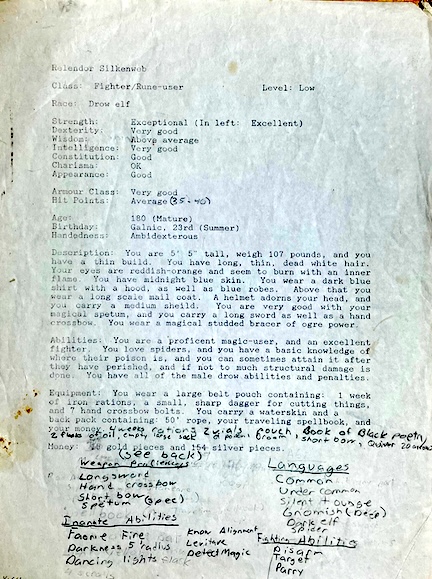
In the previous installment, I shared the origin of what I still call THE CAMPAIGN. That post covered the broad scope of the game—the 40,000-foot view, so to speak. Before I dive into the rest of the adventuring party, I want to focus on one of the only surviving artifacts from that era: my character sheet.

You’ll find a scan of it below. But before we get to that, a bit of context.

From what I can piece together, this isn’t the original sheet. The first page—the one with the main stats—was typed by Jeff, not me. The second page, which lists equipment and magic items, is definitely mine. I typed it up on my old Atari 800XL, typos and all. I recognize the format and the misspellings immediately.

The version I have is from later in the campaign. Some items had been gained, others lost. But it still brings back a flood of memories, and it’s the most tangible link I have to that incredible game.

 
First Glance at the Character Sheet
Looking at the first page of the character sheet, a few things jump out.

First—why does my character have such low Charisma? Trying to tell me something, Jeff? Ha!
More seriously, you’ll notice the Strength stat and a note about exceptional strength. That’s because I had a magical studded bracer of ogre power—functionally the same as gauntlets—but it only applied to the arm I was wearing it on. Why? Who knows. It never really caused problems in play, especially since my character fought with an unusual weapon for a dark elf: a spetum.

You’ll also see a note about ambidexterity, and under “Abilities,” the line: “You have all of the male drow abilities and penalties.” That said, I don’t recall ever fighting in the classic two-weapon drow style—not once. Why? Because I specialized in the spetum, and by the end of the campaign, I believe I was double-specialized.

Yeah, that was a house rule. But like I mentioned in Part I, we were walking our own path. I think I went through a number of magical spetums during the game, mostly because several of us were failing item saving throws at one point or another. Despite all that magic and specialization, I wasn’t the party’s top fighter—that title probably went to the half-ogre.

Fun aside: I’d just gotten a new set of smoke-colored translucent dice in the mail before we started this campaign. That d20 rolled 19s constantly. I must have used up all my luck in 1987, because now it barely rolls double digits.

The Equipment Sheet (and the Cat I didn't Ask for)

The equipment sheet was typed by me—misspellings, formatting quirks, and all. It is what it is.

Because Identify is so under-powered in 1st Edition—and due to the nature of Jeff’s campaign—we often had no idea what magic items actually did. We’d pick something up, mess around with it, and eventually figure it out... or not

Looking over the list now, it’s nothing earth-shattering. As I mentioned back in Part I, we’d just come off a short high-level campaign, so this time around we were intentionally going lower-powered. The magical bracer of ogre power was the first real item my character acquired. Oddly enough, it survived every item saving throw all the way to the end of the campaign.

One item I distinctly remember but didn’t list was the cloak of the bat. In hindsight, a cloak of the arachnid might’ve made more sense thematically, but the bat cloak served me well—until it was obliterated in a failed fireball saving throw. I still remember the collective sigh of relief from the rest of the party; apparently I’d been a little too enthusiastic about using it.

Then there’s the book of summoning “homucumuls.” Yes, I butchered the spelling. And no, I never actually used it. I think I kept it tucked away in my pouch of holding, waiting for the day my familiar bit the dust. Summoning a homunculus would’ve been cool, and it fit the tone of the character... it just never happened.

Broom? Book of Black Poetry? No idea on those...


The Familiar That Shouldn't Have Been

Here’s where things get weird. I’m not a cat person. I’ve always preferred dogs—still do. So imagine my frustration when I cast Find Familiar and, through random rolls, ended up with... a cat. Of course.

But then something unexpected happened.

Jeff’s family cat, Cogswell, started curling up on my lap every Saturday night during our sessions. He wasn’t a clingy cat otherwise, and I have no idea why he chose me—but there he was, week after week, purring away while I played. That was the only cat I ever genuinely liked.

Strangely, he never seemed interested in anyone else’s lap—or even in leaving mine. Every Saturday, it was like clockwork.

(Quick side note: despite not liking cats, I don’t like seeing them harmed either. My wife calls me “Diego the Animal Rescuer” because injured or stray animals just... find me. More than once we’ve had them show up at our house out of the blue.)

Anyway, somehow my familiar survived the entire campaign. Maybe it was dumb luck. Or maybe the real-life cat curled up on my lap had something to do with it. I’ll never know.

I also suspect Cogswell loved our gaming rituals. We’d usually chip in for pizza, and Mike (the older guy in our group) would drive out and get it. The empty pizza box often got left behind in the basement, and by the next Saturday, we’d find the cat munching on leftover crust—or whatever had hardened to the consistency of a brick.

Relendor Silkenweb, Miniatures and the Shield of Arion
One detail that still stands out from that campaign was Jeff’s use of his extensive Citadel Miniatures collection. He painted them himself—and did a great job by the standards of the time. Dave may have painted his too, though I wasn’t into miniature painting yet back then.

Looking back, the miniatures had a surprising influence on how we envisioned our characters. Mine was one of the 3rd Edition Foot Cavalry—a model named Toruviel Longstride. That mini, painted with dark blue skin and jet-black features to match the drow aesthetic, became the visual foundation for my character. Even the shield he carried would later factor into his personal goals and backstory.

And so there he was—one of my all-time favorite fighter/magic-users: Relendor Silkenweb.

A Name From the Vault
 I remember leafing through D3: Vault of the Drow in search of a name, and on page 14 I found “Captain Relonor.” Somehow that evolved into “Relendor,” and it stuck.

Relendor had one other distinction: he was the only PC in the campaign who never died. Every other party member was slain at least once, but somehow, he dodged that fate. I do recall one close call—he was dropped to -9 HP in a dungeon and stabilized immediately, purely by luck, thanks to a nearby party member. Probably because of Cogswell...

The Shield of Arion
Relendor’s full backstory is lost to time, but I remember the broad strokes. He had been sent by the Church of Arion (no Lolth in this setting) to recover the Shield of Arion, which had been stolen by a villain named Dragotha. Same name as the iconic undead dragon from D&D lore, but in this campaign, Dragotha was not a dracolich—just a powerful antagonist who ended up tying into all our characters’ backstories. He served as the thread that bound the party together.

I only ever read my own backstory, and sadly I no longer have it. Hopefully Jeff still has those character write-ups tucked away in his gaming archives somewhere.

That’s all for now. Next time, I’ll chronicle the rest of the adventuring party and the players behind them.

Previously, I said there were seven of us—but there may have been eight. I think Jim might have been playing with us at the time, and I seem to recall him running a dwarf fighter. I’ll have to see if I can jog the memory.

Until next time.


Wednesday, January 29, 2014

1st Edition AD&D Part I- A walk to remember


Not exactly accurate, but accurate enough.

Introduction

No, not the book or the movie of the same name—this is the first part of a long-ago campaign from the halcyon days of my youth. It still stands as one of the best gaming experiences I’ve ever had.

Let me get the sentimental stuff out of the way first. Over the years, I’ve been lucky enough to play in some great games, but two stand out as truly exceptional. And in both, I wasn’t the DM—I was a player, running a dark elf character. Now, before you roll your eyes and picture a dual-wielding drow ranger, hear me out. The first of these characters wasn’t anything like that, and the campaign predated 2nd Edition by a few years.

I started gaming in 1982, making me what I call a “late 1st Edition” player—a hybrid player, really. I played with a few local groups before joining up with the crew that would eventually become my high school gaming circle. That’s where I met Dave and Jeff. Looking back, it might’ve seemed like an odd friendship, especially through the lens of high school stereotypes. We were an eclectic bunch: we all played sports (I played football), we were in advanced classes (well, the others more than me—I was a late bloomer), and we didn’t exactly fit into a single crowd.

Even so, I gravitated more toward those guys than the kids I played football with. My wife—who went to a different high school—once called me a “closet nerd,” and she wasn’t wrong. Turns out that choice was a good one. Dave, Jeff, and I became lifelong friends.

A Seat at the Table

I remember the moment clearly. It was the fall of 1987 when I approached them at lunch and started talking AD&D. It was a deliberate move—I knew they were better players than I was, and I wanted to learn from them and game with them. We’d all been in the same school system since kindergarten, and while I wasn’t close with them until then, they’d been friends for years. Not long after that conversation, I was invited to join a Saturday night game at Jeff’s house.

Don’t judge us—we were freshmen. All the girls in our grade were dating older guys who had cars, while we were still zipping around on BMX bikes. I pedaled over to Jeff’s place, headed down into the basement, and that’s where the magic started.

Before that, we’d played in a short-lived high-level game run by an older player named Mike. We were going up against a lich, and while it was fun, it was more of a one-off that only lasted a few sessions. Jeff also ran a proto-campaign as a kind of warm-up, but it didn’t go far. He was already planning something bigger.

We all agreed to the concept and began developing characters. It wasn’t the only memorable campaign I’d ever play in—but it was, and still is, one of the very best.

Part I – The Game

Jeff did a lot of DMing back then, and even early on, his creativity stood out. One of the most unique aspects of this campaign was that we didn’t know our characters’ exact ability scores or hit points. Instead, Jeff used a descriptive range system inspired by the Monster Manual’s intelligence listings. So instead of a number, we might see “Good” or “Exceptional” written on the character sheet. We could make educated guesses, but we were never fully sure.

We used seven stats, with Comeliness renamed to Appearance. Hit points were similarly obscured, which added a level of uncertainty that made the game feel more dangerous. And almost all of our backstories were written by Jeff. We gave him a name and a class—or classes—and he filled in the rest. That decision added depth and cohesion from the start. The group wasn’t just a bunch of strangers who “met in a tavern.” We had shared history, and it made everything feel more real.

After that, the campaign was a sandbox. We had the freedom to go where we wanted, but there were character arcs, interwoven goals, and shared consequences. No railroads—just story.

Jeff’s rules were flexible. My character, for instance, was a multi-classed fighter but still got to specialize in weapons. He pulled material from Dragon Magazine, particularly the issues in the #110–130 range. I still use a lot of content from those today. In fact, my sheet includes a notation for Fighting Styles from Dragon #127, so I know exactly what was being used.

He also ran a few adventures pulled from Dungeon Magazine (issues #1–81), which I’ve since collected. I’ll cover some of those in later posts—they were excellent, and Jeff’s picks were always solid.

What really made the game sing, though, was the energy. We were excited to play and had the time to do it. Every Saturday night for nearly two years, we gathered for that campaign. I remember racing home after football games in the fall, barely taking time to change out of my uniform before hopping on my bike and heading to Jeff’s basement. That’s how much fun we were having.

Rules-wise, we were using 1st Edition AD&D with elements of Unearthed Arcana. That’s what gave me the idea to play a dark elf, though the main reason was just to try something different. In previous groups, I often played fighter/magic-users—or sometimes even triple-classed as a fighter/cleric/magic-user, especially in the L series.

What’s Next

In Part II, I’ll go into more detail about the players and their characters—names where I remember them, motivations where I can piece them together. I didn’t take many notes back then (not like I do now), but Jeff’s digging through his old stuff, and we’ll see what surfaces.

There were seven of us in that group, and we were a force to be reckoned with.

This post is mostly from memory, and all I really have to go on is that—and one worn old character sheet. But it’s a good place to start.

Until next time.


Tuesday, May 22, 2012

My "Golden Age" of Dragon Magazine


Everyone has their “Golden Age” when it comes to Dragon magazine and in reality it's no different then say White Dwarf. A lot of one's views will be dependent on just where you entered gaming. As I've discussed on this blog and on sites like Dragonsfoot before, I was a late comer to 1st Edition AD&D in the terms of its product run. I started gaming in 1982, but for years my friends and I really mixed and matched stuff together as we explored the game, in other words like a lot of kids I suspect we freely mixed and matched 1st Edition and Basic and never thought twice about doing so.
So with that in mind I really didn't start reading Dragon on a consistent basis until well after many 1st edition gamers would consider Dragon to be on the decline. To me this is puzzling because around #105 things started to get really good, again from my perspective.
The run from about issue #80 till around #170 fits my style of gaming perfectly: detailing out first edition stuff (albeit late 1st) that I can easily insert into my 2nd edition games with little or no fuss. To me there is little I have to change, it fits like a glove.
In a looser order here are probably my top ten all time favorite Dragon magazine issues:
1. #134- Dragons. This issue is the be-all, end-all when it comes to dragons and anything dragon related. It's a great reference for amping up 1st edition dragons and good dragon tactics in general. The cover is pretty cool too, a bit weird now, but still cool.

2. #125- Chivalry. Back in the day I was a huge fan of cavaliers and played them a lot, not for any power-gaming reasons, but more for stomping foes into the dust in the name of king and country! Being the first book I bought with my own cash (aka Unearthed Arcana probably had something to do with it). In terms of iconic images there aren't many more then a knight on horseback, lance leveled. I think I wore out my copy back in the day reading, and rereading this thing. Even the other articles not dealing with knights are damn cool. As far as cover, look at that! A  historical based Arthur, how cool is that? Couple this issue with  #118 (see below), the Arthurian characters from the Deities and Demigods (Legends and Lore) from 1st edition and you well on your way to an Arthurian themed campaign.

3. #127- Call to Arms. This is just as good as #125 in my book. There is so much meat in this you need a fork and knife. Single-class fighters are probably my second favorite class after fighter/mage. When you look at the options and idea starters this gives the DM and players you can couple this with #125 and #119 for everything one would need for a strong feudal style campaign akin to the Hundred Years War or a least a mythological one.
Again the cover on this is epic. I think I drew that cover multiple times as a early teen. There is so much going on. I especially love the one orc saying basically “Ok lets go at this one last time"!

4. #136- Urban Adventures. Damn this cover rocks too, see a pattern here? Urban adventures are a very under utilized part of the game in my opinion and often an area where newer players simply see as a “store” to exchange stuff for stuff they want from “shop-keepers”. What #136 does is give the DM a great host of options and the article “50 ways to foil your players" in a gem of an article in my opinion.
If that were not enough there is a great golem article, a very good Star Frontiers one and host of others. In short you can't go wrong with the options this issue gives you.

5. #138 Dreadful Tidings. This one gets special mention for two reasons: a wide selection of alternative undead types which I've used for years (Hungry Dead anyone?) and the article on the plague. The rest of it is a bit skimpy but the two articles more then make up for it.The cover isn't bad and has a good deal going on but for some reason it doesn't register with me.

6. #160- The City Never Sleeps. Tie this in with #136 and you've got everything you need for down and dirty city creation and defenses in a magical world. Thieves guild articles, and others fill out the special section nicely. I especially like the maps of the Inn of the Last Call.
For issue #160 the cover is ok, not my favorite, but ok. The real meat in this one is the articles.

7. #123- Arcane Arts. This cover sets the tone and is a great tool to use for the magically inclined characters of the campaign world. The special section has three outstanding articles and the Arcane Lore section with fire related spells is fantastic. Of special note is the idea of the "Arcane College", a great tool for DMs to use when PC mages get to higher levels. 
Legends and Lore has oriental heroes and the Marvel-Phile section has some of the heralds of Galactus.
 8. #118- Competitions and Tournaments. Tie into #125 and Arthurian Britain (legendary not quasi-historical) and away we go. Ever wonder about how to stage a tourney? Wonder no more, follow the pointers in this section and you're well on the way to a good framework for a fair, festival, what have you. Also consider the article “The Fairest of the Fairs” #137 in conjunction with this issue for further idea kick-starters.

Some folks will not like this issue as it contains the infamous article heralding the coming of second edition by Zeb Cook; who makes the cut in terms of classes and who doesn't... I'll leave it at that to cut down on the rancor.Personally I think Zeb did a great job and the grogs can go stuff it.

This cover is awesome and the last of the great chess series that ran for years by the artist Denis Beauvais.
9. #116- Maritime Adventures. Long before “Of Ships and the Sea” I used this issue to great effect as it covers everything needed for ships and sailing in a fantasy setting. As I got older I still liked the idea behind it, but I've never liked the the idea of SoL akin to HMS Victory in a world of high medieval tech. To me a cog or at most a caravel represents the levels of seaborne tech for most worlds. And for me a caravel would be on the hogh side of maritime technology.
The cover is what it is: a picture of a red dragon mini with some smoke effects added. Nice, but not great. 
    The whole issue is great by my estimation and there really isn't a bad article in it. 
    10. #106. This was tough as I'm tempted to pick the likes of #115, #145, #148, #167 or #178. I give the nod to #106 solely based on the strength of the article “A Plethora of Paladins” The illrigger alone is so cool you can't go wrong with it and the class has featured in my 2nd games. In fact it was the illrigger that made me reevaluate kits and dump them pretty much from my 2nd edition games entirely. I find most of the NPC classes work just fine in 2nd and you can easily use them with the likes of “Sages and Specialists” which are more akin to NPC classes in presentation anyways.
     The cover... while not a "chain mail bikini" it's starting to get close...
Honorable mention/Runner up status goes to the likes of #99 (for the expanded sword system and troop tables) #102 (Anti-Ranger), #119 (Druids) and #124 (Airborne Adventuring). The cover of #119 is especially awesome! #126 is another favorite of mine especially for the cover.
These issues for me were the “sweet spot” of gaming articles an heavily influenced my gaming and my perception of the game. It probably also explains why to some degree 2nd edition became such a non-issue to me; my group and I were already mix and matching for years the various gaming systems. When 2nd came out we continued to do so. ­