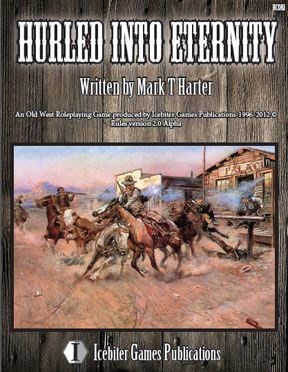
It’s been a busy stretch behind the scenes for Hurled into Eternity. If you’re just tuning in, here’s a quick status update on where things stand and what’s coming next.
The core rule book is fully written and internally locked and loaded. Every major system has been reviewed and stress tests are ongoing: the Wild Card System, Luck and Hand of Fate mechanics, wounds and death, professions, and Judge guidance. It’s all there — and it works the way it’s supposed to. Brutal. Clean. No half-measures.
The Wild Card System itself has gotten its final polish. The revised 2.0 version makes card values even more distinct: Jacks always fail, Kings always succeed, Queens are a 50/50 gamble, and Aces are rare triumphs that give you Luck back. Jokers are now better tied to your reputation (Good, Bad, Ugly, or Weird), and they don’t save you — they change the story. It’s all running leaner and tighter now, with a better sense of pacing and dramatic rhythm in play.
Two major expansions are in development:
Weird West – Currently the most developed, this expansion brings dark folklore, ghost stories, and grim Americana into the Hurled framework. Spells are live and deadly. The Reaping & Reckoning table handles catastrophic failures. New professions like Dust Tracker and Witch Hunter are already written and integrated.
It contains a full bestiary of unnatural threats is underway for the Weird West,
starting with ghosts, revenants, scarecrows, and haunts. Each creature
gets a full write up, mechanical profile, and guidance for use in dark
tales of frontier horror.
Gangland – Think 1920s noir with a switchblade in its teeth and a Tommy gun in its hand. Set in a fictional version of a Prohibition-era city, the game trades spells for rackets, bribes, and vice. It’s about loyalty, betrayal, and blood in the streets. You’re not a hero. You’re a name in the paper — if you’re lucky.
The game’s tagline still stands:
Hurled into Eternity isn’t about easy victories or quick glory. It doesn’t meet you halfway — it expects you to bleed for every mile.
That philosophy continues to guide every design decision: brutal but fair, evocative but lean, and always anchored in a tone of desperation, tension, and earned survival.
Ahead are more updates, and perhaps some surprises. For now, shuffle your deck and keep your eyes on the horizon. The next card might change everything.
Previous update and link to the Alpha rules can be found here (I'm trying to avoid linking to the rules multiple times in the blog)
In any creative endeavor, there are people who inspire us—who push us to do more or lead us down paths we hadn’t even considered. That’s certainly been true in the development of my game, Hurled into Eternity.
The funny thing is, some of those influences I recognized while building the game. Others I only saw in hindsight—ghosts riding alongside me the whole way, whether I knew it or not.
Movies - Upfront, it's easiest to say the most obvious inspirations are movies and TV. Pale Rider, The Good, The Bad and The Ugly and especially Tombstone and Unforgiven absolutely deserve a spot on the short list of influences for Hurled into Eternity. They’re baked into the bones of the game, whether I meant them to be or not. There’s something about their tone: dusty, desperate, mythic—that lines up perfectly with the world I’ve been building for over two decades.
Music- Music. Music is essential. While working on the latest iterations of Hurled into Eternity, I listened to a ton of Western-inspired soundtracks. One of my go-to favorites is The Lone Rangersoundtrack, along with this absolute gem from Ennio Morricone: Guns for San Sebastian.
After a while, though, I needed something fresh—and I stumbled across this original composition by Steven Lynn. It sounds like it could be in Red Dead Redemption 2 its that good!
Terrain and Buildings - Fall and winter are usually when I hunker down at the hobby table. That’s when the brushes come out, the minis get primed, and the terrain pieces start to take shape. Right now, I’ve got the beginnings of a frontier town called Timber Ridge coming together. It’s a fictional outpost set somewhere in a mythic version of Wyoming—a place with its own legends, rival factions, and more than a few bodies buried beneath its streets.
Alongside that, I’ve also got some old model trains that once belonged to my dad, dating all the way back to the 1940s. I need to dig them out. There’s something deeply satisfying about using a piece of family history to help build a fictional world. Somehow, it all connects.
Working with something physical—terrain, paint, tools—also helps get the creative gears turning in a way that’s hard to replicate on a screen.
Why the Southwest Always Wins - If you’ve ever wondered why so many Western RPGs, films, and stories are set somewhere in the American Southwest, I think it comes down to one thing: the Gunfight at the OK Corral.
That single shootout in Tombstone has become the gravitational center of the genre. There were other towns, other legends, and other infamous clashes—but none carry the same mythic weight.
And yes, the title of my game—Hurled into Eternity—isn’t just poetic. It’s pulled directly from the next day’s edition of the Tombstone Epitaph. That headline stuck with me. It said everything the game tries to say: when you draw your last card, you're not walking away.
Cards, Dice, and the Roads Not Taken- Cards have always played second fiddle to dice in most game designs. Dice dominate as the go-to resolution mechanic, and very few systems—maybe eight to ten at most—use playing cards as a core part of their engine, either fully or partially.
Not long ago, I looked up Gunslingers and Gamblers and felt a brief gut punch when I saw it mentioned cards. Then I dug a little deeper and saw it actually uses poker dice. Relief.
To the best of my knowledge, Hurled into Eternity is the first Western RPG that uses playing cards exclusively to run the whole system. And there’s a reason you don’t see that more often: it’s tough to pull off.
Cards offer a lot—tension, unpredictability, narrative weight—but getting them to feel fast and natural at the table without bogging things down? That took years of trial, error, and rebuilding from the ground up.
What I’ve got now feels sharp. It’s dangerous, intuitive, and full of risk and momentum. The way a proper Western should feel.
RPGS- I’ve mostly steered clear of other Western RPGs—and that was intentional. I own the Savage Worlds rules and I’m familiar with how Deadlands uses cards for initiative, but I made a conscious effort to avoid diving too deep into that material. I wanted Hurled into Eternity to remain honest and original, not a remix of someone else’s work.
In fact, it wasn’t until I had the game mostly locked in—around version 7.5 Alpha—that I really started looking into what other Western RPGs were out there. I came across some excellent games, no question. But I’m glad I waited. For better or worse, I wanted Hurled into Eternity to succeed or fail on its own terms.
That said, I didn’t avoid everything. There were a few titles I did check out, mainly for reference—to make sure I wasn’t unknowingly treading the same ground. Those were:
Western City (By Jorg Dunne)
Boot Hill (1st and 3rd Edition)
Go for Yer Gun (By Simon Washbourne)
Weird West (by Stuart Robertson)
Each one offers something different, but I always came away feeling like I was still building something distinct.
Other RPG Influences- While it might not look like it in the form it is in now, the following games had a part in influencing me over the years with Hurled into Eternity:
Warhammer Fantasy Roleplay (1st Edition)
FASERIP Marvel Superheroes
Twilight 2000 (especially early on its development)
Gangbusters (An absolutely incredible game!)
There you have it, just where Hurled into Eternity got its nods from.
Hurled into Eternity wasn’t born overnight. It wasn’t forged in a corporate boardroom or churned out to ride a trend. This game has been riding shotgun in my mind for over two decades—long before terms like “narrative-forward” or “OSR” became popular buzzwords. In truth, it was born as a game I never released called Quest in late 1996
It began with fragments. Scrawled notes in the margins of notebooks. Faded maps of ghost towns that never existed. Mechanics scribbled out, rewritten, then scribbled out again. The feel was always clear though—gritty, grim, and unapologetically unforgiving. A Wild West where death ain’t just possible; it’s likely. But if you go out, you’ll go out legendary.
And now, after twenty years of iteration, evolution, and hard-earned grit, Hurled into Eternity is finally approaching the printing press.
Aiming for 2026: The Release
We’re looking at a tentative launch in Q2 or Q3 of 2026—a full-color, hardcover edition worthy of the legends it’ll carry. This won’t be a flimsy pamphlet or a bare bones beta. This is the real deal. A full core rule book steeped in sweat, smoke, and blood.
Expect more announcements leading into a proper crowdfunding campaign. I won’t rush it—but I will finish it.
This ain’t a game about balance. It's a game about reckoning.
You don’t play heroes—you play drifters, gunfighters, soiled doves, and outlaws. Folks clawing for survival, redemption, or one last score. The tone is dark, mythic, and soaked in the kind of hard choices frontier life demanded.
The world has a pulse. Every town has its own laws, its own secrets, and its own hangman. Every trail hides both gold and ghosts. You’ll meet legends—some living, some not. And if you last long enough, maybe you’ll become one.
Mechanics on the Edge
At its core, the game runs on the Wild Card System—a playing card–based mechanic that trades in tension, randomness, and fate. Combat is resolved through card draws, where suits determine severity and Jokers can spell miracles or doom.
Forget initiative—gunfights run on High Noon rules, where the first to flinch might be the first to fall. Skills are grouped into thematic callings (Military, Urban, Rural, Wilderness), with Talents drawn from the deck itself—fate choosing your gifts as much as you do.
Your drifter doesn’t level up like a power fantasy—they claw their way through scars, legends and fortune earned by blood.
There are critical wounds, misfires, brawls and balloon fights, and plunges into the Weird—a realm of spiritual horror and ghost story made real.
A World Rebuilt
Set in a quasi-legendary Wyoming Territory, the world of Hurled into Eternity takes real frontier history and folds it through myth, folklore, and tragedy. Towns like Redstone, Whiskey Gulch, and Crow Ridge exist between fading maps and whispered tales. The railroad doesn’t just bring progress—it brings change, and not always the kind folks want.
There are factions, bounty boards, twisted cults, and fallen lands. If you’re looking for a cinematic frontier where grit matters more than gear, you’ve found your table.
More soon.
Keep one eye on the blog and the others on the horizon. The saddle’s been empty a long time, but not much longer.
Taking a bit of a side track with all the crazy stuff going on in my life I've picked my western RPG, Hurled Into Eternity back to the fore. Its now on version 7 Alpha and will be ready for review, comments and play testing soon.
More to come but for now a look at the FPO/Concept cover. The idea will be a pulpy dime store western novel approach:
Since its sub zero Fahrenheit here in western NY, (it about -2 with wind chill its -22) I figured this would be a great time for this post given the location of the movie!
Continuing my musings on campaign worlds on the blog as of late, here's a thought: How about a game (and it could work in almost any game system) based on the Thing? Obviously, the horror genre games would work, but in a way it could be derivative of zombie genre as I covered here or perhaps using Twilight 2000? These are just a few thoughts that come to mind.
The Thing is based on the work Who goes There? (1) (which I'm still reading despite reading two other books). It was first made into the movie, The Thing from Another World in 1951; smack dab in the middle of the UFO craze of the 1940s and 50s. Later it would be remade by John Carpenter in 1982 as The Thing with a prequel in 2011. All three are different with the 1982 and 2011 versions obviously having the same storyline. While I like all three, the 1982 version is clearly superior.
That the 1982 Thing is a very good is an understatement its exceptional; and at time very underrated movie. Underrated in the sense that there are tons of clues scattered throughout and is very much a mystery movie wrapped in the horror genre. Reading the novella that is drawn from this is readily apparent. Add to the fact that Carpenter and his team a had a long period of time to work on the story (and it shows) there is lots of subtle clues throughout. On such place browse these clues is the forum at Outpost 31 For the sake of brevity here, for those not in the know The Thing had an unusually long time before they actually started shooting (something like 17 months as far as I can recall) and Carpenter admitted they had plenty of time to plan out the plot, which camera shots they would use, etc to far greater detail then he might otherwise done.
So as an RPG? Imagine it starts out at a research station isolated in the Arctic or Antarctic (doesnt have to be the same Outpost 31 although it could be) and the players are confronted with the events as the unfold in the beginning of the movie. Where it goes from there is almost endless but at the same time a nice tidy sandbox. Perhaps a better ploy is to just get into the action as they will most likely already know the story. Add a different cast of characters (the players PCs) and keep the weaponry minimal. Then again even having high-powered military rifles, the PCs are screwed as they aren't very good against Things (2).
Barring that, how about a Thing has made it to the mainland and Blair's prediction starts playing itself out. Its going to take lots of flamethrowers or nukes once its too far gone.
In such a post apocalyptic scenario(s), movies like 28 Days Later or World War Z are going to seem like a walk in the park! If Things start reproducing in vast quantities in large human population centers, its largely game over. Such a game would quickly shift to extreme paranoia and one of ultra-extreme survival. Come to think of it with no recourse but to wipe out 7 billion or so Things it might be an exercise in futility.
If a GM uses Twilight 2000 it could add a good twist on the horrors of World War III; dropping some Things into that already horrific scenario? That could really mess things up. Of course it could also muddy stuff too much. Perhaps a better solution is to simply use the rules for Twilight 2000 and place it in modern day with the scenario outlined above. The only issue is that there is no really rules for monsters per say in Twilight 2000, so the GM would need to do some work, not insurmountable, but doable. Another thought is use the Savage World system which would definitely keep things moving quickly, but I think with minimal fuss All Flesh Must Be Eaten would be best.
In closing, I think such a game is better for a one-off/short campaign, or rather a series of short episodes as opposed to a multi-year/session campaign. There probably isn't going to be much "winning" if the Thing(s) make it out of Antarctica. It could be a fun/blow um up/ go out in a blaze of glory type of deal, but if there was ever a "no win scenario" this is it. Think of the end of the 1982 movie, not much (read: none) hope at the end and lots of question marks instead...
And of course I would be remiss if I didn't point out one of the best lines in the history of cinema:
No kidding indeed.
(1) Who goes there can be found on such online places at the iTunes book store for free.
(2) The Norwegian with the sweet gun was using a Heckler & Koch HK33. Details to the weapon at IMDB is here or the full details on a wiki for weaponry used in movies.
General Notes Some of you may have been wondering why I haven't been blogging about Warhammer (on that much in general) as much lately. This is for a number of reasons. One, as I've pointed out on various Warhammer forums my interest in the game is rather low right now. Two, I truly believe that Games Workshop is circling the drain and while it sucks for the people that work there that are going to bear the brunt of it, the company itself I cannot help but blame. The antics of GW now seem to rival TSR in its death throws, should be interesting to watch.
Secondly, I've been a tad bit busy in real life but I figure I'll have a few more posts to round out the year. Anyways, here are some odds and ends.
5 RPG Threads of note
I don't normally like to post about the goings on at various RPGs sites, but since it came up in a thread at Dragonsfoot
a while back, I thought I'd list my Top 5 favorite RPG threads from
around the web. I figured I'd post the
RPGs thread portion here rather then ruffle feathers elsewhere,
hopefully the coast will be clear later? Here they are in no particular
order.
Notes
*
I'm surprised it still exists, I thought it had been deleted to protect
the guilty. It's amusing on several levels, but the best is the
posturing by a certain person who claimed he knew more then the people
who were actually there at the time, classic! The best is Mike Berualt (aka Zotster)
dispelling notions that grognard chapter and verse is built on. Note: I frequent a number of sites, but only post on a few, there are probably even crazier threads out there, but these one strike me as comedy gold.
On a lark I ran across a "VultureBay" auction for some vintage minis, vintage as in 1983 Boot Hill miniatures. For $3.50 I figured what the Hell and I ponied up and snagged them. A few days later they arrive.
Minis in Boot Hill makes perfect sense when one considers that Boot Hill 1st and 2nd edition are what I call "a miniatures battle game with a skeletal RPG system attached". That's no knock against Boot Hill, I like it immensely as a system. So much so in fact Boot Hill lead me to create my own western RPG, Hurled into Eternity. Of course the fact that it is a skeletal RPG is the reason I created my own from whole cloth, rather then retrofit to Boot Hill.
I
can't really recall seeing these guys on the shelf back in the day in
gaming stores, but then again I wasn't really looking for them either, I
was looking for Warhammer minis by the time I really became interested
in the miniature aspect of the hobby.
I figured it was finally time to let the boys out..
Anyways, here is what I got in the haul: all in all very nice and in the blister
too. Think about it, much like Stinky Pete in Toy Story 2 these guys
have been in the box for quite some time, in their case for 31 years... So what did I do when I got them? Cut them out of
the blister of course. An interesting thing about these minis is the
fact that they came out in 1983. By this time (although we didn't know
it) Boot Hill was in or near its near hibernation phase. Sure BH4 and
BH5 would come out, and later 3rd edition Boot Hill, but it was closer to its run then the beginning.
In terms of scale they seem to be about 22mm. They are not as small as 20mm, but certainly not 28mm "heroic scale". The 28mm "heroic scale" Note: Warhammer minis will look
absolutely huge next to these guys. They are inline with the scale of Ral Partha minis which were the big player back in the early 80s (most of our early D&D games when we used minis utilized Ral Partha minis unpainted or "somewhat" painted".)
Adventure squares?
The pack has three gun fighters; one is a clearly a gunslinger getting ready to draw, the second wields a rifle up level firing and the last is what looks to be a cowhand firing; also looks like he's wearing a sombrero. It also looks like he has a confederate style shirt with buttons down either side rather then the middle.
A few period appropriate minis for scale.
Another look at scale: the three gunslingers,
a 2nd edition samurai warrior from Games Workshop and a 3rd edition
samurai, likewise from GW. The gunslingers are close to their
contemporary the 2nd edition samurai but a bit smaller then the 3rd
edition one.
Lastly, as noted by the graphic to the right the back had "adventure squares"? They are the right scale so cut it out and bamm indoor dueling range!
In any event, I like them and will probably be painting them up to use for testing for Hurled into Eternity.
BH4- Burned Bush Wells
The 4th module of the Boot Hill series certainly has a weird name, at least to me that is. Much like the other Boot Hill modules I did not play Boot Hill back in the day as we were not into Westerns at that time (a shame) and most of our time was spent playing D&D and AD&D. For my own part I used to watch a lot of westerns with my father, but drifted away. A few years back I started watching them again and got hooked on Boot Hill. In any event BH4- Burned Bush Wells is a module produced by Jeff Grubb with some input from Allen Hammock and Brian Blume.
BH4- Burned Bush Wells is a "later" Boot Hill module. I say "latter" in that the graphic design has changed compared to the earlier modules and its apparent that at the time TSR was focusing on D&D and AD&D, specifically as their bread winners. Perhaps the power struggle at the time of the mid 80s also accounted for this. Perhaps there were not enough folks that were that interested in working on the line, Donald Kaye's untimely death not helping matters in terms of Boot Hill overall? Just speculation on my part. In any event it would be the second to last Boot Hill module and akin to the others before it. Weird to think that it was released in 1983, with only Range War to follow in 1984. From BH1- Mad Mesa to Range Wars it was span of 1981-1984 for the entire run of modules.
The cover and interior art
Elmore seems to be a polarizing figure for grognards in terms of TSR era art. In the realm of Boot Hill (and others) I think his stuff is very good and it certain captures the feel well, certainly for a western RPG. Another thing to think about: the American West isn't usually depicted in the winter, whether its a movie or art; usually its baking, scorching hot deserts and cactus. I also like to point out the crop with the snow on the bottom right corner outside the frame. In short, I like it. One thing that detracts is some of his art in the interior. Not that its not done well but a lot of his characters tend to look alike, a certain feel to them if you will. Perhaps this is where people object?
Content
Like BH2 The GM is presented with an outline of events and like a movie certain scenes can happen at the appropriate place and time. As I've discussed with those of like minds over at the OD&D Pro Boards, its not so much as a "sand "box" but more like a "jungle gym". In so much that the idea is to provide a framework for the players but not have it be rail-roady This is a definite area where all of the Boot Hill modules struggle. A western has a number of self compartmentalized scenes, that tell the overall story leading invariability to the showdown. This works if it follows a movie script rather then fantasy sword and sorcery with six-guns and Winchesters instead.
One of the things that stands out with this and and every other Boot Hill module is the vast numbers of NPCs mentioned. In most cases I can't see this ever being terribly important. The local saloon keeper? Yes, we need to know his name, that of all of his kids? Probably not needed.
The main action takes place in the eponymous town of Burned Bush Wells in the dead of winter. As noted in the text of the module winter is a lean time in the west and the wolves are hungry. As Burned Brush Wells has a number of cattle concerns in the area they predators are naturally a problem to be dealt with. Rules are giving for hunting or trapping the critters along with the ubiquitous rules for animals that seem to make an appearance in every Boot Hill module.
The main mover and shaker is Lyle Underway the wealthiest man in town and with the most varied interests of the merchants/businessmen. He takes the role of the thoroughly unlikable power hungry businessman. He is applying pressure to the smaller businesses and cattle outfits in an effort to drive them out of business. The smaller businesses unite to for the BBBC (Burned Brush Business Council)* and retaliate over a deed, specifically the Waterhouse deed as it relates teh the Old Stage building. Underhay wants it, the PCs mostly likely end up with it and the thus a conflict is born. This is a classic western story done well in the form of an RPG. The hitch is the need to find out the former owner of the Waterhouse deed to make the transfer legal, thus foiling Underway's plans. Of course a man as powerful as Underhay is not going to let it just go at that owing to the fact that he has the law of the town in his pocket.
* The BBBC is a well thought idea that echos real like events like the Johnson County War in Wyoming that eventually drew in the US Cavalry. On one side was the Wyoming Stock Growers Association (the WSGA) and the other the smaller Northern Wyoming Farmers and Stock Growers' Association (NWFSGA). Or another parallel is the Lincoln County War of which Billy the Kid was part of.
Thus the most likely turn of events is that the PCs head out on the road to Gordon where events direct them. The overland trek is a realistic one looking at the random encounter table. Having just watched Will Penny recently I like the inclusion of Line Rider as a possible encounter (a very minor detail in the module to be sure but it shows that author had a good grasp of his content).
Another thing I like about the module is the inclusion of a ghost town. The town in question is Gordon and abandoned mining town that is largely just that: abandoned. The scenes that can take place there struck me as a very cool setting for a confrontation. Ghost towns abound in the west in real life but we have the hindsight of nearly a century and a half of space. In the game a town only recently abandoned lends an air of the campaign having been "lived in". Looking at other western themed RPGs, especially the ones of the last 20 years we get horror infused ones owing to Deadlands inspired games.
A minor point is the maps. In each case they are clear and concise, in short well done. They fit the style of the maps that appeared for various publications by TSR at the time as well as examples that appeared in Dragon a bit later.
Conclusion
Much like many of the modules before it BH4 is somewhat of a script, series of events rather then the dungeon crawls most are used to. I know I sound like a broken record in my reviews of the Boot Hill modules but it is something that they never addressed all that well.
By this stage in the run of TSR the focus was clearly on D&D.
When one adds the looming war between the Blumes and Gygax its probably
no wonder that the secondary games of TSR (Gamma World, Top Secret,
Gangbusters, etc) took a back seat or dwindled on the vine. Boot Hill
was a solid game and its miniature quasi-wargame roots show in the
rules. It wasn't until 3rd edition Boot Hill that it became more of a
role-playing game but by that point the ship had largely sealed.
The "cut scenes" (Labeled I-IX) in town as it were are well done. But its the section Waterhouse's Deed that I like very much the tramping up the stairs via the law to meet Underhay that sets in motion the events of the Waterhouse deed. I can easily picture this very event in plenty of westerns: the evil land tycoon/robber baron, etc confronts the hero(es) and tells them to clear out of to hand over what he wants, they refuse and the battle is on or at least coming to a head very soon..
As and aside by the time 3rd edition came out in 1990 my High School gaming group and I were not playing all that much in terms of AD&D let alone any other TSR games other then some side games of Marvel Super Heroes. In a sense for me, Boot Hill wasn't even a thought as I can't remember any of my high school group owning it let alone wanting to play it.
Next up
In my queue to review in the not too distant future is review of the elusive BH5- Range War!
I say elusive as it has been eluding me on eBay (its not worth $75 dollars folks) I should take comfort some wags on Amazon think people are going to pay $400 for it...
On a completely personal note I bid a fond farewell to Eli Wallach who starred in incredicble westerns like "The Good, The Bad, the Ugly" and "the Magnificent Seven" to name but a few.