Search This Blog

Sunday, August 3, 2014

Warhammer 3rd Edition Temple Dogs – From 80s Model to Nippon Army

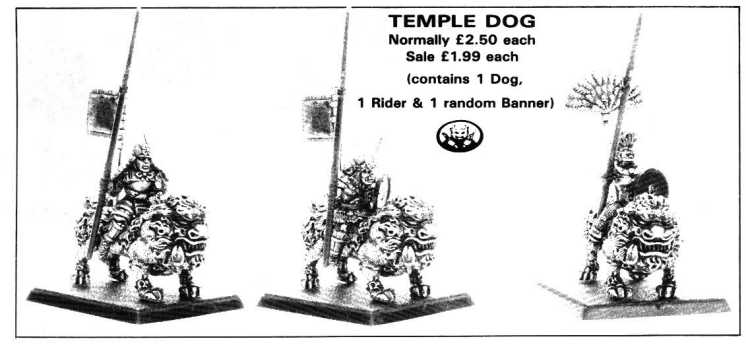
Temple Dog from 3rd Edition Warhammer Armies
"I look fierce... but crumble like blue cheese!"

"Get this Wagon Train a moving!" Hah, you thought this was going to be a western post, didn't you?

How about that? Combining a western phrase like an Old West cowboy when actually referring to the Temple Dog minis from 33rd edition Warhammer Fantasy Battle.

I have had them on my radar for a number of years. Back when we played 3rd edition I used a GW manticore sans wings to simulate one for my Dark Elf army. Game-wise they were fluffy, but as a war beast they were decidedly mediocre. The problem is the same with almost any other war beast or large models like giants: they attract an inordinate amount of artillery and magic. With a Toughness of 5 Temple Dogs usually dumped their rider very quickly. The problem I have always had is they are stone, they are divinely powered, and they fall over in a stiff breeze.

As Cianty over at his blog noted, here is the flavor text from Warhammer Armies:

"Temple Dogs are stone statues found guarding temple entrances in the lands of Nippon and Cathay. They resemble nothing so much as a cross between a giant pekinese and a lion. In times of war, the power of the temple gods is channeled into these statues to animate them. It is a great honour to mount this divine animal, indicating that the rider has found great favour with the gods." 

(Warhammer Armies, page 26, 1991)

Sounds like they should be made of sterner stuff, no?

As I move along in fits and starts on my Nippon army I have come around to the conclusion I am highly unlikely if ever going to play my Nippon Army as anything other than a third edition one. That leaves me with the open possibilities of being able to model the army however I want.

The Temple Dog was pretty much the same in each iteration (as near as I can tell as I have never actually seen one) and came with one of three different riders. The part I really like? I like that the Temple Dog's tongue is hanging out just like a real dog. My previous golden retriever Teddy who passed away always did that. Each had a plastic spear/lance that was fairly common with models back then and the hand was molded to the spear. From the look of it they are on 40x40mm bases.

Excellent Temple Dog examples over at the Stuff of Legends!

The three riders are as follows:

  •  A dark elf rider – least interest. As I pointed out this would have been useful back in the day. (EDIT: and as luck would have the first one I found in 2023).
  • A samurai rider – the one I am most interested in. Three in particular would be good.
  • A hobgoblin rider – could be useful to me particularly since I have two full units of 2nd and 3rd edition hobgoblin infantry.

As a side tangent: I have been searching eBay and they pop up now and again, but remain elusive. The maxim of eBay is playing out here: "be patient and do not overpay." I have been known to rail against insane eBay price gouging, another good indication of relative worth as it relates to inflation. If we use the sale price listed and convert it to US dollars it was about $3.28 in 1991. In today's dollars it is $5.74, a 75% increase when one counts for inflation. Often I have seen these in the neighborhood of $40-50...that's insane. Sure any item on eBay is what the market will bear, but that sure is some markup!

As noted above, a great example of this excellent model is here from Cianty, one of the luminaries of Bordertown Burning. We interviewed him for Issue #1 of the Word of Hashut waaaay back in 2008. It is more Kung-Fu inspired where I am working more for a Nippon inspired theme. Either way it is pretty cool.

In the end this has been one of the more challenging models to find. It is not super rare, but I do not really ever recall seeing it here in the US shops I frequented back when 3rd edition was current?

How common were temple dogs in your travels back in the day? 

Friday, August 1, 2014

How to Munchkin 1st Edition AD&D – Half Ogre, Druid, Drow & More

Evil Adventuring band, 1st Edition AD&D

While the later editions suffer from "builds" when players think about characters, the earlier editions are not immune to their share of munchkinism. In fact, if one looks at just the Player's Handbook in 1st edition its easy to break the game, using the Unearthed Arcana it gets even easier. It bears repeating, although its tougher to do with just the Players Handbook in 1st it can be done. Enter the Monty Haul aspects of the game. I don't believe that Gary intentionally did this, after all I truly believe the game grew organically and fast. I also think how he played was much more high powered then those that consider themselves "Gygaxian".

2nd edition avoids this to a degree in my opinion as one of the prime areas for abuse in 1st Edition, weapon specialization is toned way, way down. This is not to say combat can't be broken, fighting with two weapons anyone, and then specialized?  (Of which there are ways to tone this down too). Point being   that 1st is open to more abuse in my opinion. So in a round about sort of way what I'm saying is that the cat was really let out of the bag even with 1st edition. The later editions *cough* 3rd *cough* really drove it home.

So without further delay here is breaking the game 1st edition style lifted from my response at dragonsfoot. The point of this exercise is that with some "creative thinking" the power curve is already bent/broken at the mid levels of the game.  

Rules: 100,000 Xps for each character. 6 characters and no race or class can repeat (the original OP on Dragonsfoot said five characters, but in true munchkin fashion I ignored that limitation). Here was my stab at it, not meant to be the best, but certainly in consideration for munchkinism. Dual classed and multi-classed are ok when the limitation of no class repeated is considered.

Half Ogre, 7th level Fighter (Dragon #29/73)
This is the only single class in the lineup. Forget the duelist or any of the NPC races/classes from Dragon that people think are uber-munchkin, this is it hands down. High possibility of an 18/00 strength (check the rules). Of course if doing this via a munchkin build, there is no rolling, he automatically has an a 18/00 strength.

Next he obviously has double specialized in bastard sword (which he can use one handed with no penalties per the Dragon #73 magazine article) and attacks 2/1. Its important to note those attacks are at +5/+9 with that sword before factoring in any magical items. Read that again, that's +6 to hit with a base attack of of doing 2d4+9/2d4+9 before any magical items 4. Speaking of which, he is of course wielding a bastard sword+3 happens to be a vorpal blade as well. If feeling really munchkin, give him bracers of blinding strike to improve his initiative and double his attacks 3/day. 

Because of being able to wield the sword one handed he uses a +3 shield with his off hand meaning his AC is at least at -3 if not lower due to full plate armor. in 1st edition the damage reduction of the full plate is another nice boon and if magical, even better.

This brute also starts at 2d10 for hit dice at 1st level, so just like the ranger, but better. This is of course coupled with his natural con of 18 means at 7th level he has 108 hit points. That's 20 more than a huge, ancient, red dragon.

He could skip missile weapons for the most part as he usually does need them, but when he does he throws spears. Barring that nothing says a longbow can't be built for his height an stature

Of course by this level he has several magical options: ring of fire resistance is standard as it allows him to confront a red dragon, head on. Boots and cloak of elvenkind (which are fairly common magical items) negate the full plate penalties for moving silently. Throw in a few potions of giant strength and speed for those times he really needs it.

For added "fun" consider: if this were not enough, half ogres can also be clerics. Rather then "waste" nearly 30,000 XPs towards fighter (in this scenario) that would still leave him a7th level fighter; re-purpose them to a multi-class. Half Ogres can be clerics but their spell casting is only average even with a 12 wisdom, but he's likely the last resort cleric or healing himself only. He can still use edged weapons as multi-class clerics are allowed to or use the above mentioned hammer/girdle/gauntlets combo. It will impact his hit points some, but it might not be worth the consideration. 

NOTE: I'm not saying I would add cleric to him in this scenario, I'm just saying its possible.

Gray Elf 6th level Druid/ 5th level Ranger/ 5th level Magic User
(per Gary's errata in Dragon #96)
Ranger is included for no other reason then to be specialized in longbow in
order "mow down" enemies with a frightening rapidity (1). 19 dex + elven
bonus for bows + abilities for specialization and oh, fires 3/1 and each
arrow in point blank range that does 6-16 points of damage before factoring
magical arrows he's sure to have. If anything is caught in it's "reaper zone" (trademark- pending) that's 18-48 points of damage per round. 

Further, he wields a bow that allows him to gain his natural strength bonus up to 18/75 range so skip magical ones. That adds a +3 to damage per arrow. So in close for reference that's 1d6x2+2, +3 for strength per arrow. That equates to 9-17 per arrow with a minimum of 3 shots. And if that is still not enough he gets to fire one more arrow prior to initiative making that 4 arrows in a single round. 

Hit points are fairly good due to his ranger class adding 2d8 hit dice to the mix at 1st. Because his hit points are pretty good can be the 3rd or 4th line fighter. Could go toe-to-toe with bigger baddies when needed by fighting long sword and hand axe (short sword makes more sense) and with his dexterity he can pull it off. Pile in his animal helpers who are subject to the senior druid's animal growth spells (more on that in a moment).

Between the archer and the half ogre they might kill a red dragon in a single round by themselves.

Wears magical leather armor or bracers to preserve his stealth abilities as an elf. Or elven chain mail if need be. He primarily sits back and takes out targets of opportunity, like enemy spell casters. Can also cast as needed obviously. He is the junior druid to the dual classed druid below and his animal followers bulk out the party. Oh and he can cast druid and magic user spells...

As he rises in levels he gains additional magic user and druid spells. That leaves him with the potential for unlimited druid, 18th level magic user and 14th level ranger.

For other magical equipment the poorly worded quiver of Elhonna (2) is a must. If you really want to make it "him even more fearsome? Make him a Archer-Ranger from Dragon #45 (shudder). 

(1) and (2), yes...I know there is errata for both, but we can skip that little bit in true munchkin fashion.

Dual classed Half Elf, 1st level Fighter/9th level Druid

That's not a typo, the druid drop kicks everything's ass in 1st edition. Read "Underestimating Druids (is a Bad Practice)" in Dragon #119 until it sinks in. A revelation happened in this thread when people realized that animal growth is one of the most bad ass spells a druid can cast in 1st Edition. Basically 

Imagine he has a couple of bears he casts animal growth on, that doubles hit dice/hit points and damage...Lets that sink in.

He is the 2nd line fighter and with animal growth on his furry companions of his traveling zoo and complements the ogre in the melee. Also as a dual classed fighter he gets access to % strength. Add to this with the fact that he double specialized in scimitar at first level when he was a fighter. When really in trouble, dual wields with a flame blade spell in the off hand. I see no issue with this in munchkin-land as its not actually a weapon, its magical flame! Probably has the group's bracers of defense from previous adventures.

Spell casting outpaces both cleric and magic user at this XP level as he has access to 5th level spells. And at 9th level druid? He has access to 5th level spells besides the previously mentioned animal growth. 

Being a half elf he gets the standard half elf racial abilities of resistance to sleep and charm and secret door detection and the like.  

Likely has psionics too (of course) and the good ones, nothing crappy like empathy...

Half Orc 6th level Fighter / 7th level Thief
Arrrrgh, allocating his 100,000 XPs and dividing between the two classes means he is 1 XP away from 7th level assassin! In true munchkin fashion I've bump him one more XP and behold, 7th level assassin! 18/99 strength is a natural here as is a 19 constitution. He gets included due to being not being able to duplicate races per the rules above, still he is a viable character for the roster; much more than meets the eye. Hit points are actually good despite multi-classing as he gets 1d10/1d6 divided by 2 but has a 19 con which gives +5 hit per level. Depending on how the DM rules it you could tack that on as 2.5 per each level gained per class. The max says that if he rolled maximum hit points each time (and of course he does) in both classes he has around 83 hit points

His role is to not go toe toe-to-toe in combat (although he could). The druid and his pets are the back up for the half ogre fighter. Where the half ogre shines is backstab. 

For backstab? A backstab from this guy would cut most things in half as its not explicitly stated that a fighter/thief(assassin) is limited to weapons on a backstab. 

And since its not stated he of course uses a two-handed sword for such attacks and is double specialized in it. With that in mind his damage is 1d10x3 +5(strength), +8 damage (strength and double specialization) +3 magical two-handed sword plus any poisons he is sure to be using...

To preserve his stealth abilities he uses a magical leather armor which is of course the +5 variety which leaves him around a AC of 3 which for mid levels is not great. To help mitigate this he always seems to have a few potions of invulnerability which gets his AC to 1 and a +2 to saving throws.

And of course he's using poison on his magical two-handed sword...


If people are going to be really "sticky" on this then go with long sword instead or some such or convert to fighter/thief, plus ring of invisibility and boots of elven kind. He also has assassination abilities and can provide the party with thief skills.


Dark elf female 6th level Cleric/5th level Cavalier/ 5th level Magic User
Packed with innate magical abilities, superior infravision and the ability to fight with two weapons at no penalty, this is a fearsome combo. Here horseman’s maces (magical of course) will work well, but consider magical long swords abound in the game and Dungeon Masters Guide so have at it. She wears full plate armor for protection (remember the damage reduction) and still casts magic user spells and can wield a shield as needed.

Plus her innate abilities as a female dark elf like detect lie, levitate, darkness, suggestion, dispel magic, etc.

She also has a wide variety of weapon abilities, innate magic resistance, immunity to various spells, resistance to mind effecting spells, bonuses to weapons like longsword, lance (a few death lances from D3- Vault of the Drow) and horseman's mace, etc. Poisoned weapons go without saying here on any of these weapons.

Oh and can increase her strength, dex and con every time she levels by rolling 2d10 being a cavalier. 

While she can use other weapons she prefers to use her girdle of storm giant, gauntlets of ogre power and hammer of thunderbolts. She can pull this off as she is unusually tall for a dark elf female at 6' tall.

Her steed at 4th level is some sort of gigantic spider of course (no namby-pamby unicorn riders here). Then add in clerical and magic user spell casting to good effect. She probably has a retinue of undead fodder following her around via animate dead.

And all this is before we get to the fact she can cast the likes of lighting bolt and fireball.

Oh and don't forget she has innate drow magic resistance which for her is 60% given her current level.

Deep Gnome 6th level Illusionist/7th level Assassin

AARRRRGGGH... another 1 XP away again for 7th level! However, applying the "fix" outlined for the half orc above and boom! He has 1 more XP, and thus 7th level assassin. The deep gnome special abilities really push this over the top even at mid levels: camouflage, bonuses to saves, spell abilities, etc.

Assassination abilities and poison are another benefit here along with minor thief skills to back up the half orc and hopefully catch anything that was missed. He can scout with the ranger/druid/mu listed above with spells at his disposal, especially bending the curve with the vague phantasmal force... In a way he is the "utility infielder" of the group: jack of all trades, master of none.

Has access to weapons such as dagger+2, Longtooth and bracers of archery to provide a secondary archer for the group; shortbow+3 and a few choice arrows of slaying. Since he is not fighter in his multi-class and can't have specialization he fights with short sword and dagger both of which are envenomed  with poison as mentioned above.
Recap

  • Spellcasting- In short this setup has overall spell casting down pat: two of the characters have Magic User as a class,  one illusionist, one clerical and two with druidic spell casting. That's a tremendous amount of raw magical power at mid levels. Consider, two characters hurling 5d6 fireballs... the 9th level druid has access to spells like animal growth, insect plague, wall of fire, transmute rock to mud... The magic users probably have multiple scrolls with dispel magic. Magic User spells might be a bit weak, but at this XP level druids are far batter anyway. An overlooked part is with the druids rapid rise their spell casting which is superior to the clerics so their healing is just as good as the drow female.
  • Melee- Both of the main fighters are extreme examples and complement the other, one melee, one missile. The druid/ranger/magic user fires his bow while the half ogre closes to melee. The druid gets specialization too since he is dual classed and overall three of the characters are specialized; the dark elf getting weapons of choice due to her cavalier class. Between the characters one of has assassination abilities, two with back-stab and four of the characters are using poison regularly; I could see the case made for all of them, the half ogre hurling poisoned spears? Three or possibly four are attacking with two weapons when it comes down to melee. When it gets rough the dual classed druids animal growth spells on his and the druid/ranger/mu animal companions can get nasty.
  • Stealth- This group will be tough to surprise (the druid/ranger/mu) and has a good overall stealth capability. Notice I didn't go too overboard with some of the magic items. Boots and cloaks of elvenkind aren't artifacts after all and in this party coupled with the natural stealth nature of the members? When needed they can sneak around just fine and the gnome thief/illusionist is there to help further. The druid/ranger/mu, thief/illusionist or the half orc fighter/thief can all play the role of scouts. The half orc in particular can chop down opposition with a well placed back-stab as he is rarely if ever in the front line fighting it out but waiting for the right time then BAM!!!
  • Mundane- when considering munchkinism don't neglect the mundane: the longbow is the best missile weapon in the game doing 1d6 points of damage per arrow, but its RoF of 2/1 makes it swine compared to crossbows. Looking at this group there are four characters (the half ogre, gray elf, 1/2 elf and 1/2 orc) that have access to this weapon with one specialized in it. That means the half ogre, dual classed druid/fighter and half orc can fire six shots a round. Damage of the combined arrows if they hit is 6-36 or the equivalent of a wand of fireballs. Now add in 3 or 4 shots from the specialized archer? That's up to ten arrows in a round. To crank this up even further this could actually be a use for the flame arrow spell which might be one of the worst spells in 1st edition, but in this context? Gives the drow something to do while polishing her nails. If that doesn't work, all of them firing poison arrows instead? Oh and the gnome can use a short bow boosting this to 12 arrows in a single round. While not quite as bad as 3rd edition build malarkey for archers this is nothing to scoff at. In first edition by way of example? You can hit a dragon and wound it with a non-magical arrow. And if fighting lycanthropes, The entire archer brigade of the groups has access to silver arrows.

Another advantage that might not be readily noticeable is that this group is redundant in almost every area. There is at least one other character that can back up the other. This also means that in a lot of cases there is a good degree of success should say one of the thief fail to unlock a chest, find a trap, etc, the assassin can back him up.

The only alignment issue is the druid/ranger/magic user, but make him CG with CN tendencies and everything works out. I know Dragon #100 says they have to be Neutral Good, but we will fudge that a bit too.

One observation is that no dwarfs or halflings need apply for this group; nor do thief-acrobat, paladin,
single class thief, barbarian or monk. Bard is the odd man out, but he would be next "off the bench" in In my opinion but having to progress through fighter and thief firs limits s how high his bard level would be at 100,000 XPs. If anyone gets replaced its probably the half orc with the bard or maybe an illrigger. The lack of a single class thief really points out there is no real need for them as the multi class thief and assassin plus the cleric can take care of  this role. Basically replacing the single class thief in aggregate.

Magic items are modest and nothing that a band of 6-7th level PCs wouldn't have access to...well with a bit of stretching here or there. 

So there you have it, pretty easy to get a munchkin build in 1st Edition AD&D, its simply easier in 3rd and 3.5 Edition.

How about your munchkin party(ies), lets hear them. 

Sunday, July 27, 2014

Why Derro Are the Coolest Monster in the Monstrous Manual (Not Dragons)

Derro warrior from 2nd Edition AD&D

Despite the fact that the game is called Dungeons and Dragons, dragons are not the coolest monster in the Monster Manual/Monstrous Manual. The title instead goes to the...

DERRO!

"Scrawny, pale, little psychos" That is a great appellation for the race!

Scrawny (from the Monstrous Manual): "Derro a are one of the most dexterous of humanoid races (averaging 15-18), and their Armor Class must be adjusted for this." Usually those that are dexterous are not depicted as hulking brutes...

Pale (from the Monstrous Manual): "Derro are short, with skin the color of an iced over lake (white, with bluish undertones), sickly, pale yellow or tan hair (always straight), and staring eyes that have no pupils." When one considers most dwarfs in AD&D that is certainly off the beaten path.

Psychos (from the Monstrous Manual): "The derro have made a name for themselves by their marked cruelty. It is said that a derro lives for just two things: to witness the slow, humiliating death of surface demihumans, and especially humans; and the perversion of knowledge to their own dark ends." And they are chaotic evil to boot.

Tired of dark elves being overdone, angsty, and lame? Throw them out the window or at least out of the Underdark. That is basically what I have done with my legendary World of Galena. With the derro in place there is no need for namby-pamby dark elves. In all seriousness I like dark elves just fine, I just find them overdone or at least the cat is out of the bag when one considers the big reveal of G3 Halls of the Fire Giant King. Most often I do not feature dark elves in my games and usually steer players away from them. Otherwise they prefer they play gnome illusionists. Thus enter the derro.

Derro are a creation of Gary Gygax and first make their appearance in S4- The Lost Caverns of Tsojcanth. It is possible that the derro are based on "deros" in the stories of Richard Sharpe Shaver which appeared in Amazing Stories, a pulp mag from the 1940s. Given that Gary did not elaborate too much on this I am inclined to believe the probable origin. Also given Gary's predilections towards pulp for his sources and the fact that he was a well-read man? More than likely.

What is not to like? To start with from the strategic level, derro are very scalable. I think one of the most overlooked aspects of them is a DM could use them not just at low levels, but at high levels as well. As the PCs rise start throwing some derro with class levels at them, have them tote out more charmed umber hulks and other various slaves. Spell casting via the higher level savants is another boon and an effect that the DM can use strategically.

At the tactical level Derro, properly used, can be tough to combat. Taken from a short companion guide I threw together a few years back called "The Menace of the Derro" here are some of their main high-level tactical pros:

  • 30% Magic Resistance
  • Small in size (S); this is not an obvious advantage, but they may take less damage from certain weapons; plus not being large creatures they do not take large damage obviously. This is of prime importance as the characters rise in levels. An ancillary benefit to their size is the fact that unless the group is entirely composed of dwarves they are going to have a hard time using derro sized weaponry and armor; selling these items is fine, but this has the practical effect of them having lots of high powered armor. This functions in a manner similar to how Gary gave the dark elves magic items without having to worry about the PCs having tons of extra magical items.
  • Automatically possess the Blind Fighting proficiency due to superior hearing. Additionally due to their keen hearing a derro of any HD may Hear Noise as a thief, with a 10% chance per Hit Die. Example: a 3 HD derro may hear noises with a base chance of 30%. A secondary function of this ability is that all derro possess the sound analysis proficiency from the 1st edition Dungeoneer's Survival Guide. With this, derro are very difficult to surprise.
  • They are cunning and intelligent in combat; play them as such.
  • Savants have genius level intelligence; use that as well.
  • Savants have spell-casting capabilities; these are increased in my campaign world.
  • Savants can use any magical item, even if they do not know command words (where applicable).
  • Savants can have weird magical effects to their spells; feel free to make them unusual.
  • All derro savants and apprentice savants can instinctively use read magic and comprehend languages an unlimited number of times per day. Derro high level savants will often have 2d4 Umber Hulks as servants through charm monster spells.

In terms of cons or negatives? There are only a few:

  • Only have a Movement rate of 9; players will most often be able to outrace them.
  • Infravision is only 30 feet; lowest of all the underground races.
  • Derro are chaotic evil. As such they can be prone to the strife this alignment is known for. Another issue to consider is if your PCs have a paladin and he gets the inevitable holy avenger...
  • Sunlight: The effects of sunlight are vague in the 2nd edition Monstrous Manual. However Dragon #241 has a much more complete discussion of effects: All derro are nauseated by direct sunlight touching their skin, losing 1 hit point per hour of exposure and suffering a -2 to all combat rolls, defensive adjustments, and saving throws while exposed. Hit point losses are slow to heal if curative magic is not used; only 1 hit point per day maximum will be healed by complete rest, so a derro left outdoors will lapse into a coma and die after a few days of a condition resembling heatstroke. All spells and magical powers that duplicate prolonged sunlight (such as continual light) have this same effect, though the light spell, flashes of bright light, and normal bonfires, torches, and lanterns do not.

Although they are ambushing types, with their weird effective weapons, magic resistance and a host of other abilities and tactics to boot they are tough customers. Derro also have great unique weaponry in the derro repeating crossbow with poison bolts, a specialized hook-fauchard, and aklys (which is useful in cramped, underground settings). They can also be beefed up by tooling up the "elites," that's what I call the derro sons and daughters that comprise 10% of any derro war party armed with heavier armor, spears and military picks (although I would have them use the hook-fauchard).

All in all, these monsters are bad-ass. On top of that they got their own box set, Night Below. That is enough for an adventure and a campaign setting all in one. Need a review of Night Below? Here is a pretty balanced one. Derro appear in a number of modules and articles, here are but a few (this is by no means complete):

Another great module that feature derro? They appear in the best module of all time: UK4 When a Star Falls.

So to recap. Your players lamenting the drow and you need a different race to take their place in your games? Look no further than the derro. I also think that properly planned out, a TPK could very easily be accomplished in my not so humble opinion.

Another great avenue is that they hate humans and demi-humans. This gives them even more reasons to be raiding on the surface than the deep dwelling dark elves. Throw in that a local community of derro are undergoing a Uniting War and a lot of upheaval can be thrown into a campaign, of which the PCs can be stuck in the middle of. Couple this with the events of Kingdom of the Ghouls in Dungeon #70 and a DM has all of the Underdark political intrigue he could want.

Your musings on these tough, little psychos? 

(1) If you know anything about me you know how much I like illusionists or gnomes, or both... /sarcasm

(2) In joke: as in Dwimmermount is/was?

Sunday, July 20, 2014

AD&D Cosmology: My Thoughts on the Great Wheel, Planes, and Less-Is-More

Astral dreadnought on the cover of Manual of the Planes
"Meh book, great cover."

Cosmology. 

The word alone means a number of things to a number of people as it pertains to AD&D. The Great Wheel cosmology that marries up to the alignment charts are the first stabs at different planes of existence. It is neither good nor bad in my opinion, it just is. It introduced the ideas of planes and everything that was to come after. It also is an odd man out to a degree.

One of the things I often hear people refrain is "I don't like the Manual of the Planes" or "I don't like how AD&D cosmology is set up." Ok...so how would you do it I ask or wonder? The funny part is usually most people do not have a definitive answer, but rather a nebulous idea. Some scratch their heads because they really don't have an idea of how it could be better as they only know what D&D presented decades ago. This is probably to be expected given that cosmology in D&D is a bit of an odd bird.

And I don't knock anyone with this stance as I'm in the same boat. 

Cosmology from 1st Edition AD&D Player's HandbookAs originally presented in the 1st edition Players Handbook it looked like this (see image to the right). Then when one then goes to what is presented in Deities and Demigods it doesn't get much better and the two don't exactly jibe. When one looks at the way that it is presented in the 1st edition Players Handbook then the differences to Deities and Demigods to the Manual of the Planes it is apparent that throughout the late run of 1st edition the idea was continuing to evolve. Consider the Manual of the Planes, it expands and yet confounds more than it helps to a degree. Manual is another book that draws a lot of fire if for no other reason than it is what it is: an encyclopedia of facts and rules for the planes in a textbook fashion. It has its merits but still doesn't really satisfy. 

(This is not a defense or praise of the Manual of the Planes of which I'm neutral on. The astral dreadnought on the front cover is pretty damn cool.)

As is well known the Manual of the Planes came out when Gary was on the way out of TSR with his fight with the Blumes/Williams nearing its end. This leads many to label the likes of the Manual of the Planes along with the Dungeoneer's Survival Guide and the Wilderness Survival Guide as "AD&D 1.5." (As some call it from time-to-time.) 

Manual of the Planes in a way suffers from the company it keeps rather than its rules, which it should be fully judged on. In the end to me at least it is a somewhat useful reference, but not one I consult all that often. MoP and OP1 Tale of the Outer Planes. These two formed the majority of late first edition material for the
outer planes, well really all of it for that matter.

With the move from 1st to 2nd edition AD&D the cosmology stayed roughly the same as it was in 1st. There really wasn't much movement and most adventures didn't really focus on this aspect of the game to any large degree anyways. It wasn't until the midpoint of 2nd Edition's run that it was tackled.

Enter Planescape which a number of people absolutely love. I can understand why, even though I'm not a fan per se I do like the Tony DiTerlizzi art and the graphical representation. Others like it because the CRPG Planescape: Torment captured it so well. 

For me Planescape is an odd bird. There are parts that I like but as a whole it is not something I would use especially in light of the topic of this blog post, cosmology. I think the one really interesting thing that Planescape introduces is Sigil: The City of Doors, a place that is connected to every point in the multiverse. That's a cool concept but sometimes I can't help but wonder if it is merely a mechanism to facilitate adventuring at 1st level in the outer planes? After all the PCs really aren't on the planes per se, they are in a walled garden where they can gain levels, experience other-worldly creatures far beyond the norm of adventuring on the prime material plane. Add to the fact that Sigil can be seen as having some qualities of The Hitchhiker's Guide to the Galaxy, to a degree that is. Then there is the story told by some of Planescape's designers (I think it was the modules) that "Hey, here 100 gps, go save the universe!" Basically saying that at first level in your traditional land of adventuring fare such inducements make sense, in the City of Doors less so.

Planescape is likewise odd for me given the designer: Zeb Cook. Many people hold a grudge for his work on 2nd edition, the perceived or real animus Gary had for him. In my case much like say I1 Dwellers of the Forbidden City it is some of his works I like the least. It is also odd that a lot of older school fans like Planescape in varying degrees as well as say I1. Different strokes and all. It just goes to show just how different my lens of D&D is from those who came before me.

Tying it into my games my 2nd edition campaign world of Galena is heavily influenced by the Finnish myths and some of the cosmology is the same, some different. There are two other world places after death largely along the good/evil axis: Taladis (akin to Valhalla) and Pohjola (using as a name) but in the campaign world means "Halls of the Dead." Positive and negative planes as well as the classical elemental planes and the astral are present. After that I ditch everything else. In doing so I'm able to ignore/avoid not use a lot of stuff that doesn't make much sense: no Olympus, River Styx, Valhalla, Yggdrasil, The World TreePlane of Concordant Opposition??? You name it. Also by drawing from the world of the Finns legends it brings something that is familiar yet at the same time different enough that it gives an exotic feel.

Last quick note, in a way the idea of Yggdrasil is a good one for D&D cosmology as it is fairly self contained, just add the Astral plane "around" the tree and problem solved. As shown right here:

A minor point that some might ponder: I don't use the ethereal? As presented in AD&D, either edition, I think excluding it solves far more problems than it adds in terms of the game. Consider going through G1-3 with the possibility of popping around ethereal? This would be a huge advantage to any group and not out of the realm of possibility for a group of characters at that level. On the magic item front, what is lost? Plate mail of Etherealness...and a few other minor parts? Psionics? I don't use them either.

In closing I'm not entirely convinced that planes are the best way to represent cosmology in the game. Sigil and its doors has some merit, but as I noted I'm not overly fond of it either. I also would like to add, as always this is no knock against the progenitors of the ideas. In most cases they were inventing as they went. Simply put, I'm just not sold on the ideas. Not sure if I ever was, but as I've gotten older a case of less is more works for me.

How about you? Cosmology wonky for you as well?

Sunday, July 13, 2014

Will Penny (1968) – Charlton Heston’s Finest Western Role

Will Penny 1968 Western starting Charlton Heston

I have to say this first: this is a great, great Western and in my opinion Charlton Heston's finest Western role in the eponymous Will Penny.

I've been working on Hurled into Eternity in a diligent manner, and as I often do, I watch Westerns for inspiration. In searching on that man's man (Heston) I thought about where he appeared in the genre, and aside from his cameo in Tombstone (see below) I was hard pressed to name any of his Western roles. IMDB was invaluable in pointing me in the right direction, but I had never heard of Will Penny before.

I rented it off AppleTV as it's not easy to find on DVD let alone Blu-ray. Then I promptly fell asleep watching it, not because it was boring, but because I was that exhausted. The great thing about AppleTV is once you start watching something you can watch it anytime over the next 24 hours. I made it home with an hour to spare before it expired and got to watch the whole thing. I'm glad I did.

I'll admit this was not a movie I knew a lot about and it's not one of the most well known of the genre or at least one that will immediately come to mind when a Western is talked about. Then when one thinks of Heston it's Ben-Hur, or one of his equally epic roles.

Charlton plays Will Penny, an aging cowhand, rather than a gunfighter which is a departure from the Will Penny, Cowboy and Line Ridertraditional role of a Western leading man. He is even tempered and reliable, a man that can be counted on to do his job and see it through. I can't understate this enough, he's not a gun hand. In the genre of Westerns that's huge. Rather he is cast as an every man.

The story starts out just as a trail drive of cattle is ending. With no family and no job lined up he is unsure of what to do. He settles on setting out with Blue, a younger but sturdy cowhand played by Lee Majors, and Dutchy. The action starts off fast enough, a day or two after leaving the trail job. After rising early one morning Blue and Dutchy are out stalking a deer before it all goes south.

"My eyes are even crazier in the movie!"

The villain of the story makes his appearance, the unhinged clergyman of sorts, Preacher Quint who is played most excellently by Donald Pleasence. His startling wide eyes and rants really set him up. My only regret is that he would have had more screen time because he was fantastic in this role. Quint and his sons set upon Will and his friends early on setting the stage for problems later. In the immediate sense a gunfight erupts over a deer and just who it belongs to.

This particular scene oozes with character! After a brief shootout where several of Quint's men are slain and Dutchy is wounded, Blue and Will set out for the nearest town in hopes of getting Dutchy to a doctor for his gunshot wound.

Along the way they stop at a roadside inn/tavern where the two encounter the dark haired beauty Catherine played by Joan Hackett and her son Horace (aka Buttons) on the way out west to join her husband. After her meeting with Dutchy, wounded in the back of the wagon, she forms a decidedly negative view of Will. And just like that she departs with her son being guided by a rather unreliable man.

From there after making it to town and having dropped off Dutchy, Will departs looking for work, or perhaps simple wandering. After recovering a corpse and bringing it to the local ranch he takes work as a line rider. A line rider worked a section of a range herding cattle back to a particular area especially during winter. In almost every case it's solitary work for months at a time. His boss Alex informs him of but a few rules one of them is to keep settlers moving through the ranch and not letting them stop, of course this will factor in later.

Oddly enough having finished up my read of the Boot Hill Module BH4- Burned Brush Wells at nearly the same time as I watched Will Penny. I was pleasantly surprised to see a minor nod to a "line rider" in one of the random encounter tables.

In establishing his shack and hauling up supplies he is startled to find Catherine and her son holed up after their guide abandoned them. He is able to talk Catherine down and doesn't immediately kick her out of the cabin.

While out Will is ambushed by Quint and his sons who leave him in the wilderness to die. He somehow manages to make it back to his cabin. Eventually Will returns back to health nursed by Catherine. This being a Western of course a romance has to develop. I must say I was pleasantly surprised. At no time did the action drag in my opinion, in fact even during the scenes where they are setting up the romance between Will and Catherine. It moved along well. At first it is clear she is intrigued by him, and he is clumsy about the whole thing. Eventually the two are drawn closer and closer as they form a sort of family with Button. As it mounts Will delivers one of the best lines of the entire movie: "It's just a case of too soon old and too late smart." In a sense we can feel for Will given his upbringing as an orphan working as a boy in the saloons of San Francisco. I often wonder if Will Penny is even his name?

Of course all of this can't last as Quint and his sons return at the most inopportune time. The shootout is brief and Blue and a recovered Dutchy help save the day. I'm glossing over the final fight as that's not what makes the movie, it's what comes after is what makes the movie.

More so than any movie I've seen recently, certainly a Western, it does not have a "Hollywood ending" where everyone lives happily ever after. Will knows what his heart is telling him, what he wants to do, but his logic rightly points out that at nearly 50 "he doesn't have that kind of time." In the West, living a hard life outdoors in the rain, snow, heat and dust, 50 was ancient. People didn't have life expectancy like we do now. At best he might have another 10, maybe 15 but one filled with hard work.

All too often movies seem to have a contrived ending and the couple is brought together in equally contrived ways. Not so here. Had that happened the movie certainly would have been poorer for it. In a way that's what makes it a great Western. I have no issue with giving this 4.5 out of 5 stars; in all it's a solid movie.

Some random notes

  • The movie also introduces us to Lee Majors which is cool as in 6 years before hisSix Million Dollar Man TV  show. This was one of his first major roles.
  • While not his first Western, it is probably Charlton Heston's best. The last Western he would appear in was Tombstone as a rancher named Hooker in one of his last onscreen roles.
  • One scene in particular I liked was the Christmas scene where Catherine and her son Horace (aka Button) sing "O Tannenbaum" in German. All too often with the filters of our modern life and especially a seeming reluctance to acknowledge America's past we forget that America was awash with immigrants in the 19th century. Likewise many of us have lost touch with our ancestors. I engage in genealogy for my family and have German roots so this spoke to me in a way that it might not to others.

One final thought, Charlton Heston says (according to IMDB) that out of all of his many roles, this was his favorite... It shows.

If you are looking for a great western that is not too well known? You could do far worse than this amazing movie. 

Monday, July 7, 2014

Oriental Heroes and the Lands of Nippon- Warhammer style


Old-School Warhammer Oriental/Nippon cut-away diorama.
All kinds of amazing!

(Blog Note: WoooHooo! 100th published blog post — better make this a good one! Onwards toward 200.)

Much like my recent foray into Oriental Adventures, I thought I’d pause and retrace some steps back to Warhammer. I’ll be taking a moment to comment on Oriental Heroes and the line of minis for Nippon in Warhammer Fantasy Battle. I’ve been working on a Nippon Army in an on-again, off-again fashion over the years.

But first, a very cool diorama (see to the right). I’m not sure where it’s from, but I found it while scouring the web for Nippon imagery for Warhammer.

Right now I’m in a bit of a prolonged lull in regards to Warhammer that has been going on for a number of years. After being burnt out with the Word of Hashut webzine and all that came with it, I’ve been largely uninterested in Games Workshop’s wares. I’ve found it’s far better to wait until my disinterest wanes and I’m interested again, rather than forging ahead for no reason other than to do it. This happens to me from time to time, but this one has been far longer. In the meantime, I’ve been having fun collecting minis from the Oriental lines of Games Workshop in the 1980s — minis I really wanted back in the day but was never able to secure more than three of them, being on the other side of the pond…

Nippon was a curious case for minis. They figured right from the earliest days of Games Workshop, appearing in the rules here and there, but never had their own dedicated army other than the mercenary contingent in the 3rd Edition Warhammer Armies book (see below). In the orange 3rd Edition Warhammer Fantasy Battle rulebook it notes on page 205: “Lustrian, Steppeland and Cathan creatures and races are dealt with in sufficient detail for you to assemble armies of Slann, Nippon etc. but we feel that only by dealing with each area in a separate supplement can we hope to do them justice.” It became obvious when looking at the history of Games Workshop at the time that they were already underway with 4th Edition Warhammer and weren’t going to revisit these lands, at least not in the 3rd Edition
sense.


Nippon Army contingent from 3rd Edition

It was not to be, however. Aside from this blurb along with the Nippon mercenary force listed in the aforementioned Warhammer Armies book, that was it. I have a feeling it was a number of factors that led to this decision:

  • The 2nd Edition Nippon army list in Ravening Hordes was enough?
  • If they did a Nippon army, would they have to create a Cathay one as well? Would there be an outcry for Amazons? Norse? Pygmies?
  • By the time the 3rd Edition Warhammer rules were gaining steam, the “ninja craze” of the 80s was already waning.
  • Limited resources?
  • The rise of Warhammer 40,000, which would become (and still is) its “breadwinner.”
  • The oft-repeated line of “there are already two human armies in the game.”
  • Some combination of these?
  • Perhaps none of these?
  • Too many manga/anime inspired fans?

In any event GW showed no inclination to move on an Eastern themed army. I don't see them ever doing it either. I don't have an inside info, this is more or less just a hunch, a hunch backed by 25 years of watching Games Workshop. NOTE: they would eventually release a Cathay army for Warhammer Old World.

Here is a partial list/number of links of the actual GW line of minis, at least enough to give an idea for those not in the know.
Oriental Heroes at the Stuff of Legends
Ninjas at the Stuff of Legends
Older Oriental Heroes at the Stuff of Legends
Temple Dog Riders

Onto my oft delayed Nippon Army, as of right now it has a serious amount of lead for it as chronicled here. I'm hoping as the weather turns colder in the Fall to get back to working on it. In the meantime I'm continuing to trade for minis at the excellent site Oldhammer Forum. I'm a big fan of the guys and the excellent work they are doing there. In fact I just secured some more ninja bringing me closer to having one of every GW ninja from the Oriental range.

Unlike in the past when I've worked on an army I've always been in a rush and with an eye towards playing. In reality I get to play so infrequently that its no my prime concern. So with that in mind Im working on my Nippon warband in terms of how they might have looked or been configured for 3rd edition warhammer using the 3rd edition Mercenary contingent as a guide.

In the meantime while I get my act together regarding my Nippon army here are some great images to get inspired by (I found the thread here).


 What are your thoughts? Tired of the same old pseudo-medieval European campaign worlds? 

Saturday, July 5, 2014

In Defense of the Maligned- Part II, Oriental Adventures


(Part I of this two-parter covering Unearthed Arcana is here.)

Much like Part I, this is not a straight review of the product itself, but more of a high-level discussion around the particulars of the time, and the how and why it came about.

The biggest gripe that makes me shake my head? “It’s too much Shōgun and not enough Crouching Tiger, Hidden Dragon!”

Usually a lot of the ire also revolves around some of the things Oriental Adventures (OA) featured — namely non-weapon proficiencies. As we all know, NWPs (“non-weapon proficiencies”) were included because those things are from the spawn of Satan and any game that has them can’t be good. More on that below.

Did it ever occur to these same people that some folks actually like Shōgun?

Consider the timeframe. James Clavell’s Shōgun was written in 1975, and the miniseries aired in the early 1980s. It was very much in the national consciousness and a contemporary of Dungeons & Dragons. It seems completely natural to me that Oriental Adventures would come about.

Before I get going, on a completely random note: I really like the cover of the book. Samurai, ninja, a Japan/Nippon-style castle in the background, and those pastel colors invoking the Far East? Damn skippy. Pack it with samurai riding a foo creature? Good to go.

Oriental Adventures (at least to me) was part of the "ninja craze" that gripped the USA in the middle 1980s. There were awesome/bad movies like American Ninja, GI Joe had ninjas, Hell go back to the 1960s with James Bond and ninjas show up in "You Only Live Twice". Point being that the inclusion of was building long before the publication of Oriental Adventurers. Couple that with the point above about Shogun? Works for me.

The Messy Production History of Oriental Adventures

Now onto some of the particulars about OA which aren’t really in dispute:

  1. Oriental Adventures started as an idea by Gary Gygax and François Marcela-Froideval. Apparently François’ manuscript was only about 30 pages, double-spaced… obviously not enough to fill a major hardcover book.
  2. Gary turned to Zeb Cook to finish it on a tight four-month deadline.
  3. Given that TSR needed hardcovers out the door because of their shaky financial position (due to mismanagement by the Blumes), getting the book published was critical.
  4. Gary was tied up with the fight against the Blumes, hence him tapping Zeb to finish the product.
  5. Cook did the work.

After that, the story of Oriental Adventures gets as sordid as a soap opera. Note that Gary’s name is on it — this is hardly a revelation — but it doesn’t say “By Gary Gygax.” There’s a whole twisted tale here that outlines Mike Berrault’s work with Zeb regarding the situation around 2nd Edition and touches on the timing of Oriental Adventures. (Warning: it’s long and full of grognardiness.) It also shows some interesting tidbits regarding Gary’s maneuvering to regain copyright.

Then there’s the whole angle of Gary’s later distaste for the product after he had left TSR. I’m not going to delve into Gary’s musings, but the legend of François Marcela-Froideval’s “Lost Manuscript” just won’t seem to die. There seems to be a faction of people that believes this lost piece of gamer lore, as originally presented, is “the holy grail, the font of knowledge, etc.” (I’m aware of the samurai class as presented by François, but not much more past that.)

With no slight intended to Mr. Marcela-Froideval, if it had been up to par in Gary’s estimation, then how come there wasn’t more? How come it didn’t form the book? Partisans on either side will point fingers, saying the other side is self-serving on this point of contention: just how much there was to become an actual rulebook. By Cook’s estimation there wasn’t nearly enough. In the absence of any evidence to the contrary, that’s where it stands. The burden isn’t on Zeb’s work to prove it doesn’t belong; it actually got produced. The burden of proof is on those who believe François’ work was/would have been better.

Another angle to consider is to look at Zeb’s output compared to François’. François was (and apparently still is) active in the realm of comic books/graphic novels. I have no objection to that. In the realm of gaming, Zeb had a lot more output of gaming material — and depending on which side of the partisan divide one is on, the quality of it. For me, Zeb’s place is assured. 2nd Edition AD&D is excellent, and he produced such gems as X1: Isle of Dread, I1: Dwellers of the Forbidden City, BH2: Lost Conquistador Mine, Planescape , and many more. Usually the objections I hear are that a lot of his stuff is uneven — again, depending on which side of the divide you’re on. Ironically, the works of his that garner the most praise in old-school gamer circles (I2) is one of the things I like the least. And in newer circles Planescape garners a lot of praise but again is not my favorite.

Looking at the quandary objectively and using Gary’s own words from Tim Cask's Q&A thread over at dragonsfoot: "I have nothing to add save to state that I stand on my creative works, and Mr. Arneson can do the same."

Applying that same logic: let’s take Zeb’s work and compare it to François’ in the context of AD&D. If François’ Oriental Adventures was indeed superior, would it not have seen the light of day by now? Or put another way: compare Zeb’s output to François’. It’s not even close.

Again, I’ll reiterate that I don’t know either man. I never got a chance to converse with Zeb before the rabid neckbeards ran him off from Dragonsfoot, and I’ve never corresponded with François. I am, however, interested in slaying this particular zombie as it keeps staggering back to life.

I should also note that I am not implying any rivalry between Zeb and François. I have no knowledge of that timeframe, nor do I claim to. I’m simply looking at the scant evidence presented and making logical inferences.

Gary is a somewhat unreliable source in all of this as well, as his statements are not always consistent over the years. Again, nothing is implied here. We are human, memories fade, and they vary. Add to the fact that Zeb was the lead designer of 2nd Edition and he didn’t follow Gary after he left TSR? I’m sure there was some bad blood on Gary’s side in regards to Zeb. Prior to Gary leaving there seems to have been some affection for Zeb; afterwards it ended.

From what I’ve read about Zeb, it seems clear he was aware of his own failings, took criticism (whether deserved or not), and did the best he could. He handled the situation with dignity and class in the face of unreasoning hate for something he tried his very best to do. And for the abuse hurled at him from around the web? Ridiculous.Forgotten Realms - Kara Tur Box set

So what am I trying to say? Just like 2nd Edition itself, people attach all sorts of crap to the rules of OA — and by extension to Zeb — that has everything to do with defending Gary and nothing to do with the rules themselves or Zeb as a game designer/writer. What does that sound like? (Yes, I’m repeating myself): 2nd Edition Dungeons & Dragons as a whole.

OA fits into that era to a degree — it’s a late 1st Edition product. And much like I alluded to in Part I, it also points the way that Gary may very well have been going in regards to his version of 2nd Edition.

On the negative side

I can see how people object to the land mass (which predates the inclusion of the Forgotten Realms) being more China-inspired, yet the rules being more in line with Japan. This is a fair point. By the flip side, the Kara-Tur boxed set does detail the mysterious Orient well and expands the lands in far greater detail. Taken by the book alone it’s a fair criticism perhaps, but stuff doesn’t exist in a vacuum. Added to this, if need be, OA has enough details that the Kara-Tur boxed set isn’t exactly needed.

Non-Weapon Proficiencies (NWPs) were an area of the game that was badly needed, and with their inclusion — along with the ones in the Dungeoneer’s Survival Guide and Wilderness Survival Guide — they pointed the way forward.

Now, to run a counter-line to my own thinking and tangentially related: perhaps adventuring in Wa is too boring. After all, it models feudal Japan after Tokugawa united the land following the turmoil of the 1400s. In a way it’s too orderly, with not enough action and fighting going on. Strangely enough, this is mirrored in the Forgotten Realms in the Kingdom of Cormyr. Cormyr is too orderly, too close-knit — well… boring. Despite my love of 2nd Edition, I’ve never been a fan of adventuring in Cormyr: too many rules, too much law, and the War Wizards watching everything.

While that sounds like a very safe place to live (especially if you’re a pseudo-medieval peasant), it’s an entirely boring place to be an adventurer. You even need adventuring licenses? Ugh. The best adventuring locales tend to be areas where law is the weakest — where the heroes are making their own way, whether on the frontier of the American West, the Borderlands with its eponymous Keep, or something in between. So too for the Utter East.

In summation, I’ll gladly take Shōgun. It’s what you make of it once you’re presented with it that counts.