Search This Blog
Friday, January 14, 2011
Some improvements to the Blog!
Also never fear I have a bunch of posts in the pileline for the blog in various states of completion, just trying to get things organized.
Its also important to note that the blog is still going to cover Warhammer stuff but is also expanding to cover gaming in general and other nerd topics, maybe sports too.
Willmark
Saturday, January 1, 2011
A1 Slave Pits of the Undercity – Old School AD&D Thoughts and a Review
(UPDATE: 7-7-26) As I’m in the process of moving content to the blog from various spots, I’m bringing over many of my old reviews and articles. This post contains my original review below, with a link to the full thread on Dragonsfoot.
A1 Slave Pits of the Undercity
By Davis "Zeb"Cook
An adventure for characters levels 4-7
Original Blog Post
I know I said I’d do Part II of my Dark Elf thread, but I picked up a bit of a curve ball over at Dragonsfoot.org. With noticing that in the reviews section the seminal A1-4 series was not fully reviewed and had some weird edits early in the thread, I figured I’d start at square one.
I mainly play 2nd Edition AD&D but I have this in mind for using in an upcoming Castles & Crusades campaign that I’m working on in an "on again/off again" fashion as time allows.
Note that this is not about the super module Scourge of the Slavelords but rather each module individually.
So with this in mind if you are so inclined take a peek over there and tell me what you think.
For those wondering, I know the focus of the blog is for Chaos Dwarfs; well I’ve been on a bit of a break so think of the blog evolving more towards a general gaming blog.
Text Corrected Review from Dragonsfoot
A1 Slave Pits of the Undercity by David "Zeb" Cook An adventure for characters levels 4-7
(I was surprised to see that this module was reviewed, but the review suffered from some sort of quasi-wiki edit war and the edits were either removed or edited out. So here goes nothing I suppose). Original reviewed here.)
Originally this was the first module of the tournament series used at Gencon XIII in 1980. A1 - Slave Pits of the Undercity however is probably more familiar to a number of gamers as the first of a series A1-4 in regular campaign play. I’d wager that more people have probably experienced this module as a regular adventure rather than a tournament setting.
Physically it’s 24 pages (counting maps) and it’s decent for several nights worth of play. I like the interior cover maps especially as there is a fair amount of art on the upper level map once you really look at it.
I’ve played A1 a number of times and it was actually one of the first if not the first AD&D module that I played as a kid playing a ranger that I still have to this day who later participated in S2 - White Plume Mountain. He started in 1983! Man time flies.
A1 is probably one of the more seminal modules for a lot of gamers. Other than the GDQ series it’s probably the series that most gamers will remember as the best examples of linked scenarios from the earliest days of the game. That’s not to say it’s seamless, but rather it’s linked. Later on it would be combined into a super module Scourge of the Slavelords. While okay it has a lead in from T1-4 The Temple of Elemental Evil, but I digress.
In A1 slavers (bandits and pirates) have been raiding coastal towns along the Sea of Gearnat ranging from Onwal to the Wild Coast in the World of Greyhawk. For a time these raids were tolerated, but the increase in tempo necessitated an intervention by the PCs and local rulers send them to investigate. (This is very similar in nature to G1-3 when one thinks about it, but enough of a hook to get the PCs moving).
The best reconnaissance information from the lords points to the City of Highport. Highport as the PCs will discover is just the starting off point however. Highport can best be thought of as a Mos Eisley in terms of a city. The DM can have a bunch of fun here depending on his whims or skip directly to the adventure (Note: Highport is not fleshed out herein).
In the module play begins with the PCs standing outside a ruined temple. Obviously the DM will have to work the events to fit his or her own individual campaign, but this is a small matter.
As to how the PCs might tackle this is open-ended, which is one thing I like about it. The last time I played it our group was cautious and reconnoitered the outside noting entrances. Rather than the tournament play we entered through area #6 surprising the half-orcs and slaying them before they could raise the alarm. #6 is probably the most likely one when one considers the map of the upper level.
The Upper level is largely ruined and climbing the walls at least to get a look around or flying will help complete the recon of the outer walls (if the players think to do this).
Orcs and a few other creatures largely populate the upper levels, some quite deadly like the pair of basilisks and a wight but these are largely avoidable.
The upper level suffers from a bit of layout issues here as the upper level is essentially two separate areas, side by side and there are no connections between them. Placing a corridor between area #16b and the ruined room immediate to the west of it easily solves this. I don’t think this upsets the module in the slightest in my opinion.
Areas 12a, 16a, & 18 are probably the toughest challenges of the upper levels and properly played could result in a few fatalities for a sloppy group. A group on their toes expecting anything (especially after #12) will most likely make it through to breach the lower levels.
Once the stairs that descend to the lower levels are identified it’s time to plunge below to tackle the lower level. I think if the PCs descend through the trap door in #18 they will probably have the most fun as it brings them through aspis areas and the fun that should ensue there.
![]() |
| Bill Willingham art rocks! |
Notes:
The art - A1 presents one of the few pieces of Jeff Dee art that I actually like. I have good memories surrounding this because as noted above it was the first AD&D module that I played in and the character I played it with. I must admit that about the only other piece of his art that I enjoy does appear herein too, the orcs on page 14.
Although a small touch I always liked the descriptions (realizing that not everyone is fond of boxed text). Case in point is page 14 with the "Elves are Fairies, Grom the kobold takes baths." Another point of this is the underground encounter table: got to have crocodiles in them!
Some debate the wisdom of using aspis in the module. I for one like them. One has to remember that this is a fantasy game. I always visualized the aspis residing here as a natural cave system (which they are) and the slavers discovering them by accident. A mutual non-aggression pact ensues and the slavers gain some useful denizens for their deep. As far as them working for the slavers in areas like #18 I also have no problem with this, it is a fantasy game. The only problem that I can think of here is the ecology of it as to how do the aspis move around? That can easily be solved by long wandering tunnels linking to the deeper earth.
The stairs down from area #8 on the upper map do not match up with those on the lower map near area #21 on the lower. This could be explained as maybe they twist but I’m thinking it simply got missed in proofing it for production.
Even to this day I think A1 introduces the most iconic adventuring party in the form of the pregenerated tournament characters: a female bearded dwarf (on the cover), a fighter named only as "Ogre" which I’m guessing is depicted in A3 on page 19... But an illusionist named Phanstern? I mean C’mon! It’s either him or the magic user "Dread Delgath" giving the rock and roll devil horns on the cover. Either way it left an impression on me as a young gamer. Plus we get the Halfling Karraway doing his Spiderman shtick from the beams. Has there ever been so much character madness going on with the cover of a module? The first time I played through was with my ranger as noted above and I think we used some of these as NPCs to flesh out the group, as I recall there was only the DM and one other player.
Strengths: I always liked area #12 - The False Slavers lair; while only orcs the 2 assassins in the mix could be the most lethal part of the whole module as many a group never ventures into area #9 to meet the Basilisks or Wight.
Area #16 with the flame-throwing device! Nothing warms my heart as a DM more than using a bizarre contraption that hurls 4-24 points of fire damage! As a DM I was able to blast one group with it. As a player we were lucky to dodge it last time through the usage of massed archery raining into the open courtyard.
Area #18 is another of my favorites (not just because of the art) as it features trolls in a novel way and yet another assassin.
Another strength of this module is the fact that it’s sparse on monster text in a way and translates easy to other editions. Indeed last time we played through this with my group I was playing a Wizard (around 6th level at the time) in 2nd edition Castles and Crusades. In C&C it played as equally well as it did in 1st edition the times I ventured through it.
As noted these are well suited for one shots or series of one shots. It’s very easy to use these as pick up and play modules as it’s a tourney module. The characters in the back are from Gencon XIII I presume, but perhaps Frank can shed some light on this.
Perhaps its biggest strength is the fact that as the mid portions of a group’s adventuring career A1 can be dropped in almost anywhere. All that is required is a city and place it on the outskirts of said city. To me this is truly old school as the fact that there is minimal back-story makes it infinitely malleable for usage in a campaign. In fact it’s quite possible to set the stage long before the characters actually undertake the series arc. In fact I’m considering using the Slave Lords as movers and shakers in an upcoming Castles and Crusades campaign.
Weaknesses: Overall the first module of the A series is not that tough when one considers the foes involved and I expect that this is by design (sans the parts I mentioned in Strengths). After all this has its roots as a tournament module and will carry itself that way. Orcs are the primary foes throughout and for characters 4-7 probably not enough of them to truly be a serious threat but used in the tourney sense makes sense. The assassins boost this somewhat as they are likely to be encountered. Some say that A1 is the weakest of the series. I’m not sure I agree with this: A3 might be the weakest as the ending relies on an entirely contrived encounter if you are to use A4 as is...
As with most of the series the module is a bit "rail-roady", again owing to the fact that it’s a tournament module. (C2 - Hidden Shrine of Tamoachan suffers from this as well).
The BBEG at the end is a... 7th level thief guarded by five giant weasels and 10 orcs? Again I guess this is because it’s a tournament module and the party is probably going to be fairly beat up by this point. But to put it in perspective one of the Slave Lords Slippery Ketta (from A4) is 10th. I’m not sure whether or not this makes a difference but it has always struck me as odd. Played by a superior group of PCs this can be an anti-climax. A magic user with a few fireball(s) can clear the area or even sleep held in reserve could wreck havoc here. A lot of it really depends on the tactical decisions of the DM playing everyone here. The flip of this is that if the characters are on the higher side of the levels recommended here, say 7th its going to be much easier. I think that the outgoing caravan assembling at area #19 might be a tougher fight then anything else.
For a mid range module the loot is rather lacking here. What is present is not bad when one considers the challenges and perhaps in that light warranted. I think however adding a few more mid level goodies especially if the party defeats both basilisks, and/or the wight.
Closing:
All in all it’s a good start and I recommend it. The overall series is good background material too as one could use them as an entire campaign arc and space out the traditional modules with a number of other sources and use the Slave Lords as a series of recurring villains. To me that is where the strength and not often utilized meat of this series is. But again, all in due time. For me I'd give it 7 out of 10. There are certainly much worse modules for 1st edition than this.
I understand that this module will be a bit of a touchstone for those that don’t like the writer based on his later work on 2nd edition. I’d ask keep the comments to constructive rather than disparaging it for no other reason than Zeb Cook wrote it.
In time I’ll be going through A2, A3, and A4 as A2 and A3 suffered the same "phantom edit" that A1 did in the original threads.
Updated Thoughts
Since my review of A1 on Dragonsfoot in 2011 my thoughts have only solidified on it: it’s a solid series with a few holes owing to the fact they are tournament modules. The strengths of the series is the setting part — it can be used for a lot. Personally I never bought the tie in from T1, to A series to G series to D series to Q1 - Queen of the Demonweb Pits; it’s a clunky idea that doesn’t flow well in my opinion.
Friday, December 31, 2010
My Perspective on Dark Elves, 1st and 2nd Edition AD&D – Part I
![]() |
| Awesome Bill Willingham art! |
Before I get into the particulars of the role-playing genre and dark elves in general, I think I should point out a few things. Unlike most people that started playing the game, I was not a geek or nerd per se. I suspect that some had the same path as me, but not too many. I played sports (football even from the time I was 7-8), had lots of girlfriends even from an early age. So suffice to say I was not the lonely prototypical nerd staying in my basement playing D&D to the exclusion of all else. In fact, some of my girlfriends in high school were downright hot! (what the Hell they were doing with me is another post for another time ;) I might be a geek now, but I digress. So for at least me it blows the angst geek stereotype that wants to play dark elves right out of the water.
Now, with all this said I have a terrible secret: I have played drow characters! Harsh? Fan-boy, I know? Hardly. However, I have only played two in my gaming life of 30 years and both were fun for different reasons.
My first experience with dark elves started with the first AD&D book I bought myself, the much maligned Unearthed Arcana. Contained within the tome, really a collection of Gary Gygax's home campaign notes to a large degree, were expanded rules for demi-human races, including Dark Elves. Funny when I look at it now, the deep gnomes may have even more munchkin rules than the dark elves! The Duergar and the Dark Elves are about neck and neck in my honest opinion.
Playing in one of our last 1st edition D&D campaigns in high school before we switched to 2nd, I decided to play a dark elf fighter/magic-user wielding a spetum and shield to mean effect and casting many a fireball and lightning bolt that crossed his path. This was late 1986/early 1987. I still have his character sheet and looking through his notes he finished at around levels 7/9 for about 2 years of play. His name was Relendor Silkenweb. The main memories I have of playing him was that he was very much a mercenary and approached most obstacles with that mindset.
My second dark elf was from the 90s and was created in early 1997 for a 2nd Edition AD&D campaign. Previously the DM tried to get us to play Basic via the Rules Cyclopedia. For one reason or another the group stopped playing and reformed a few weeks later. I played an elf fighter with a morbid curiosity towards death. With that short-lived character called Cormac in Basic D&D I came up with the idea of my second dark elf character named Yonel Var-Empyr, a dark elf elven knight using a kit from Elves of the Evermeet based off Cormac.
Now how I got to this was a bit weird so bear with me. At the time I was re-reading all of the Elric books and being easy reads I plowed through them all. It was from this third read that I would later form up his back-story. I also remember being influenced by Worf on Star Trek - The Next Generation.
I also chalk some of it up to breaking my leg in thirteen places and being on pain killers for months on end...
With all that said, the character gained a ton of back history and it melded to the history of the game the DM presented. It was quite organic. He eventually became a leader of outcast elves, mainly surface elves at that. The interesting thing is that at either time with either character I can’t say I was influenced by the Dark Elf sagas of Drizzt Do’Urden. Shocking I know? In the first case I looked up some drow names from D3 - Descent into the Depths of the Earth and jumbled something around or dropped some letters. In the second case more Elric influence. Can’t quite remember how I came up with the second name.
So what does this have to do with dark elves per se I hear you say? Nothing and everything. As a player that came in a later wave to D&D and 1st AD&D via the Moldvay boxed set I got for Christmas in 1982, I have a different perspective of TSR and its events relating to dark elves, and the road that led to second edition. I mention these because to many the two are the same thing: dark elves and 2nd edition.
Switching gears a bit: Being 12 in 1985, I only had a vague impression or understanding that Gary Gygax had left TSR and no idea as to all the reasons till many years later. So with this in mind my friends and I had about two years of AD&D under our belts and much of that was figuring out what to do with it and coming up with some munchkin characters that make anything R.A. Salvatore could come up with look tame in comparison.
We noodled around with both Basic and AD&D and blended them together as I am sure a lot of people did. I quit that group and joined another group which is where I played my first dark elf listed above. From there I played with some excellent guys who are still my friends to this day, yes even including the 2nd edition games.
Now cross this with my DMing. In my current gaming group either one other DM and I take the DMing chores. In the times I DM’d I think I have used the dark elves as protagonists exactly once as a minor story arc revolving around a human PC cleric. When it is all said and done my favorite underdark race and one that I often use in my AD&D games is the Derro, another creature that first appeared in 1st edition AD&D...
So thus you have my perspective as a Dungeon Master (I rarely use them) and I have played exactly two dark elves since 1982. Thus the stage is set for my discussion of Drizzt, Dark Elves and 2nd edition AD&D.
So this closes out Part I. I will be starting on Part II soon. That next one is going to really get into the meat if you will, mirroring my analysis of the rise of 2nd Edition and the hated cliché of the Dark Elf character, what the archetype means and how it mirrored TSR.
Monday, December 27, 2010
Jack Whyte’s Camulod Chronicles / A Dream of Eagles
Now that the holidays are done and the Word of Hashut is underway, I thought I would take a moment to talk about my latest readings. As noted to the side, I am reading Glen Cook’s The Black Company. However my erstwhile friend Randy just provided me with book 6 of the Camlann Chronicles (or in Canada, A Dream of Eagles) by Jack Whyte
This is a great series that I can’t say enough about. I have recommended it to a few of my friends and work colleagues and thus far no one has disliked it. Without spilling the beans too much, it is set in the time of the historical Arthur and gives plausible reasons as to why and how the legends have come down to us the way they have. I say “historical Arthur” but then again that is truly up for debate anyway. I won’t spoil it by saying anything further — just pick up the series.
Currently, I am on Book Six: The Sorcerer Part 2 – Metamorphosis, which is six out of nine.
Again, highly recommended.
Thursday, September 9, 2010
The Bellower Issue 3 is Out

Sorry gang but it has been a while with health issues and all and hopefully I find out some good news later today from my doctor.
I have also updated what I am currently reading. If you have not read the Jack Whyte series called either the Dream of Eagles or the Camlann Chronicles (depends on where you live) then I highly recommend doing so. Great read and a great telling of a classic tale, perhaps the classic tale.
On to other stuff: I see that the next issue of the Bellower is out from Ogre Stronghold so it is time for me to download and review it.
The issue can be downloaded from here: http://www.ogrestronghold.com/forum/index.php?topic=17070.0
At a quick glance I like the cover (I knew what it was however due to the Ad exchanges amongst the current ezines in production). Looks like it will be a good read.
Also on the horizon I am hoping to start reviews of some of the fan made modules for 1st and 2nd edition AD&D. We will see how that goes.
Sunday, July 25, 2010
First 2nd Edition Module done!
Despite tons of tribulations in my life right now I managed to somehow get my first module for 2nd Edition AD&D done: W2 - Assault on the Hill Giant Raiders to a playable form. (It is called W2 because module W1 is taking far longer to write than I would like).
This came about from my players getting some fairly high level characters and wanting to challenge them with giants but not wanting to resort to G1-3 Against the Giants by Gary Gygax. While I love G1-3 I wanted to opt for something different. Thus this first stab.
Look for more to come as I write them.
Willmark
UPDATE: as of 7/4/26. I decided a long time ago to not push forward with publishing 2nd edition modules. I ended up using this adventure twice in two different campaigns and it was a success each time.
Sunday, June 13, 2010
Gold and Glory #4 Released – Ezine Layout and Design Thoughts
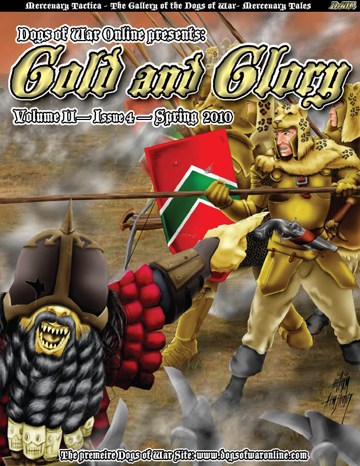
Once again I go insane by actually designing and laying out not one ezine, but two.
In this case I am talking about Gold and Glory #4 rather than the Word of Hashut. As soon as I finished it I had to immediately start working on Word of Hashut #9, which is now very, very late as a result. It was fun and it was nice to do something different.
This time around I tried out a few new things in terms of layout and it brought me back to the Winter of last year when I did Gold and Glory #1 (February 2010).
One thing is for sure: there is no way I can do two, so I am sure that the Gold and Glory crew will be looking to hire some folks to work on it.
Also a nice touch is TwilightCo's cover for this issue, his second in a row.
Issue #4 can be found here. Enjoy!


