Search This Blog

Showing posts with label OId West. Show all posts

Sunday, July 13, 2025

The Inspiration for Hurled Into Eternity


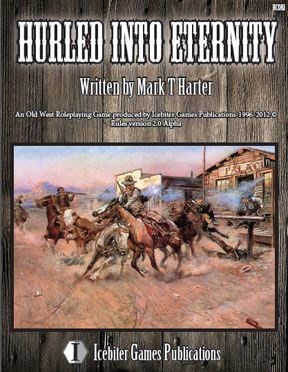
Illustration by Edward Borein


In any creative endeavor, there are people who inspire us—who push us to do more or lead us down paths we hadn’t even considered. That’s certainly been true in the development of my game, Hurled into Eternity.

The funny thing is, some of those influences I recognized while building the game. Others I only saw in hindsight—ghosts riding alongside me the whole way, whether I knew it or not.

Movies -  Upfront, it's easiest to say the most obvious inspirations are movies and TV. Pale Rider, The Good, The Bad and The Ugly and especially Tombstone and Unforgiven absolutely deserve a spot on the short list of influences for Hurled into Eternity. They’re baked into the bones of the game, whether I meant them to be or not. There’s something about their tone: dusty, desperate, mythic—that lines up perfectly with the world I’ve been building for over two decades.

Music- Music. Music is essential. While working on the latest iterations of Hurled into Eternity, I listened to a ton of Western-inspired soundtracks. One of my go-to favorites is The Lone Ranger soundtrack, along with this absolute gem from Ennio Morricone: Guns for San Sebastian.

After a while, though, I needed something fresh—and I stumbled across this original composition by Steven Lynn. It sounds like it could be in Red Dead Redemption 2 its that good!


Terrain and Buildings - Fall and winter are usually when I hunker down at the hobby table. That’s when the brushes come out, the minis get primed, and the terrain pieces start to take shape. Right now, I’ve got the beginnings of a frontier town called Timber Ridge coming together. It’s a fictional outpost set somewhere in a mythic version of Wyoming—a place with its own legends, rival factions, and more than a few bodies buried beneath its streets.

Alongside that, I’ve also got some old model trains that once belonged to my dad, dating all the way back to the 1940s. I need to dig them out. There’s something deeply satisfying about using a piece of family history to help build a fictional world. Somehow, it all connects.

Working with something physical—terrain, paint, tools—also helps get the creative gears turning in a way that’s hard to replicate on a screen.

Why the Southwest Always Wins - If you’ve ever wondered why so many Western RPGs, films, and stories are set somewhere in the American Southwest, I think it comes down to one thing: the Gunfight at the OK Corral.

That single shootout in Tombstone has become the gravitational center of the genre. There were other towns, other legends, and other infamous clashes—but none carry the same mythic weight.

And yes, the title of my game—Hurled into Eternity—isn’t just poetic. It’s pulled directly from the next day’s edition of the Tombstone Epitaph. That headline stuck with me. It said everything the game tries to say: when you draw your last card, you're not walking away.

Cards, Dice, and the Roads Not Taken - Cards have always played second fiddle to dice in most game designs. Dice dominate as the go-to resolution mechanic, and very few systems—maybe eight to ten at most—use playing cards as a core part of their engine, either fully or partially.

Not long ago, I looked up Gunslingers and Gamblers and felt a brief gut punch when I saw it mentioned cards. Then I dug a little deeper and saw it actually uses poker dice. Relief.

To the best of my knowledge, Hurled into Eternity is the first Western RPG that uses playing cards exclusively to run the whole system. And there’s a reason you don’t see that more often: it’s tough to pull off.

Cards offer a lot—tension, unpredictability, narrative weight—but getting them to feel fast and natural at the table without bogging things down? That took years of trial, error, and rebuilding from the ground up.

What I’ve got now feels sharp. It’s dangerous, intuitive, and full of risk and momentum. The way a proper Western should feel.

RPGS- I’ve mostly steered clear of other Western RPGs—and that was intentional. I own the Savage Worlds rules and I’m familiar with how Deadlands uses cards for initiative, but I made a conscious effort to avoid diving too deep into that material. I wanted Hurled into Eternity to remain honest and original, not a remix of someone else’s work.

In fact, it wasn’t until I had the game mostly locked in—around version 7.5 Alpha—that I really started looking into what other Western RPGs were out there. I came across some excellent games, no question. But I’m glad I waited. For better or worse, I wanted Hurled into Eternity to succeed or fail on its own terms.

That said, I didn’t avoid everything. There were a few titles I did check out, mainly for reference—to make sure I wasn’t unknowingly treading the same ground. Those were:

  •  Western City (By Jorg Dunne)
  •  Boot Hill (1st and 3rd Edition)
  •  Go for Yer Gun  (By Simon Washbourne)
  • Weird West (by Stuart Robertson)

Each one offers something different, but I always came away feeling like I was still building something distinct. 

Other RPG Influences- While it might not look like it in the form it is in now, the following games had a part in influencing me over the years with Hurled into Eternity:

  • Warhammer Fantasy Roleplay (1st Edition)
  • FASERIP Marvel Superheroes
  • Twilight 2000 (especially early on its development)
  • Gangbusters (An absolutely incredible game!) 

There you have it, just where Hurled into Eternity got its nods from. 

Tuesday, May 6, 2025

Hurled Into Eternity Reborn!

Taking a bit of a side track with all the crazy stuff going on in my life I've picked my western RPG, Hurled Into Eternity back to the fore. Its now on version 7 Alpha and will be ready for review, comments and play testing soon.

 More to come but for now a look at the FPO/Concept cover. The idea will be a pulpy dime store western novel approach:


Saturday, June 4, 2016

Timber Ridge – My Northern-Style Old West Town for Warhammer Legends of the Old West & More


WIP 28mm western town for wargaming or reolpalying games
The Old West town of Timber Ridge underway
 

I’ve embarked on the creation of a Western town for such games as Warhammer Historical – Legends of the Old West, my game Hurled into Eternity, and perhaps even Boot Hill.

Unlike most towns people have created out there on the web, this one is not set in the American Southwest, but rather in more northerly climes. (As an aside, I love the movie Tombstone but I wanted a look and feel that was something different for an Old West town.)

A major inspiration for this is one of my favorite movies of all time: Unforgiven.

I’ve only just started on the town itself, so there is not much to show just yet. I anticipate with the pace I’m going at that I’ll complete it by the fall of this year, but we’ll see what happens.

Thus, the start of the town of Timber Ridge, a logging encampment, but full of cut-throats, desperadoes, and gunmen!


Tuesday, June 3, 2014

Next Revision of Hurled into Eternity is up and Beta version printed

This post explains why I haven't updated the blog in a few weeks: the first true print out of the rules for Hurled into Eternity, at least in this format. Years ago (as in 15+) when the progenitor to these rules were in its d12 configuration and a traditional fantasy RPG called Quest, I printed sections of it, but never the entire rules themselves.

This is a prototype of the rules. I say prototype loosely here because I'm not sure I'm going to use this styling when it gets ready for a potential kick starter. None-the-less, I printed out two copies at the local Office Max as you can see in color for the covers and the interiors are double sided black and white. Total cost for printing out two copies was under $20 including the color covers.

It weighs in at 78 pages, doubled sided when printed with two more for the covers. All told the entire rule set in terms of page count is 154. Maybe these will be collectors items someday (hah!)

The main purpose of the print out is to help facilitate testing and get a physical copy to make it seem more real. After years of only looking at it in its electronic form its good to finally see a physical manifestation of it. So far it has been very useful as I can reference as I work in the Willmark man cave testing the rules. So far its helped me tweak the rules for the Wild Card System, a bit for the better I hope.


Of course since printing stuff out I've noticed issues with it and changed the Wild Card System to flow better. I think I fixed the obvious problems regarding it. So far gun-fighting is looking very deadly with shotguns being perhaps to much. I'd really like to hear about feedback on the combat sections with the revisions.

Regardless, here is the latest version of the revised rules here.


Wednesday, February 12, 2014

Hurled into Eternity- Latest Revision

(Quick Note: No I have not forgot my series of "Playing 1st edition AD&D", next post is almost ready to go but still needs a bit more work). 

As promised version 11 of the 2nd generation of the Hurled into Eternity rules (link to download is below). Improvements include clarifications in the following areas:
  •  Clarifications to the Wild Card System.
  • Modes of gunfire have been streamlined to eliminate the need for 1/2 or 1/3 configurations for gun fighting scores.
  • Modifiers condensed and streamlined for bonuses and penalties to hit.
  • Condensing and changing healing rates for Wounds (W) along elimination of differing healing rates for damage.
  • Early write up of a intro adventure (still not complete).
As always, spell checking  and proofing is still on the radar, but not quite there yet as I'm continuing to focus on the rules. The feeling that I have now is I'm inching closer to a finished product. The rules are getting some, good constructive feedback and fixing areas that don't make sense. I saty that every post but two recent rounds of feedback have led to a even tighter game.

As a quick aside every once and a while I get the feedback: "Hurled into Eternity"? That doesn't make sense for a western, it sounds Sci-Fi. Sorry folks, you don't get much more Western then the name of this game! I'll leave it up to you to figure it out...

Lastly feedback is always welcome.

Sunday, February 2, 2014

Back in the Saddle with Hurled into Eternity

Well, after a fairly busy and interesting fall I'm now finally ready to *ahem* "climb back in the saddle" with Hurled into Eternity.  Whats that you ask? Well my on-again off again western RPG game is now undergoing internal play testing to see how it works. My main focus of the play testing is to make sure I have the mechanics specifically nailed down. Lets face it the heart of any RP is the combat engine if that is not good then the RPG it's likely that the game is not so good.


My gut instinct tells me that the mechanics for the game work well, the conversion to an all card based mechanic is complete, now its simply a matter of making sure all of the parts line up with any gaps in a many they actually do, rather then what I think they do.

The next order of business is to take the combat chapter and pull it into a quick play doc to make sure that it flows. The parts that have been tested thus far are High Noon, (the imitative phase) in which the Judge and the players engage in 5-card draw. While its optional to deal it each round I prefer once per combat as it makes it battles go faster. Next up the hit determination. Some feedback I received was that it was bit to heavy with the modifiers so I scaled it back. Now the mods are reasonable and are fairly easy to calculate. Damage is likewise fairly straight forward. 

One nagging thing has been the inclusion of poker chips. Now I feel it adds a nice western feel but at the same time I am mindful of the implication that it has been used in Savage Worlds. While my game is sufficiently different I don't want it to appear that it is lifting the idea. Currently they serve as a visual reminder of Luck (L) in the game and nothing more; they are not required for play.

The rest of the rules have been tightened up here and there and look to have missed almost all loopholes and areas that could be broken. 

In the end game is fast, exciting and deadly. Cant wait to fully try it out. 

Friday, July 19, 2013

The Lone Ranger, Mail-Order Dreams, and 1981 in the Rearview Mirror

Free Western town promo Legend of the Lone Ranger 

That is what the ad said "Just mail away!" and man, I always wanted one. But for some reason I never actually sent it in. Chalk it up to the distracted priorities of an eight year old.

If you were a comics fan in 1981, you probably saw the massive merchandise blitz for The Legend of the Lone Ranger plastered across the back covers of practically every comic book on the rack. I did not know it at the time, but the movie was a critical and commercial bomb. That did not matter to me. The advertising hit hard, especially for kids.

The toy line that really grabbed my attention was the smaller scale Lone Ranger figures from Gabriel. These were not the old school 13 inch behemoths (those were always a little too bulky for my tastes), but the more manageable, play friendly action figures. You had the full lineup: The Lone Ranger and Silver, Tonto and Scout, Butch Cavendish and Smoke, even historical figures like Buffalo Bill Cody and General George Custer (who was a lieutenant colonel at the time of Little Bighorn).

To this day I wonder how, or if, they crammed all of that into one movie.

I never saw The Legend of the Lone Ranger as a kid (still have not, actually), but the toys were definitely on my radar. The problem? Serious competition. Star Wars was in full swing and I was all in on the Kenner figures. I was just getting into D and D too, poring over my Moldvay Basic Set and trying to figure out hit points. The new 3 3/4 inch G.I. Joe: A Real American Hero line was right around the corner, and that would steal what little toy budget (and attention span) I had left.

Looking back, I wonder if this was the real life early version of Toy Story. Lone Ranger and Tonto, quietly sidelined by Luke Skywalker and Darth Vader. Relegated to the back of the toy box, never to ride again.

Carson City western town; Legend of the Lone Ranger promo

Still, that mail away town? The play sets? That stuff looked cool. Really cool. And while I did not get in on the Lone Ranger craze, it still sticks with me as one of those "almost" moments of childhood. One of the few times something slipped by me in that golden age of toys and pulp inspired adventures.

Watching The Lone Ranger the other week (yes, that one) reminded me of all this, of a time when the Wild West still had a place in our toy aisles and imaginations, even as the galaxy far, far away was pushing everything else out.

In the end, this is not really about the toys or even the movie. It is about the snapshot of 1981 it conjures. That brief, weird moment in pop culture when cowboys, space wizards, and dungeon crawlers all coexisted in a kid's world.

And if you were eight like I was at the time, that world? It was very cool.

How about you? Do you every see one or actually get the set?

Sunday, March 17, 2013

Silverado – One of My Favorite Westerns


The movie Silverado. As noted, it made my list of top ten favorite westerns (favorite, not necessarily the best). Silverado is a wicked fun movie and a throwback to the Westerns of old. I even mentioned it as a guilty pleasure, but it is not. I re-watched it recently and I have to say, in terms of pacing, it is hard to beat.

The opening scene of Emmett fighting off some desperadoes who were looking to bushwhack him while he was sleeping is all kinds of awesome. It then spreads out to the majestic scenery of the American West.

Did I mention this happens in the first five minutes of the movie?

From there we quickly meet the second protagonist, Paden, left for dead in the desert. From there it is a quick job picking up his brother Jake (played by Kevin Costner) and almost at the same time meeting Mal (played by Danny Glover). So within the first 20 minutes or so, we have all four main characters together.

One of the great things this movie does is give a sense of background very quickly for each of the protagonists. It is a bit clichéd, sure, but in each case it serves the movie well. Remember, Silverado is about quick action and keeping the momentum going throughout.

Before they even make it to Silverado, Paden and Emmett encounter Paden’s former trail friend Cobb and his unsavory henchmen, including Tyree. This introduces the running joke of “Where’s the dog?” This is of course preceded by a great gunfight with Paden in his underclothes.

Lawrence Kasdan also does a good job handling the racism of the Old West with Mal’s character, particularly in the bar fight in Turley. It is difficult to do in today’s political climate, but it is handled well, even with the subtle implications from Sheriff Langston when he runs Mal out of town.

A side track to recover a stolen money box from some wagon train eventually results in the four reaching Silverado. There Paden finds Stella at the Midnight Star saloon, meeting Cobb, who reveals himself as the town sheriff shortly thereafter.

The events in the middle section start the buildup to the finale, but are not without tension or deaths. Mal’s father is killed, Emmett’s nephew is kidnapped, and Emmett is nearly killed by the vicious Tyree. At no time does it feel forced as it jumps from scene to scene, with Jake getting into it with Tyree and Mal and Slick arguing over Mal’s sister.

Events come to a head with the kidnapping of Jake and Emmett’s nephew and McKendrick burning down their sister’s house.

I cannot say it enough: the movie is a whirlwind, with each scene having something to it. One area that lacks somewhat is the usual Western romance. Apparently it was part of the movie and we see snippets of it from the interactions of Paden, Emmett, and Hannah. The problem was that during editing they had to cut something from the various subplots. Because of that, the only thing that seems disjointed is those scenes, as the full story is not there.

In the end the final showdown is great as each of the protagonists guns down his own personal foe: Emmett killing McKendrick, Mal taking out Slick, Jake taking out two bad guys simultaneously (one being Tyree), and finally a high noon showdown with Paden getting the drop on Cobb.

The film ends with a toast in the Midnight Star, which Stella now runs on her own, for the brothers as they head to California. As Emmett and Paden exchange goodbyes, Emmett remarks that Paden will make a farmer yet, to which Paden grins and says “I’ve got a job” as he slowly pulls back his coat, revealing the sheriff’s star of the town of Silverado.

I would also be remiss if I did not point out the ensemble cast, its loaded with stars: Kevin Cline as Paden, Scott Glenn as Emmett; Kevin Costner as Jake, Danny Glover as Mal, John Cleese, Rosanna Arquette, Brian Dennehy, Linda Hunt, Jeff Fahey, Joe Seneca and Jeff Goldblum to name but a few of the actors in the movie. There are a number of other actors you'll probably recognize.

The scenery is great and the town feels very realistic. The filmmakers did an ingenious thing by simply filming it from different angles during shooting to represent different towns as needed. Shot in New Mexico, it is obviously the right climate and locale for the film.

Since critics give out stars, this gets 4.5 out of 5 from me. For a Western there are very few that are better in terms of pure action. Sure, some are legendary like Searchers or Once upon a Time in the West, but Silverado is a fun movie any way you slice it. It is PG-13 as the level of violence is up there, but no worse than the revisionist Westerns of the 1970s.

How does this apply to RPGs?

If you are playing your favorite Western system (Deadlands, Boot Hill, Western City, or whatever), modeling even a portion of your campaign on Silverado will give you a great game. Right from the beginning there is a rise in tension, setups galore for later payoffs, and reasons to care about the heroes (and wrongs for them to right). If one were using the default city and area in Boot Hill (Promise City and its environs), it would work extremely well.

Think about it: recovering loot, vengeance, stampedes, gunfights, shootouts, swearing, tension, whiskey, bar fights, hangings (almost), gambling, backstabbing, the cavalry making an appearance (not in the usual clichéd way) — you name it. The only thing missing is some stagecoach or locomotive fight scenes. In fact, my own game Hurled into Eternity would be a great way to recreate the Old West! (Plug, plug.) Speaking of which, I am gearing up to add some changes to the way combat works to make it a bit more survivable and it should be up soon.

All in all, a great movie, saddle up!

Sunday, September 9, 2012

Let it Beagle Media Debut as an Indie RPG Publisher - Hurled into Eternity


Time for a micro blog update.

Since June I've been toiling away most nights in my man cave working on my first RPG. But, the story of the RPG in question: Hurled into Eternity goes farther back then June of 2012; in fact it goes back to 1995/96. Hurled into Eternity got its start as a traditional fantasy RPG back then. I wrote the game in an on and off again fashion for years, never quite finishing Quest (as the game is called).

This year my interest in westerns was reawakened and I started to write a Boot Hill module. It quickly became apparent there are far too many holes in the 1st and 2nd editions of Boot Hill, and 3rd is a different animal altogether. So in June I started to consider writing my own game. Looking about, the western genre isn't too crowded so I went for it. Fortunately for me however, I was able to reuse a ton from my unreleased game.

As of right now the game is available in its Alpha state
. The rules are there, a bit rough and not edited by my editor yet, but playable.

If you are interested let me know and I can direct you to the rules. Owing to its fantasy roots I might back-port the game to Quest. They certainly worked the other way around. So in a sense I've got a game that can go from ancient times to 1920s tech fairly easily.

I'd just like to be able to go back to my 1995 self and tell me that what I was working on would first be released as a western, I probably wouldn't have believed it.

Friday, September 7, 2012

Western City RPG – A Dusty Gem Worth Discovering

 Western City Card based Role Playing Game

Continuing my read-through of lesser-known Western RPGs and modules, today I’m taking a look at Western City, designed by Jörg Dunne and first published in Europe back in 2006.


Before we get into it: this is an overview, not a rules deep dive.


might be a rules-light system on the surface, but it’s got enough nuance that a full breakdown would go well beyond a standard review. Just know: it’s lean, but not shallow.

How I Got It

I came into possession of Western City thanks to a good friend who scored a lot of games off eBay. He handed it to me with a shrug and said, “I’m probably never going to read this.” Challenge accepted.

It sat on my desk for a few days until I cracked it open — and then finished it in one go. That’s not too hard, since it clocks in at a digest-sized 92 pages with a clean layout and a manageable word count per page.

Presentation & Style

Let’s start with the aesthetics. Western City immediately gets a nod for its sharp cover design and internal art by Kathy Schad, which has a distinctive and appealing style — somewhat reminiscent of early Elmore, which is a plus in my book (despite what the grognards say).

The period photos, bullet-hole textures, and playing card visuals throughout reinforce the Western tone well. This isn’t the dry grit of Boot Hill — this feels more stylized, more cinematic.

Unfortunately, the translation (in my January 2008 first printing) leaves a lot to be desired. There are numerous awkward phrases and reversed quotation marks. It’s readable, but janky — a shame, because the presentation otherwise really works.

The Game Itself

Let’s clear one thing up: Western City isn’t a Western RPG in the vein of Boot Hill, Deadlands, or even Sidewinder. Instead, it’s designed for collaborative storytelling, player-driven scenes, and a gamemasterless structure. It leans more “story game” than “simulation.” Think improv theater with poker chips.

Here’s all you need to play:

  • One d8
  • A deck of playing cards
  • Poker chips
  • A dollar bill (!)

That’s it. And just to make it more impressive: it was written in 72 hours for a game design contest. If that’s true? Hats off.

Character Creation

Characters are built around three core stats:

  • Body (Clubs)
  • Mind (Diamonds)
  • Charisma (Spades)

Players distribute points between 1–5 across these. Everyone gets 8 “Hearts”, which serve as your hit points (shades of Legend of Zelda, maybe?). No rolling — just assign points and move on.

Skills range 1–5 and are resolved with a d6. You get a pool of points to spread as you like, with difficulty based on what you’re trying to do.

From there, you assign background details, Hubris (a character flaw), and — most importantly — you create an Extra and a Foe. These characters serve as part of the supporting cast for other players’ stories. Once all players have built theirs, you use poker chips to bid and assign Extras and Foes. It’s a brilliant mechanic — ensuring everyone’s story is already entangled with everyone else’s. You’re building a shared narrative web from the jump.

Later in play, you can also introduce spontaneous Extras as needed, which keeps the story flexible and reactive.

How the Game Flows

Time is divided into three parts per day:

  • Dawn
  • Noon
  • Dusk

Events or “Scenes” happen during those time blocks. Each player proposes a scene where their character is the star. Other players take the roles of Extras or Foes — so no one is ever just watching. Even if your character’s not in the spotlight, you’re still part of the action.

Scenes are bid on and ordered collaboratively, though if there’s strong disagreement, there’s a rule called “Not In My Town” that lets a player force a scene through. It’s all very improv-heavy — and cleverly set up to prevent players from just sitting on the sidelines.

High Noon, naturally, is where the big confrontation is most likely to take place — though it’s not locked in.

Mechanics & Design Choices

Combat, wounds, resolution — all are simple and snappy. The suits from the playing cards play a subtle mechanical role in tests and effects. It’s clever without being clunky.

One downside? Characters can’t die unless the player wants them to. For me, that’s a head-scratcher. I’m not saying every RPG has to be meat-grinder mode, but the lack of stakes takes the wind out of high tension moments. Then again, this is designed for narrative control, not tactical risk.

Optional Magic

There is an optional magic system, and it follows the same rules-light approach as the rest of the book. Personally, I’m a fan of gritty realism in Westerns, so I’d likely skip it — but if you want to inject a bit of Weird West flavor, it’s there.

Equipment? Monsters? Nope.

There are no gear lists or bestiaries. The assumption is: if it exists in a Western, it exists here. That’s either liberating or annoying depending on your comfort level with improv.

Leveling Up

No XP tables here. Players vote on experience awards based on scenes and performance — another narrative-heavy design choice that fits the game’s structure, even if it leans more “actor” than “gamer.”

Final Thoughts

Rating: 3.5 out of 5 stars

There’s a lot to admire in Western City. The system is elegant, unique, and impressively efficient. It leans hard into collaborative, character-driven roleplay — and if you’re the type who loves improv, narrative arcs, and shared storytelling, it’s probably a 4-star (or higher) game.

But for me? I’m a role-player, not an actor. I like some structure. I like GMs. I like death being on the table. Western City is a beautifully crafted storytelling machine — but it’s not what I reach for on game night.

Still, it’s inventive, inspiring, and absolutely worth a read — especially if you’re looking to stretch beyond traditional RPG formats.

Thursday, August 23, 2012

Boot Hill BH1 Mad Mesa Review – Classic TSR Old West Module


Cover art by Bill Willingham

Boot Hill modules were something of a mixed bag. This is especially true when you consider that BH1 through BH5 spanned two different editions between 1981 and 1984. Granted, the structural differences between 1st and 2nd Edition are minor, but it’s still worth noting. Five modules in three years, with one being a Gen Con tournament module (BH2), is not a stellar track record. Of course, D&D was exploding for TSR at the time, so they rightly focused on their biggest seller. Can’t fault them for that.

As I’ve covered before, Boot Hill is one hell of a game. It was one of the very first RPGs ever written and was designed by Brian Blume and Gary Gygax.

Back to the modules: I’ll be reviewing all five:

Right now I have the first three and just finished reading through BH3.

First off, I’m a big fan of the graphical presentation of the first three modules. They have that tooled-leather look, and my favorite old-school TSR artist, Bill Willingham, did the cover. Anytime you get Willingham and two-gun action, it’s going to be good. There are also several of his interior pieces, which is even better. Everything about the look screams Old West, mission accomplished. The early covers also remind me strongly of the excellent Time-Life Series "The Old West series (which I finally completed!).

I even like some of the Jeff Dee and Erol Otus pieces here. Dee’s sense of motion is excellent. The inside cover has a map of the town of Mad Mesa, and the back cover features the Mesa Gazette. In general, there is a lot of art inside the module, especially for an early RPG product. Contrast this with A2- Secret of the Slavers Stockade which sparse in comparison but is around the same length.

BH1 Mad Mesa - interior art by Bill Willingham
Interior art by Bill Willingham

BH1: Mad Mesa

BH1 is a collaboration between Jerry Epperson and Tom Moldvay (of Basic Set fame). At 32 pages it’s a standard-length module for the era. Like many TSR products of the time, it includes a large solo-play section using “choose your own adventure” style rules. Before that, it adds new rules, something all Boot Hill products do. This can’t be overstated: the core 1st and 2nd Edition Boot Hill rules are incredibly sparse, skeletal is how I often describe it. Mad Mesa nicely fleshes out law & order and NPC reactions.

The solo-play premise is straightforward: Your character is riding at dusk looking for a place to spend the night when shots ring out. From there you follow numbered entries until the tale ends. It’s a quick way to learn the system and gives the referee (they weren’t called GMs yet) a chance to practice without players.

The multi-player section builds on the solo material and uses the central NPC “Uncle Zeke” (related to one of the PCs) to kick things off. This works well because in Western RPGs, NPC interactions matter far more than in fantasy games. Western adventures are driven more by character drama than by monsters in funny suits. BH1 gives the referee a bare-bones plot and plenty of encounters to expand upon.

The Kane-Russell Cattle War could easily stretch for months or years of game time. Many of the hooks can lead to glorious gunfights and TNT-flinging, and there’s nothing wrong with that.

I’ve only recently gotten deeper into Western RPGs, but Mad Mesa would work great as a Village of Hommlet or Keep on the Borderlands -style introductory module. The town setting keeps the scope manageable even with a large cast of NPCs. From there the referee can expand outward as the players get comfortable.

If I ran it, I’d set it in a slightly “mythical” Old West rather than strictly historical. I’m not talking full Weird West, but modern Western RPGs often lean too hard on “six-guns and sorcery” because pure roleplay-driven adventures are harder to structure than dungeon crawls.

BH1 Mad Mesa - interior gunfighters art by Bill Willingham
Even more Bill Willingham art!

Final Verdict: Out of 5 stars I give BH1: Mad Mesa a 3.5. There are no real flaws, but it also lacks deep, standout hooks. Like the core Boot Hill rules, it relies heavily on the referee’s skill to bring it to life. At its heart, Boot Hill feels closer to Chainmail than to D&D. In summary: I like it, it looks great, and it’s a useful module, just not a barn burner.

I should add that my next review might be Western City RPG before I tackle BH2, as I’ve also been reading through the Mongoose/Redbrick Western RPG I received as a gift. It’s a neat system, but I’m not sure I’d run it. More on that later.

What are your thoughts on BH1- Mad Mesa?