Search This Blog

Thursday, January 30, 2014

1st Edition AD&D Part II- My character, Relendor Silkenweb

Relendor and his familiar, the black cat, Soot
 
My Character
In the previous installment, I shared the origin of what I still call THE CAMPAIGN. That post covered the broad scope of the game—the 40,000-foot view, so to speak. Before I dive into the rest of the adventuring party, I want to focus on one of the only surviving artifacts from that era: my character sheet.

You’ll find a scan of it below. But before we get to that, a bit of context.

From what I can piece together, this isn’t the original sheet. The first page—the one with the main stats—was typed by Jeff, not me. The second page, which lists equipment and magic items, is definitely mine. I typed it up on my old Atari 800XL, typos and all. I recognize the format and the misspellings immediately.

The version I have is from later in the campaign. Some items had been gained, others lost. But it still brings back a flood of memories, and it’s the most tangible link I have to that incredible game.
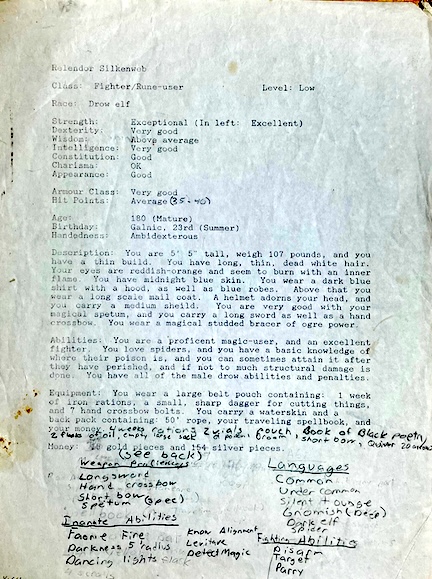
 
First Glance at the Character Sheet
Looking at the first page of the character sheet, a few things jump out.

First—why does my character have such low Charisma? Trying to tell me something, Jeff? Ha!
More seriously, you’ll notice the Strength stat and a note about exceptional strength. That’s because I had a magical studded bracer of ogre power—functionally the same as gauntlets—but it only applied to the arm I was wearing it on. Why? Who knows. It never really caused problems in play, especially since my character fought with an unusual weapon for a dark elf: a spetum.

You’ll also see a note about ambidexterity, and under “Abilities,” the line: “You have all of the male drow abilities and penalties.” That said, I don’t recall ever fighting in the classic two-weapon drow style—not once. Why? Because I specialized in the spetum, and by the end of the campaign, I believe I was double-specialized.

Yeah, that was a house rule. But like I mentioned in Part I, we were walking our own path. I think I went through a number of magical spetums during the game, mostly because several of us were failing item saving throws at one point or another. Despite all that magic and specialization, I wasn’t the party’s top fighter—that title probably went to the half-ogre.

Fun aside: I’d just gotten a new set of smoke-colored translucent dice in the mail before we started this campaign. That d20 rolled 19s constantly. I must have used up all my luck in 1987, because now it barely rolls double digits.

The Equipment Sheet (and the Cat I didn't Ask for)

The equipment sheet was typed by me—misspellings, formatting quirks, and all. It is what it is.

Because Identify is so under-powered in 1st Edition—and due to the nature of Jeff’s campaign—we often had no idea what magic items actually did. We’d pick something up, mess around with it, and eventually figure it out... or not

Looking over the list now, it’s nothing earth-shattering. As I mentioned back in Part I, we’d just come off a short high-level campaign, so this time around we were intentionally going lower-powered. The magical bracer of ogre power was the first real item my character acquired. Oddly enough, it survived every item saving throw all the way to the end of the campaign.

One item I distinctly remember but didn’t list was the cloak of the bat. In hindsight, a cloak of the arachnid might’ve made more sense thematically, but the bat cloak served me well—until it was obliterated in a failed fireball saving throw. I still remember the collective sigh of relief from the rest of the party; apparently I’d been a little too enthusiastic about using it.

Then there’s the book of summoning “homucumuls.” Yes, I butchered the spelling. And no, I never actually used it. I think I kept it tucked away in my pouch of holding, waiting for the day my familiar bit the dust. Summoning a homunculus would’ve been cool, and it fit the tone of the character... it just never happened.

Broom? Book of Black Poetry? No idea on those...


The Familiar That Shouldn't Have Been

Here’s where things get weird. I’m not a cat person. I’ve always preferred dogs—still do. So imagine my frustration when I cast Find Familiar and, through random rolls, ended up with... a cat. Of course.

But then something unexpected happened.

Jeff’s family cat, Cogswell, started curling up on my lap every Saturday night during our sessions. He wasn’t a clingy cat otherwise, and I have no idea why he chose me—but there he was, week after week, purring away while I played. That was the only cat I ever genuinely liked.

Strangely, he never seemed interested in anyone else’s lap—or even in leaving mine. Every Saturday, it was like clockwork.

(Quick side note: despite not liking cats, I don’t like seeing them harmed either. My wife calls me “Diego the Animal Rescuer” because injured or stray animals just... find me. More than once we’ve had them show up at our house out of the blue.)

Anyway, somehow my familiar survived the entire campaign. Maybe it was dumb luck. Or maybe the real-life cat curled up on my lap had something to do with it. I’ll never know.

I also suspect Cogswell loved our gaming rituals. We’d usually chip in for pizza, and Mike (the older guy in our group) would drive out and get it. The empty pizza box often got left behind in the basement, and by the next Saturday, we’d find the cat munching on leftover crust—or whatever had hardened to the consistency of a brick.

Relendor Silkenweb, Miniatures and the Shield of Arion
One detail that still stands out from that campaign was Jeff’s use of his extensive Citadel Miniatures collection. He painted them himself—and did a great job by the standards of the time. Dave may have painted his too, though I wasn’t into miniature painting yet back then.

Looking back, the miniatures had a surprising influence on how we envisioned our characters. Mine was one of the 3rd Edition Foot Cavalry—a model named Toruviel Longstride. That mini, painted with dark blue skin and jet-black features to match the drow aesthetic, became the visual foundation for my character. Even the shield he carried would later factor into his personal goals and backstory.

And so there he was—one of my all-time favorite fighter/magic-users: Relendor Silkenweb.

A Name From the Vault
 I remember leafing through D3: Vault of the Drow in search of a name, and on page 14 I found “Captain Relonor.” Somehow that evolved into “Relendor,” and it stuck.

Relendor had one other distinction: he was the only PC in the campaign who never died. Every other party member was slain at least once, but somehow, he dodged that fate. I do recall one close call—he was dropped to -9 HP in a dungeon and stabilized immediately, purely by luck, thanks to a nearby party member. Probably because of Cogswell...

The Shield of Arion
Relendor’s full backstory is lost to time, but I remember the broad strokes. He had been sent by the Church of Arion (no Lolth in this setting) to recover the Shield of Arion, which had been stolen by a villain named Dragotha. Same name as the iconic undead dragon from D&D lore, but in this campaign, Dragotha was not a dracolich—just a powerful antagonist who ended up tying into all our characters’ backstories. He served as the thread that bound the party together.

I only ever read my own backstory, and sadly I no longer have it. Hopefully Jeff still has those character write-ups tucked away in his gaming archives somewhere.

That’s all for now. Next time, I’ll chronicle the rest of the adventuring party and the players behind them.

Previously, I said there were seven of us—but there may have been eight. I think Jim might have been playing with us at the time, and I seem to recall him running a dwarf fighter. I’ll have to see if I can jog the memory.

Until next time.


Wednesday, January 29, 2014

1st Edition AD&D Part I- A walk to remember


Not exactly accurate, but accurate enough.

Introduction

No, not the book or the movie of the same name—this is the first part of a long-ago campaign from the halcyon days of my youth. It still stands as one of the best gaming experiences I’ve ever had.

Let me get the sentimental stuff out of the way first. Over the years, I’ve been lucky enough to play in some great games, but two stand out as truly exceptional. And in both, I wasn’t the DM—I was a player, running a dark elf character. Now, before you roll your eyes and picture a dual-wielding drow ranger, hear me out. The first of these characters wasn’t anything like that, and the campaign predated 2nd Edition by a few years.

I started gaming in 1982, making me what I call a “late 1st Edition” player—a hybrid player, really. I played with a few local groups before joining up with the crew that would eventually become my high school gaming circle. That’s where I met Dave and Jeff. Looking back, it might’ve seemed like an odd friendship, especially through the lens of high school stereotypes. We were an eclectic bunch: we all played sports (I played football), we were in advanced classes (well, the others more than me—I was a late bloomer), and we didn’t exactly fit into a single crowd.

Even so, I gravitated more toward those guys than the kids I played football with. My wife—who went to a different high school—once called me a “closet nerd,” and she wasn’t wrong. Turns out that choice was a good one. Dave, Jeff, and I became lifelong friends.

A Seat at the Table

I remember the moment clearly. It was the fall of 1987 when I approached them at lunch and started talking AD&D. It was a deliberate move—I knew they were better players than I was, and I wanted to learn from them and game with them. We’d all been in the same school system since kindergarten, and while I wasn’t close with them until then, they’d been friends for years. Not long after that conversation, I was invited to join a Saturday night game at Jeff’s house.

Don’t judge us—we were freshmen. All the girls in our grade were dating older guys who had cars, while we were still zipping around on BMX bikes. I pedaled over to Jeff’s place, headed down into the basement, and that’s where the magic started.

Before that, we’d played in a short-lived high-level game run by an older player named Mike. We were going up against a lich, and while it was fun, it was more of a one-off that only lasted a few sessions. Jeff also ran a proto-campaign as a kind of warm-up, but it didn’t go far. He was already planning something bigger.

We all agreed to the concept and began developing characters. It wasn’t the only memorable campaign I’d ever play in—but it was, and still is, one of the very best.

Part I – The Game

Jeff did a lot of DMing back then, and even early on, his creativity stood out. One of the most unique aspects of this campaign was that we didn’t know our characters’ exact ability scores or hit points. Instead, Jeff used a descriptive range system inspired by the Monster Manual’s intelligence listings. So instead of a number, we might see “Good” or “Exceptional” written on the character sheet. We could make educated guesses, but we were never fully sure.

We used seven stats, with Comeliness renamed to Appearance. Hit points were similarly obscured, which added a level of uncertainty that made the game feel more dangerous. And almost all of our backstories were written by Jeff. We gave him a name and a class—or classes—and he filled in the rest. That decision added depth and cohesion from the start. The group wasn’t just a bunch of strangers who “met in a tavern.” We had shared history, and it made everything feel more real.

After that, the campaign was a sandbox. We had the freedom to go where we wanted, but there were character arcs, interwoven goals, and shared consequences. No railroads—just story.

Jeff’s rules were flexible. My character, for instance, was a multi-classed fighter but still got to specialize in weapons. He pulled material from Dragon Magazine, particularly the issues in the #110–130 range. I still use a lot of content from those today. In fact, my sheet includes a notation for Fighting Styles from Dragon #127, so I know exactly what was being used.

He also ran a few adventures pulled from Dungeon Magazine (issues #1–81), which I’ve since collected. I’ll cover some of those in later posts—they were excellent, and Jeff’s picks were always solid.

What really made the game sing, though, was the energy. We were excited to play and had the time to do it. Every Saturday night for nearly two years, we gathered for that campaign. I remember racing home after football games in the fall, barely taking time to change out of my uniform before hopping on my bike and heading to Jeff’s basement. That’s how much fun we were having.

Rules-wise, we were using 1st Edition AD&D with elements of Unearthed Arcana. That’s what gave me the idea to play a dark elf, though the main reason was just to try something different. In previous groups, I often played fighter/magic-users—or sometimes even triple-classed as a fighter/cleric/magic-user, especially in the L series.

What’s Next

In Part II, I’ll go into more detail about the players and their characters—names where I remember them, motivations where I can piece them together. I didn’t take many notes back then (not like I do now), but Jeff’s digging through his old stuff, and we’ll see what surfaces.

There were seven of us in that group, and we were a force to be reckoned with.

This post is mostly from memory, and all I really have to go on is that—and one worn old character sheet. But it’s a good place to start.

Until next time.


Sunday, August 25, 2013

Marvel Superheroes RPG – Why FASERIP Remains the Best


Some like Champions with its crunch. Some like Villains and Vigilantes. For me it is neither. If I am going for a superhero system it has to be Marvel Superheroes. In my mind nothing else even comes close. The Marvel system does a great job of recreating the comic books. Henceforth I will refer to it as MSH.

One huge advantage the system currently enjoys is the wealth of information available for the game, most notably at Classic Marvel Forever. To put it bluntly there is no shortage of material for the Judge to pick from. TSR then Wizards of the Coast apparently let the copyright expire and it went into the public domain. Woot!

The Marvel system is a breeze. Many fans know it as Marvel FASERIP. FASERIP stands for the attributes in the game: Fighting, Agility, Strength, Endurance, Reason, Intuition, and Psyche. The first four are combined to create the character’s Health score and the latter three are combined to determine the character’s Karma. Health is analogous to Hit Points while Karma is akin to Luck Points in other systems. Characteristics range from Feeble (2) to Beyond (unlimited) with most being somewhere between Typical (6) and Monstrous (75). Once you start getting above Unearthly (100) it starts to get a bit dodgy, but I think a skilled Judge can pull it off. In Marvel there is always someone tougher than yourself or your group.

Talents are likewise well thought out and easy to use. Equipment is straightforward and does not bog the game down. In a way the entire rule set is an early version of Savage Worlds when one thinks about it: keep it Fast, Furious and Fun. MSH does just that.

While there are powers listed in the rule book the best route to go is to use the Ultimate Powers Handbook (do not forget the errata from Dragon Magazine issues 134 and 151). Powers are always something of a weak spot in MSH. The main problem is you pick a grouping (say Defensive) and then roll to see what you get. I think it works because otherwise everyone would be picking the same powers (can you say every character with Danger Sense, Cosmic Awareness, True Flight, Regeneration and Invulnerability?). That said in my groups we just picked powers after rolling for the number of them and it always seemed to work out.

"Don't leave super hero HQ without me."
The box set is a great entry into the game and has everything that fledgling players and the Judge need to get rolling. I recommend actually getting the base game and going for Advanced rather than the Basic rules (the picture above is from the Advanced game box set).

Most of my experience with the game was in high school where we played it irregularly, which is a shame as it is a fine system. Most of my characters were mutants as I liked characters who actually had powers. This is probably because I also disliked DC comics whose heroes were typically non powered as typified by Batman. One of my gaming crew from back in the day was a big fan of the rule set but paradoxically a big fan of DC and created his own version of Batman he tried to foist on me. I had none of that and preferred to play my own characters.

Task resolution is handled via a well thought out system of green, yellow and red intensities. The task becomes harder as it goes from green to red and requires a higher percentile dice roll. Speaking of which, being based on a d100 makes it easy to use and visualize for players where their scores lie. It also works perfectly with the ranking system from Feeble (2) up to Unearthly (100) in the attributes. One would guess they did this on purpose.

As noted above the Judge is spoiled for choice. He has a vast amount of material to draw on in the Marvel Universe before even writing his own stuff. The Basic line and the Advanced line cover all of the main material from the Bronze Age of comics in the 80s to the early 90s.

If I were to play today I think a hi-tech wonder character ala Ironman would hold the most interest for me. There is just something about being able to tinker with one’s battle suit and adding more gizmos than R2-D2 that is appealing.

No matter what your inkling you really cannot go wrong with Marvel Super Heroes as it is a great system.

What is your favorite super hero RPG?

Saturday, August 24, 2013

Hurled into Eternity RPG – Domain Name Secured


Hurled into Eternity Main Page

http://www.hurledintoeternity.com/

As you  an see its not much at the moment, but I have taken the steps to make sure that I have my preferred URL reserved. In the future the plan is to house my online endeavors there with links to my Facebook Page as well as back to this blog.

As it stands right now Hurled into Eternity is being edited as we speak. My next goal is to get it to play testing then onto production for print. Right now a fiend of mine and I are contenplating some custom playing cards to go with the game. That is at the planning stages.

While Im waiting for the editing to be complete I'm hard at work on the first two supplements for the game as well as Let it Beagle Media. Right now its a lot of ideas, but not in a cohesive form.

Stay tuned for more.

Thursday, August 8, 2013

Inside My Man Cave – Gaming Table, Terrain, and Old School Vibes

Manc cave with book shelves of gaming materials
Just some of the shelves in the gaming man cave...

EDIT: (7-14-26) The man cave has changed a lot since 2013 when I originally posted this, time for the upgraded version!

Man Cave, every gamer has one, or should. I’m lucky enough to have the whole basement to myself! We built my current house in 2011 and left the basement is unfinished, but I've managed to fill it up with a pretty decent gaming space. 

Over the years it received upgrades in an ad-hoc way, but last December (2025) I upgraded eve more beyond the photos you see here. Now an improved stereo system, a new fish tank for Fred VII, new book cases, new computer desk, carpeting, and a new gaming chair amongst others.

In a way, it hearkens back to the days when we played in my friend’s basement on Saturday nights in early high school, at least until we could drive.

Not only is it where I game with my friends but where I've written two novels, worked on countless terrain pieces and painted tons of minis. 

Its also where my dogs fall asleep on their various beds throughout, including one dreaming and paws twitching as I type this.

Monday, August 5, 2013

Weird War II for Savage Worlds – Monsters, Magic, and Mayhem in WWII

 Weird Wars rulebook for World War II

Weird type events for World War II? Yes, please. Unlike Deadlands, I think this one pulls it off. (That’s not an indictment of Deadlands, I like the concept, but that’s another topic.)

The topic at hand is the Weird War II sourcebook from Pinnacle Games for their Savage Worlds rules.

Weird War II is a source book for using the Savage Worlds system with a twisted take on World War II. Like Deadlands, there are dark forces at work, and Europe is in deeper trouble than just Nazi Germany or Imperial Japan. The “Weird War” genre has been around for a while, but I think this book captures it better than anything else in RPG form.

I’m not diving deep into the Savage Worlds rules here (if you’re reading this, you probably already know the system). Instead, I’m focusing on the book itself as source material.

Released in 2009, Pinnacle did a solid job capturing the feel of the genre. Character creation really shines, with advantages tailored to soldiers from each major nationality. While you could play Axis forces, the best campaigns are built around the Allies. The mixed nature of Allied forces gives tons of latitude for military and civilian backgrounds. Female players will find great inspiration in the illustration on page 12, who wants to play a WAC when you could be a French resistance fighter with a penchant for explosives?

The Office of Special Investigations concept neatly sidesteps traditional gender roles in combat: if you can handle the horrors of Weird War, you’re in, regardless of gender. It also feels very ad-hoc, much like units in Twilight 2000.

Equipment levels feel just about right. The book adds the right amount of new skills and Edges, plus an excellent mission generator that keeps things moving. The Warmaster can always “pull rank” with superior officers when the players start wandering off in search of Option Z.

The material scales perfectly, from personal arms all the way up to fighters, bombers, and naval vessels. Rules for fortifications, artillery, disease, parachuting, and more let you play out nearly every aspect of the war (and then some).

Large sections focus on the weird elements (especially Chapter Five), with monsters, Nazi blood magic, and Soviet psychic powers. While the European Theater gets a lot of attention, the Pacific campaign offers just as much potential for weirdness amid sweltering jungles and vast oceans.

The last chapter covers the Axis powers and their monstrous creations. Standouts include the Axis Stitch (soldiers sewn together from multiple bodies), nasty mustard gas zombies, and Wehrwolves.

Graphically, the book looks excellent. Even with some recycled art from previous editions, it’s uniformly strong and captures the tone perfectly. My favorite piece is the Axis Stitch on page 163. Additionally, the front and back covers are also outstanding.

Axis Stich Monster for Weird Wars, Savage Worlds Rules
Axis Stich, one fearsome monster!
 
One negative: the hardcover binding is flimsy. My copy is already separating from the spine despite light use.

If I ran this, I’d draw heavily from Return to Castle Wolfenstein for visuals, there’s natural overlap there. Handled right by the referee, Weird War II makes for a fun, exciting break from traditional sword & sorcery.

In closing, I give it 4.5 out of 5 stars. How about you? Have you played Weird Wars?

Sunday, August 4, 2013

Talisman as I Know It – A Fond Look at the Fantasy Board Game

3rd Edition Talisman from Games Workshop Main Rules

One great game that one of my gaming buddies Simrion owns is Talisman 3rd edition. It’s a very fun game with many twists and turns. I’ve tried to purchase it for myself many times, but these days even the base game (without expansions) is costly on the second-hand market like eBay. The Realm expansions push auctions into the $150 range. Along with Lost and the Damned, it’s one of those items that keeps eluding me.

Talisman is one of our go-to games when someone doesn’t show up for game night. Looking at it overall, it’s one of Games Workshop’s better releases. The rules are not overly complex, the playtime is just right, and it remains engaging with several viable strategies. It’s a true classic, and many players still remember the older editions fondly.

The goal of the game is to amass enough power, obtain a Talisman, and ascend the tower to slay the Dragon King. In theory a player can accomplish this in a number of ways, but remember that everyone else at the table is trying to do the same thing.

3rd Edition expansions for Talisman from Games Workshop
All three of the Talisman expansions for 3rd Edition.

To get the full experience you’ll want the three main expansions: The Dragon's Tower, City of Adventure, and The Dungeon of Doom. The latter two add the additional Realms to the board. A word of warning: 3rd Edition has been out of print for a long time and commands high prices on the secondary market. I completed my full set plus expansions back in 2013 and it wasn’t cheap.

Character Selection & Gameplay

To start, each player randomly draws character cards and their matching minis. Many classic GW favorites are present: Chaos Warrior, Goblin Fanatic, Chaos Dwarf, Witch Elf, and more. Each character has its own special abilities. While some are stronger than others, all start within a similar basic range. (There’s still an active online community that creates fan-made characters for the game.)

The Outer Realms (Forest, Mountains, City, and Dungeon) are stand-alone expansion boards that connect to the main board. When traveling in these realms, players roll a d3 instead of a d6, which slows movement.

Game play is fairly quick with some classic Games Workshop flair: “If a rules conflict arises, roll a d6 — on a 1-3 you are right, on a 4-6 the other interpretation stands.” You roll a d6 to move, land on a space, and draw the appropriate cards. Early encounters can be deadly depending on your character. Combat is resolved through Strength or Craft. Warrior types excel at Strength fights, while spell casters fare better with Craft. Another player rolls for any enemies, so everyone stays involved even when it’s not their turn.

I’m of the mindset that warriors are generally the stronger choice if you want to win consistently. Good characters like the Ranger or Templar, and neutral ones like the Barbarian, are solid. Spell casters feel weaker early on due to lower Strength and limited spell capacity.

Magic is handled as a random draw from a recycling deck. Some spells are far stronger than others, and certain magic items or character abilities boost spell casting.

Strategies

There are several viable strategies. One strong approach is to become powerful enough to claim the title of High Wizard or Sheriff for big boosts to Craft or Strength. Attacking other players is allowed when you land on the same space, but I only do it occasionally, usually only when someone has a Talisman I need.

Evil characters often hunt for the Doom Sword (which restores lost lives on successful hits). Other strong items include the Sword of Power in the Forest and the Hammer in the Mountains. I’ve had good success heading to the Mountains or Forest once strong enough. In all my years playing I’ve mostly avoided the Dungeon, something I should try next time. The Mountains usually offer the best return on time invested.

Two things to keep in mind. One. with experienced players its possible the game can go on for basically "forever," especially if the opposing players have certain spells and another player is making a run against the Dragon King. 2. The nature of the rules is such that randomness can still effect even well built out characters with cards like the Toad, Witch or Imp. Be forewarned this game can go on for hours!

I’ve enjoyed many great games of Talisman with my friends and usually come out on top (much to Simrion’s wife’s dismay). In fact, I’ve won the last two times we’ve played! EDIT: Since I originally wrote this my family and I played quite a bit. I have even manged to win with the halfling out of all the characters!

If you can find a copy of the 3rd Edition, it’s well worth it. For me this gets a solid 5 out of 5 stars.

What about you? Is 3rd Edition you preferred version of Talisman?